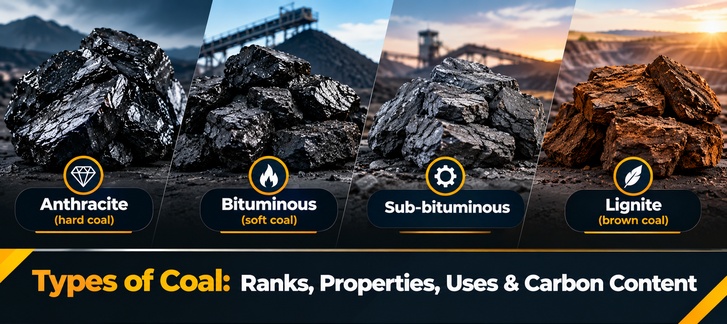
Types of Coal: Ranks, Properties, Uses & Carbon Content
The four types of coal explained, how they form, and what each grade is actually used for, including coal varieties sourced in Pakistan.
People talk about coal like it's one uniform thing you just dig up and burn. It's not. What really separates one chunk from another is how much carbon it managed to hold onto, how much moisture and other junk got trapped in there along the way, and how much heat it actually gives off when you put a match to it.
All of that changes depending on how long buried plant matter sat under heat and pressure before anyone dug it up, sometimes tens of millions of years, sometimes closer to a hundred million. That's really the whole story behind why coal gets sorted into different types in the first place.
This piece walks through the four main types of coal and their uses, how coal actually forms in stages before it becomes any of them, and what buyers sourcing coal in Pakistan tend to run into when comparing regional varieties.
The Four Types of Coal and Their Uses
Coal gets ranked into four categories, and the ranking basically tracks how much the original plant material has been compressed and cooked over time.
More time and pressure generally means more carbon, less moisture, and more heat per tonne when it's burned.
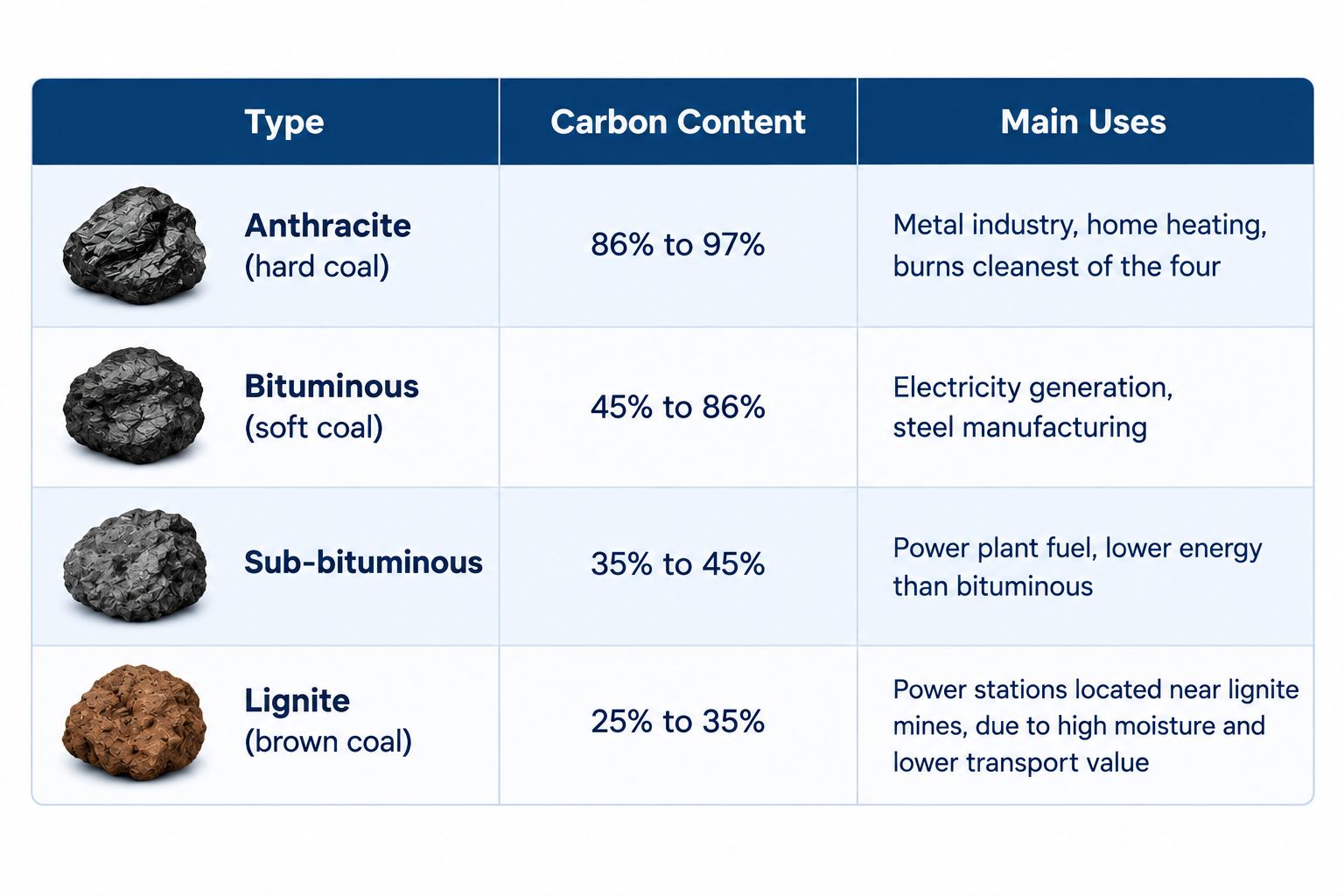
Anthracite sits at the top for a reason. It's the densest, the cleanest-burning, and the highest in energy content out of all four, and that's also exactly why it's the least common and usually the most expensive.
Lignite is on the opposite end: soft, crumbly, and holding onto a lot of water, which is precisely why it rarely travels far from the mine before it's burned.
Different Coal Kinds by Formation Stage
Coal doesn't start out as coal at all. It starts as dead plant matter piling up in a swamp, and what it eventually becomes depends on how much heat and pressure it sits under, and for how long.
Coal doesn't just appear underground fully formed; it goes through stages, and each one takes serious time.
Peat: The starting point. A soft, spongy material that's often mistaken for coal but really isn't; it's more like coal's raw ingredient.
Lignite: Once enough pressure and time are added to the mix, peat slowly transforms into lignite, technically the lowest rank of true coal.
Bituminous coal: Leave that heat and pressure working for another few million years, and lignite matures into bituminous coal.
Anthracite: If the geological conditions squeeze things just right, bituminous coal can be compressed even further into anthracite. That final jump is rare though; most coal deposits never actually reach this stage, which is precisely what makes anthracite the rarest and most valuable grade out there.
Coal Varieties Sourced in Pakistan
Pakistan's coal doesn't get sold by rank the way global commodity markets talk about it. It gets sold by region, and each region tends to produce coal that clusters around a fairly consistent grade.
On coal price, that shows up as separate products by mining area rather than a single generic "coal" listing.
Quetta coal, from Balochistan, runs on the higher end of what's mined domestically, with fixed carbon typically in the 55 to 65 percent range and calorific value between 5,000 and 6,200 Kcal/kg, putting it closer to the bituminous side of the spectrum. It's a common choice for industrial heating and brick kilns where a hotter, more consistent burn matters. Check current listings for Quetta coal directly, or Duki coal, also from Balochistan, which comes from one of the province's older established coalfields and tends to serve similar industrial applications.
Afghani coal, imported rather than domestically mined, is generally sourced for buyers who need a higher and more consistent grade than what's typically available from Pakistan's own reserves, particularly for cement kilns and heavy industrial processes that are sensitive to fuel quality. For these applications, Afghani coal can be considered when consistent fuel quality is important.
Hyderabad coal, from Sindh's coal belt, sits lower on the rank scale, with fixed carbon closer to 40 to 50 percent and calorific value around 4,200 to 5,200 Kcal/kg. That's a grade that leans sub-bituminous, still genuinely useful for power generation and industrial fuel, just with more moisture and ash to account for than the Quetta-region product. Listings for Hyderabad coal and Punjabi coal fill a similar role for buyers sourcing closer to central Pakistan rather than paying to transport coal in from Balochistan or Sindh.
That doesn't mean coal from one region beats coal from another across the board, though. It really just depends on what the coal's going to be used for, and how much that job actually cares about things like ash content, moisture, or the heat you're pulling out of every tonne.
How to Choose the Right Coal Type for Your Use Case
A brick kiln, a cement plant, and a household heater are all burning coal, but they're not after the same thing from it. Higher fixed carbon and calorific value usually mean a hotter, more efficient burn, and that tends to matter a lot more for industrial setups running nonstop than for something like seasonal home heating, where the cost per tonne often outweighs a few hundred extra Kcal.
Sulfur content deserves a look too. Higher-sulfur coal means more emissions, and depending on the application, that can turn into a real compliance issue.
And for businesses weighing coal against other fuel options altogether, it's worth reading up on how we can use coal vs solar for industrial power needs, since the right answer isn't always more coal. Sometimes it's a different fuel mix entirely.
Frequently Asked Questions
What are the four stages of coal formation?
Coal takes its time forming, we're talking buried plant matter getting slowly cooked under heat and pressure for a very long stretch. It kicks off as peat, works its way up to lignite, then bituminous coal, and if the conditions happen to line up just right, it eventually reaches anthracite. Each step along the way locks in a bit more carbon and loses a bit more moisture than the stage before it.
What are the four types of coal, best to worst?
Going from best to worst, the order is anthracite, bituminous, sub-bituminous, and then lignite. Anthracite tops the list with the highest carbon content and the cleanest burn, while lignite sits at the bottom, holding the most moisture and giving you the least heat per tonne of the four.
What is pure coal called?
Anthracite is usually the answer here, it's the purest form of coal that's actually burned as fuel, with carbon content that can hit around 97 percent. Graphite technically beats it on carbon purity, but by that point it's not really coal anymore. It's gone through further metamorphism and turned into a separate mineral, one that isn't used as a fuel the way coal is.
What category is coal in?
Coal falls under the fossil fuel category. More specifically, it's a combustible sedimentary rock that forms when plant material gets compressed and heated over the course of millions of years. It's grouped with solid fossil fuels alongside peat, which is what sets it apart from liquid fossil fuels like crude oil and gaseous ones like natural gas.
Wrap Up
Coal isn't one product with a single price tag and a single use case, and treating it that way is usually how buyers end up stuck with the wrong grade for the job.
Knowing exactly where a batch falls on the rank scale, and what that means in terms of heat output, ash, and moisture, matters a lot more than just comparing price per tonne across different suppliers.
Whether it's an anthracite import for a process that demands the cleanest burn possible, or a regional Pakistani grade that's better suited to a brick kiln, the right coal is simply the one that matches what it's actually being used for.