Agriculture Loan Scheme | Business & Agricultural Development
Explore agriculture loan schemes in Pakistan 2026, including PM Youth loans, interest rates, eligibility, required documents and how to apply online.

An agriculture loan scheme is a government or bank program that gives farmers credit for seed, fertilizer, machinery, or irrigation, often at a reduced or zero markup.
Among the options discussed in this guide are the Prime Minister’s Youth Business and Agriculture Loan Scheme (up to Rs 7.5 million at 0% to 7%), Punjab’s interest-free machinery and input loans, and ordinary bank agri loans priced off KIBOR.
This guide compares them side by side, including costs, eligibility, and how to apply. Zarea is a commodity marketplace, not a lender, and it is not part of any scheme below, so we identify the source and date of the figures where available.
Rules, rates, and registration windows change, so confirm the details with the scheme’s portal or your bank before you apply.
Quick Answers
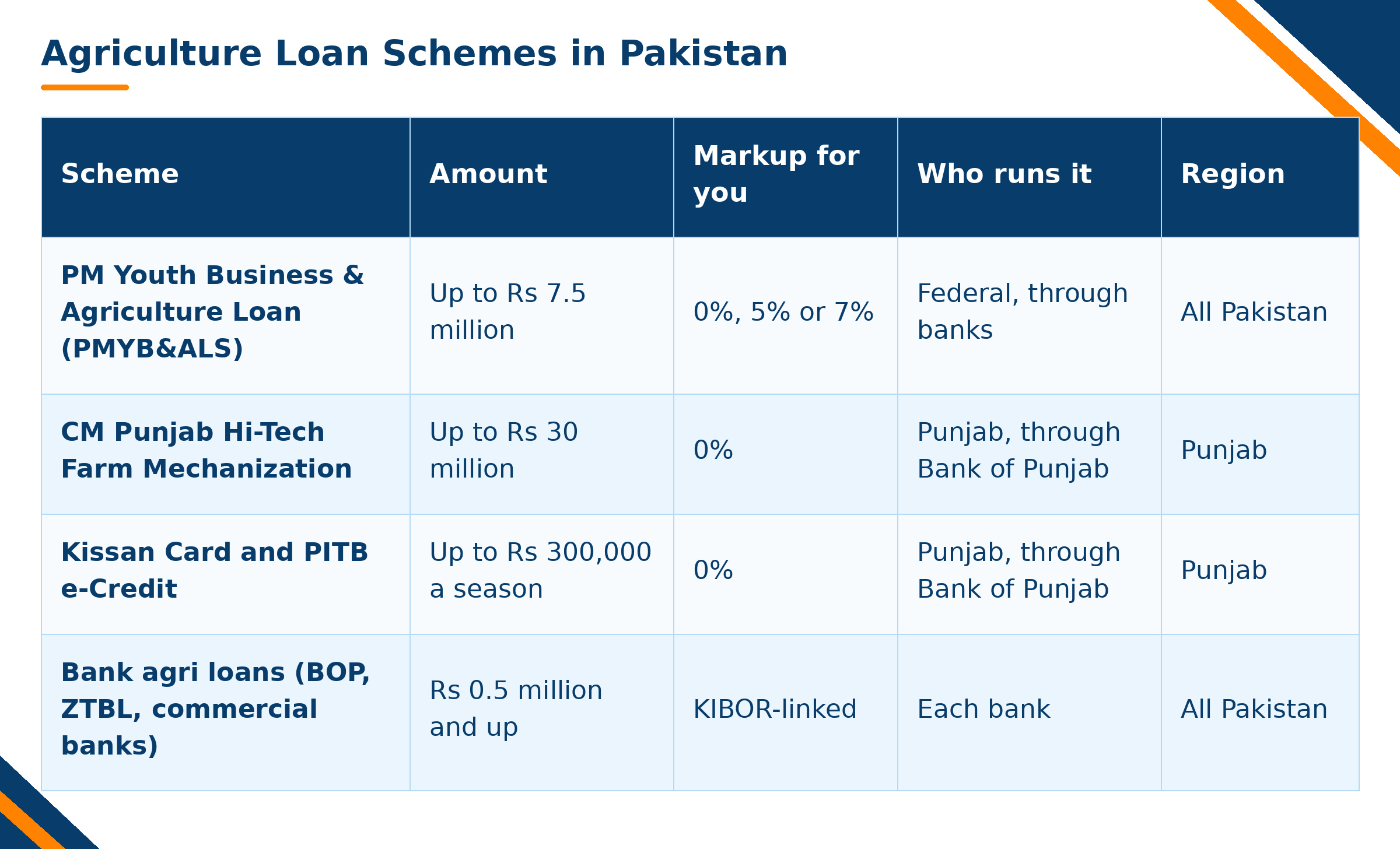
The PM Youth Business and Agriculture Loan Scheme lends up to Rs 7.5 million: 0% up to Rs 0.5 million, 5% up to Rs 1.5 million and 7% above that. Apply online at pmybals.pmyp.gov.pk.
Punjab’s Hi-Tech Farm Mechanization program gives interest-free loans of up to Rs 30 million for 12 categories of machinery.
Commercial agri loans float with KIBOR. With the SBP policy rate at 11.5% (14 September 2026), check the bank’s current quoted rate and charges.
No bank is best for everyone. Pick the one that runs the scheme you qualify for, then compare rates, security and processing time.
Main Agriculture Loan Schemes in Pakistan
Prime Minister’s Youth Business & Agriculture Loan Scheme (PMYB&ALS)
PMYB&ALS, the successor to Kamyab Jawan, is the PM Youth Programme’s loan scheme. Banks, microfinance banks, and institutions lend the money, the Finance Division pays the markup subsidy, and SBP sets the rules.
The scheme uses an online application portal, and the 2026-27 federal budget set aside Rs 9.5 billion for the subsidy, according to an independent guide citing Dawn.
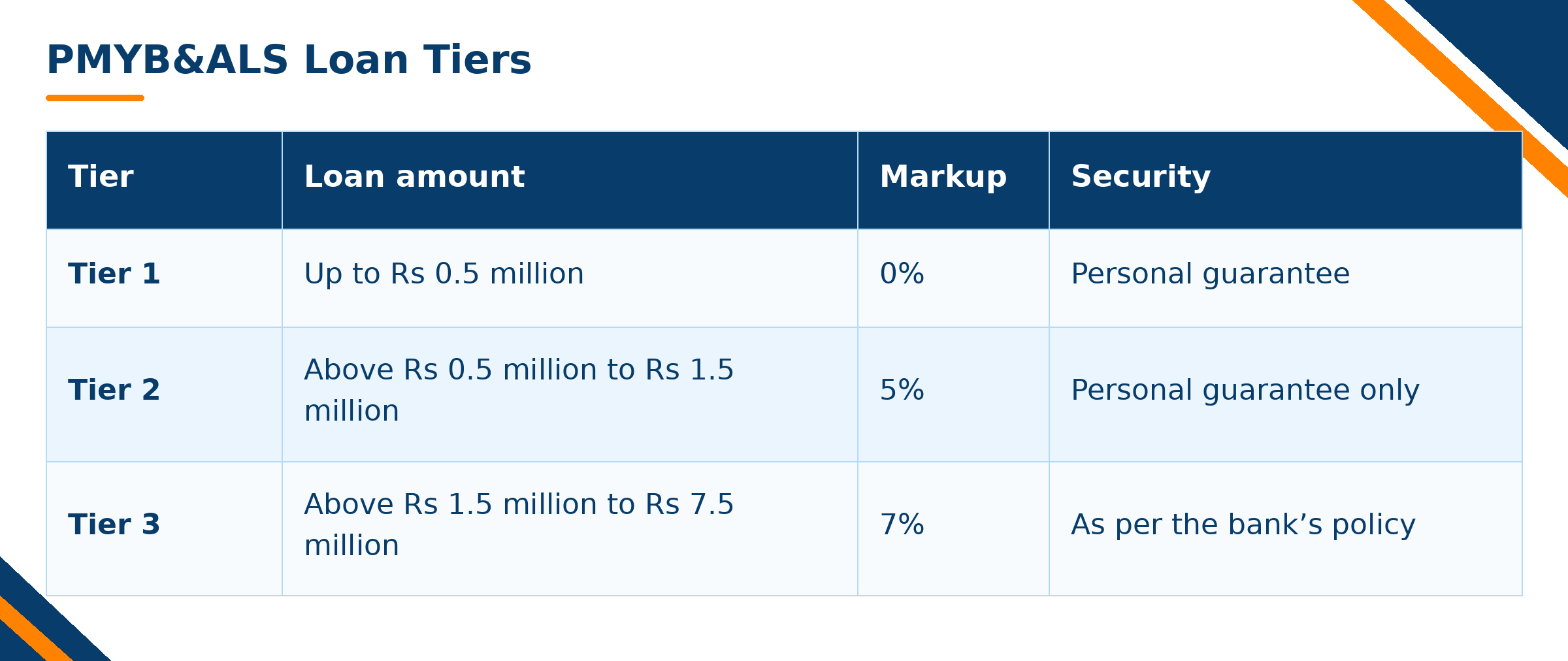
For farmers, SBP’s agriculture financing rules decide who qualifies. All crop and non-crop sectors are eligible, including crops, livestock, poultry, fishery and dairy.
A borrower can take one production loan and one development loan within the Rs 7.5 million total, according to Bank AL Habib’s scheme page.
Production loans cover working capital such as seed, so buyers planning a season can compare options in the seed category before they apply.
Age: 21 to 45 (18 for IT and e-commerce), with a valid CNIC. Government employees cannot apply.
Tenor: up to 8 years, with up to one year of grace for term loans, and up to 5 years for working capital.
Your own money: 10% (Tier 2) or 20% (Tier 3) for a new business, and nothing for an existing one.
Speed: processing should not exceed 45 days, and the bank checks your credit record.
CM Punjab High-Tech Farm Mechanization Finance Program
This program gives interest-free bank loans of up to Rs 30 million to buy modern farm machinery. The Punjab government pays the markup, and Bank of Punjab handles the loan, as Bank of Punjab’s program page describes it.
In June 2026 Pakistan Today reported that Punjab had launched the scheme for 12 categories of machinery, and the Agriculture Department’s 2026-27 plan lists loans for 1,485 farmers or service providers.
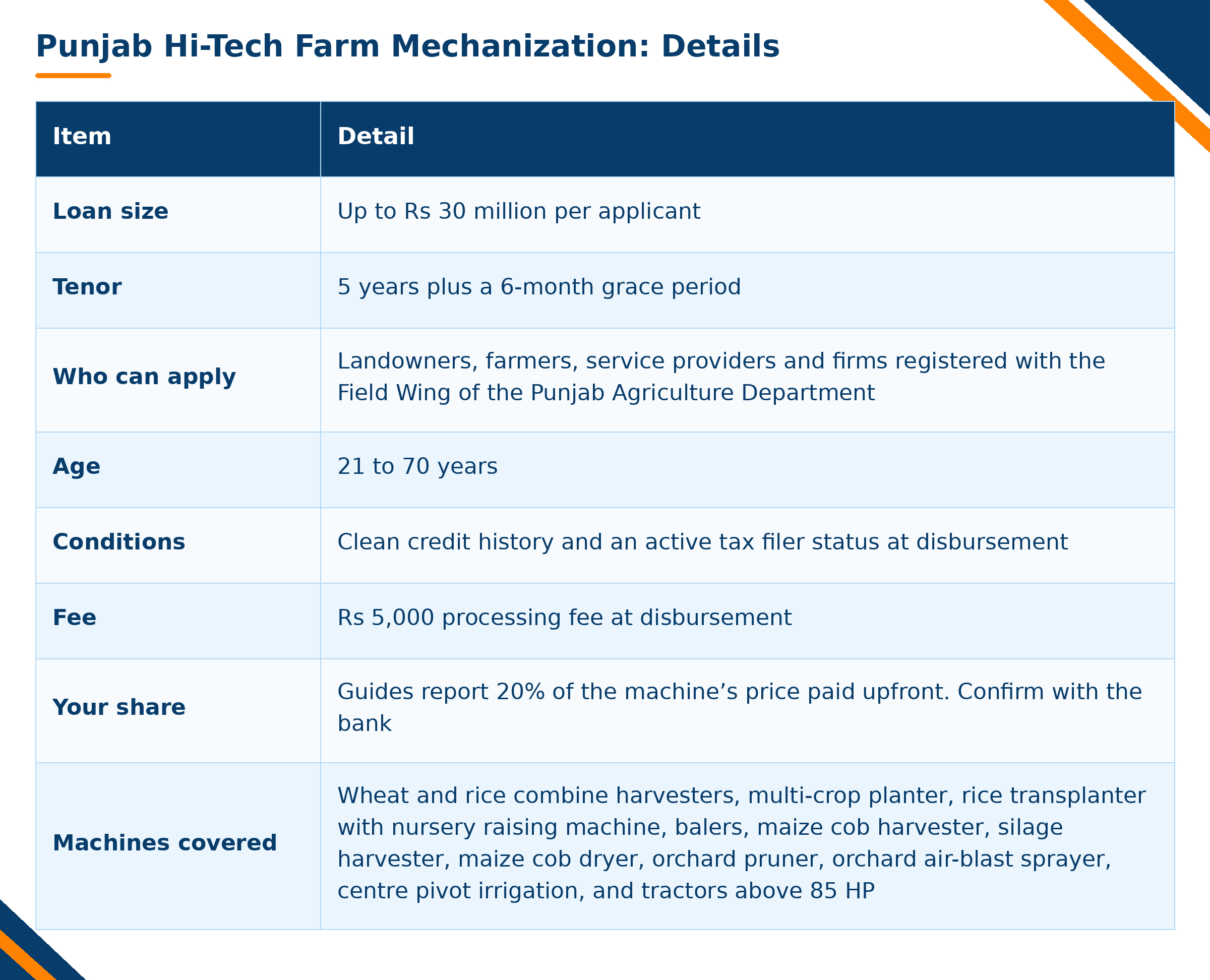
The program is aimed at specified machinery categories. Subsidy projects for smaller implements run separately.
If you are comparing machines first, see our guide to agricultural machinery in Pakistan for dated tractor and implement prices.
Punjab IT Board (PITB) Agriculture e-Credit Scheme
The e-Credit Scheme is a digital system that PITB built for the Punjab Agriculture Department to verify farmers and disburse interest-free loans. It targets farmers with less than 12.5 acres.
PITB says it cut the number of visits to the land record office and bank from more than 10 to three, and that it had disbursed over PKR 71 billion to 275,000 farmers by July 2023, according to PITB.
The Kissan Card is its newer form. Farmers verified through PLRA, NADRA, and eCIB get a Bank of Punjab card for interest-free input loans, and the official Agriculture Department guidance (July 2025) lists up to Rs 300,000 per crop season on 1 to 25 acres, with 30% as cash, 20% for diesel, and 50% for inputs.
Limits vary across published scheme phases; confirm the current loan cap, land eligibility, and registration status with the Punjab Agriculture Department or 0800-17000 before applying.
Dealers and pumps registered with the scheme take the card. Zarea is not one of them, but its fertilizer category gives a market price reference for urea, DAP, and other fertilizers before you buy.
Specialized & Commercial Agri-Loan Products
Outside the government schemes, farmers borrow from banks at commercial rates. Three types of lenders matter in Pakistan.
Bank of Punjab: its Agri Kissan Dost Production Loan finances seed, fertilizer, pesticides, and other crop costs. Its product page lists Rs 0.5 million to Rs 50 million for individuals, up to 3 years, with at least 5 acres, a clean eCIB record, and ages 21 to 65.
Zarai Taraqiati Bank Limited (ZTBL): the state-owned agriculture bank, with schemes such as Kissan Dost and Sada Bahar for crops, green tractors, and farm development.
Commercial and Islamic banks: HBL, MCB, NBP, UBL, Bank AL Habib, Meezan, and others offer production, development, and tractor loans, and many also process PMYB&ALS.
Terms change, so ask each bank for a current written offer. Check the current product sheet before relying on published loan limits.
What Do Agriculture Loans Cost?
Scheme loans have a fixed, subsidised markup. Commercial agri loans float. The SBP policy rate was 11.5% after the 14 September 2026 meeting, and the 6-month KIBOR was about 11.83% (bid) to 12.08% (offer) on 30 September, according to the State Bank of Pakistan.
Inflation is also high, with average CPI at 10.18% in the first two months of FY27, according to ProPakistani. The next policy meeting is on 26 October 2026, so rates can move.
To see what the difference means, here is a worked example on a Rs 1 million loan repaid over 5 years. The 14% row is illustrative, not a bank quotation. These examples do not represent the repayment schedule of any specific scheme.
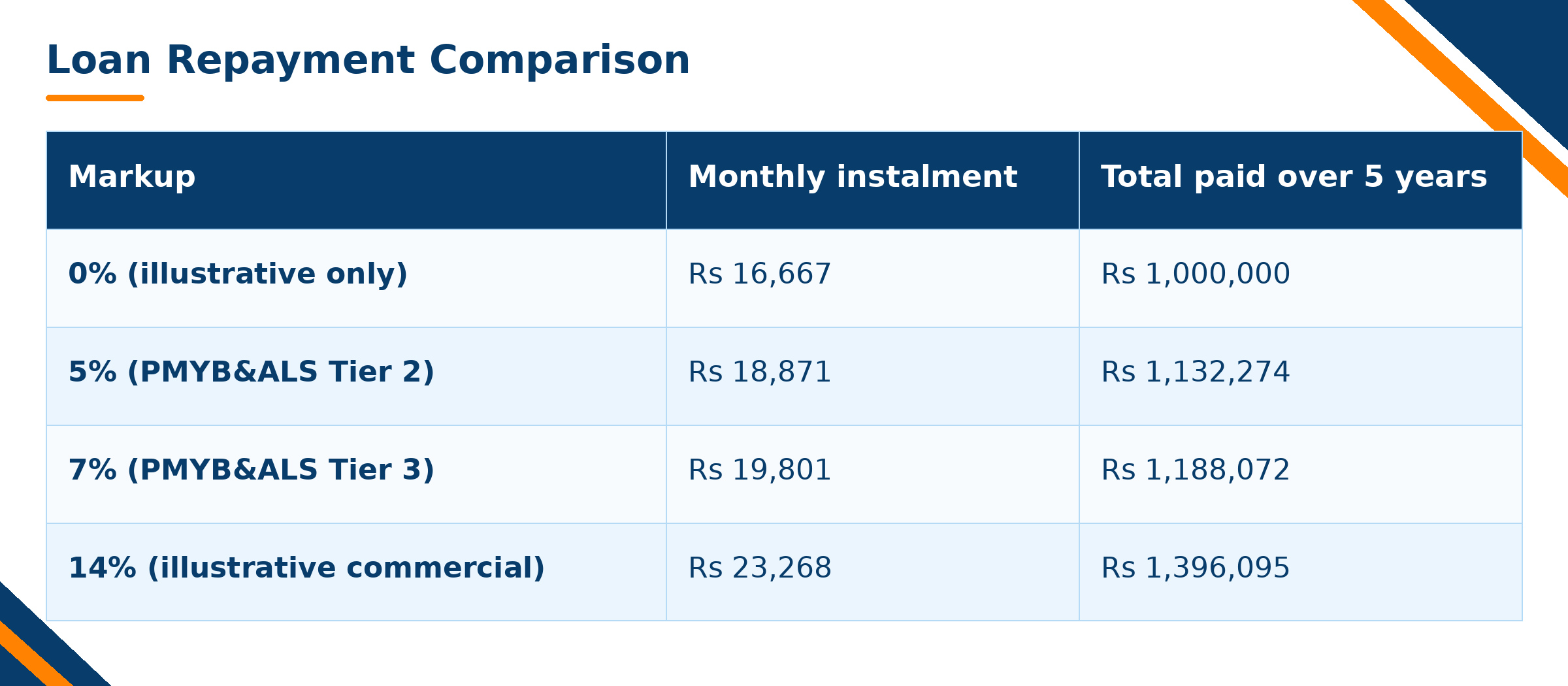
We assumed equal monthly instalments on a reducing balance, and real schedules differ. The point is the gap: the illustrative 14% loan costs about Rs 396,000 more than a 0% loan over five years.
Repayment follows harvest, so keep an eye on what your crop will fetch. The daily price page tracks commodity prices, and the grains and pulses category shows bulk grain listings.
How to Apply for the PM Loan Scheme in 2026
The scheme’s official online application portal is pmybals.pmyp.gov.pk. No paper form is needed. The steps below follow an independent guide that checked the live form on 15 September 2026.
Open the loan application form on the portal, or sign in at pmyp.gov.pk and choose Apply for Loan.
Enter your CNIC, its issue date, and the tier you want. NADRA checks the CNIC details automatically.
Choose a bank and branch, the loan type, the tenure, and your own share. For agriculture, pick a production or development loan.
Fill in your business plan, any loan history, and two references who are not blood relatives. You need a mobile number registered in your own name.
Submit. A registration number appears on screen and is sent by SMS, and the bank contacts you. Track the application on the portal with your CNIC, mobile number, CNIC issue date, and date of birth.
Documents may be requested depending on the application and lender. Check the portal’s current requirements, which may include: a photo, CNIC front and back, your latest degree, NTN (register with FBR first if you don’t have one), an electricity bill consumer ID, and a recommendation letter from a chamber or trade body for an existing business.
Do not pay anyone to speed things up. The independent guide says the form fee under SBP’s rules is Rs 100, and that no agent can guarantee approval. The official helpline is 051-9203585.
How to Choose a Bank for an Agriculture Loan
The best bank depends on which scheme you qualify for, because the scheme sets the markup, not the bank. For Punjab’s interest-free programs the lender is Bank of Punjab. PMYB&ALS runs through about 15 banks. For a regular agri loan, compare these before you sign:
Markup: is it fixed or KIBOR-linked, and what is the spread over KIBOR?
Fees: processing, insurance, takaful, and early-repayment charges.
Security: personal guarantee, land, passbook or hypothecation of the machine.
Speed: how long approval takes, and whether the bank keeps to the 45-day limit for PMYB&ALS.
Reach: a branch or agri officer near your land.
Structure: Islamic financing or a grace period if you need one.
Using the Loan Well
A cheap loan can still hurt if it funds the wrong thing. Match the loan to the cash cycle: seed and fertilizer for production loans, equipment and irrigation for development loans.
Fertilizer is the biggest input cost for many crops, and a listing such as DAP on Zarea shows what a bulk price looks like. For irrigation, the solar category is a starting point when diesel pumping costs are the problem.
And if you grow wheat, see how a bulk wheat listing is priced before you commit to a repayment date.
Frequently Asked Questions
Which bank is the best for agriculture loans?
There is no single best bank. Bank of Punjab runs Punjab’s interest-free programs, ZTBL is the state-owned agriculture bank, and about 15 commercial, Islamic, and microfinance banks process the PM Youth loan. Choose the lender that offers the scheme you qualify for, then compare markup, fees, security and processing time in writing.
What is the interest rate of an agriculture loan?
It depends on the loan. Scheme loans are 0% for Tier 1, Hi-Tech machinery and Kissan Card loans, 5% for PMYB&ALS Tier 2 and 7% for Tier 3. Commercial agri loans are linked to KIBOR, which was about 12% for six months at the end of September 2026 with the policy rate at 11.5%, so expect double-digit rates plus a spread. Ask the bank for its current rate sheet.
How to apply for PM loan scheme 2026?
Apply online at pmybals.pmyp.gov.pk. Enter your CNIC and tier, choose a bank, fill in your business plan and two references, and submit. You get a registration number by SMS and the bank contacts you. Applicants must be 21 to 45 (18 for IT and e-commerce) with a CNIC, and the processing time should not exceed 45 days.
Which Pakistani bank has the lowest interest rate on loans?
For government schemes, the rate is set by the scheme, so it is the same at every participating bank, and Bank of Punjab delivers the 0% Punjab programs. For regular loans, rates differ by bank and change with KIBOR, and we found no reliable public ranking. Compare written offers, and look at SBP’s monthly weighted average lending rate for a benchmark.
Wrap-Up
A subsidised government scheme may cost less than a regular bank loan if you meet its conditions: zero-markup input and machinery loans in Punjab, or the PM Youth loan at 0% to 7%. Check eligibility first, apply only through official channels, and never pay an agent.
If you need a regular bank loan, compare the full cost, including fees and security, and plan the repayment around your harvest. Borrow only what the crop can repay.