What Is Carbon Steel? Types, Uses & Properties Explained
Explore the fundamentals of carbon steel, from mild to ultra-high grades. Learn about its core properties, key advantages, and common uses across industries.
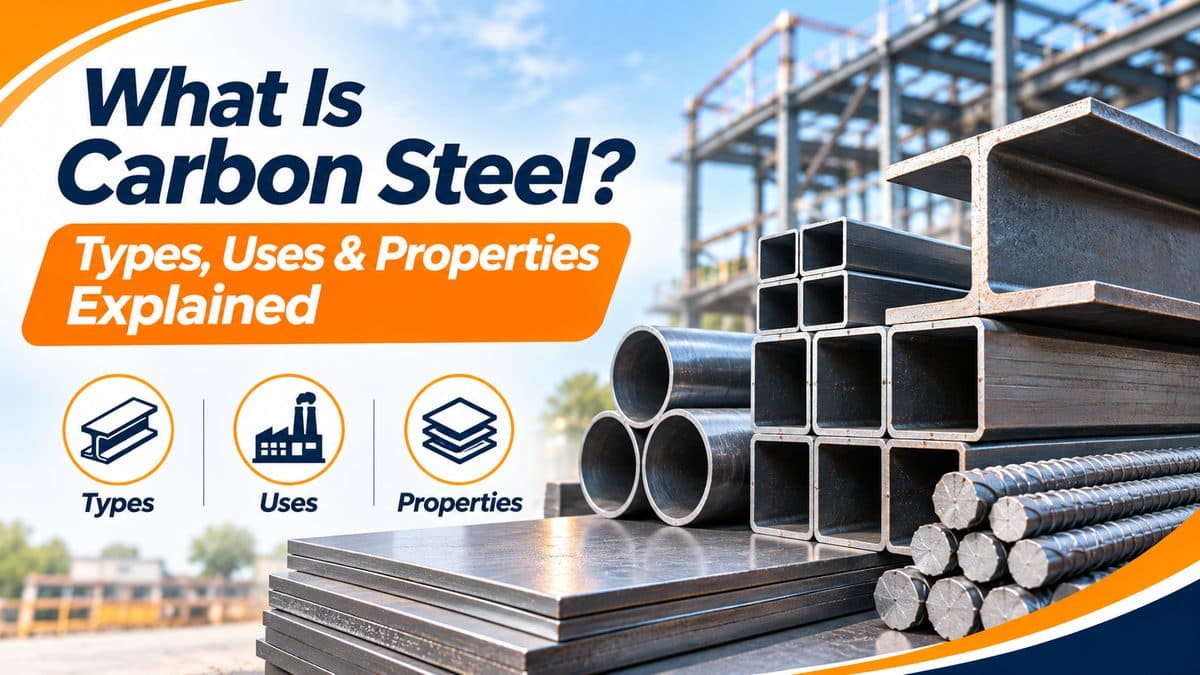
A steel bar in a concrete column, a sheet-metal bracket, and a machine shaft may all be made from carbon steel, but they are not interchangeable.
The amount of carbon, the manufacturing process, and any heat treatment affect how the metal bends, welds, and carries a load.
This guide explains the main types, compares typical mechanical properties, and shows what buyers should check when choosing steel for construction or fabrication in Pakistan.
Grade values are illustrative unless a specification states a minimum; the relevant standard and mill test certificate take priority.
Quick Answers
1) What it is: a family of iron-based steels in which carbon is a principal influence on mechanical properties; exact composition depends on the grade and standard.
2) Main types: low carbon (mild steel, up to about 0.30%), medium carbon (0.30 to 0.60%) and high carbon (0.60 to 1.00% and above).
3) The trade-off: higher carbon content generally increases potential hardness and strength after suitable processing, while making welding and forming more demanding.
4) Corrosion: ordinary uncoated carbon steel can rust in damp conditions, so exposure and protective finishes matter.
5) In Pakistan: Grade 60 reinforcing bars are a familiar carbon-steel product, but rebar should not be confused with mild-steel plate or structural sections.
What is Carbon Steel?
Carbon steel is an iron-based alloy with carbon as a key ingredient. Commercial grades also contain controlled amounts of elements such as manganese and silicon.
There is no single composition or strength value that describes every carbon steel: a low-carbon sheet and a high-carbon tool steel behave very differently.
Stainless steel generally contains at least 10.5% chromium, which helps form a protective surface film.
Alloy steels use additional elements to achieve specified performance.
The boundaries depend on the standard, so compare the actual grade designation rather than relying on a broad sales label.
Main Types: Low, Medium and High
Carbon-content ranges are useful starting points, not universal specifications.
The examples below illustrate common grades; tensile strength, formability, and hardenability also depend on product size, processing, and heat treatment.
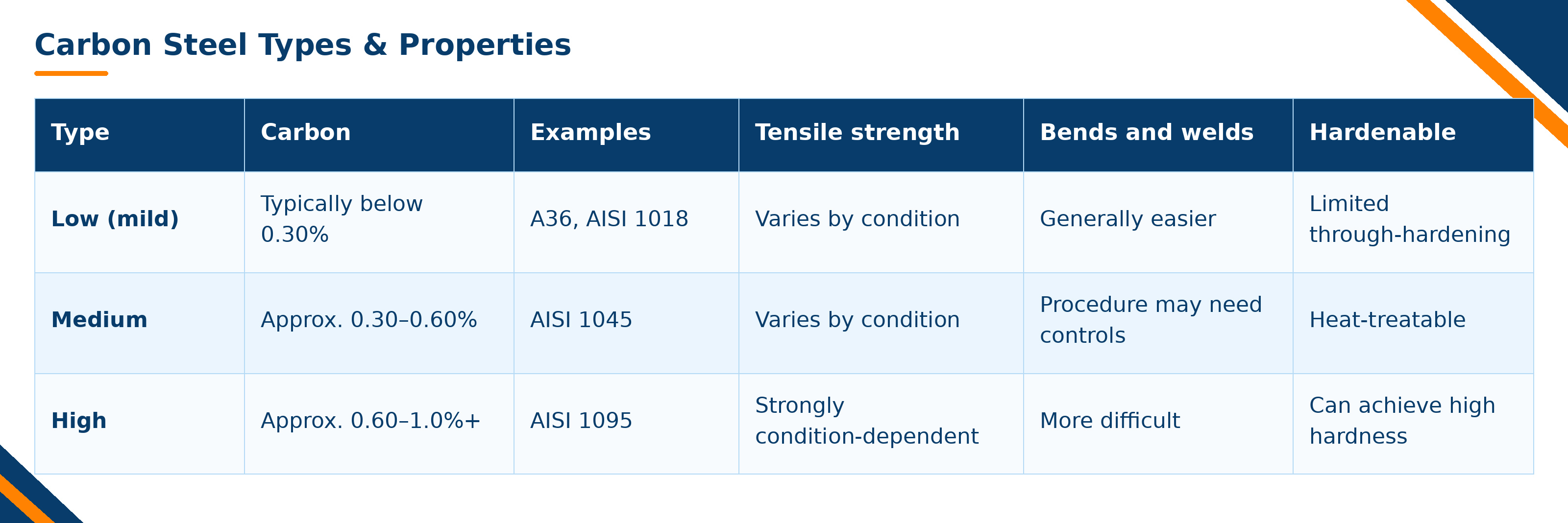
Indicative comparison only. Values are not interchangeable across delivery conditions; request the applicable ASTM, AISI/SAE or other specified grade documentation.
Low, Also Called Mild Steel
Low-carbon steel is often called mild steel. It is generally easier to form and weld than higher-carbon grades, which makes it common in structural sections, sheet metal, brackets, and fabricated parts.
ASTM A36 structural material, for example, has specified minimum yield strength that depends on product thickness and standard requirements; do not assume every mild-steel item is A36.
In local buying conversations, “MS” commonly means mild steel.
Ask whether a quote covers plate, angle, pipe, or another product, and confirm the relevant standard. Reinforcing bar has separate grade and testing requirements.
Medium: The Machinery Grade
Medium-carbon steels such as AISI 1045 are often selected for shafts, pins, and other mechanical parts.
They can respond to heat treatment, but their final strength depends on section size and condition.
A quoted number from a hot-rolled data sheet should not be used as a guaranteed value for a cold-drawn or heat-treated component.
Welding needs more care as carbon content and hardenability increase.
Depending on the grade, thickness, and joint design, a qualified welding procedure may require preheating and controlled cooling.
Tell the supplier or fabricator if welding is part of the job.
High: Hard, Springy, and Less Forgiving
High-carbon grades such as AISI 1095 are used for certain blades, springs, and wear-resistant components.
Their useful hardness comes from the grade together with suitable heat treatment; excessive hardness can reduce toughness.
Not every spring or cutting-tool steel is plain, so check the full specification.
Key Properties
Many carbon steels have a density near 7.85 g/cm³ and an elastic modulus around 200 GPa. Their melting range varies with composition.
Magnetism can help with a quick check, but it cannot identify a steel grade or reliably distinguish every stainless steel from carbon steel.
Strength and hardness are not determined by carbon percentage alone. The table compares representative published conditions for several grades.
It should help readers understand the trend, not serve as a substitute for a mill certificate or design calculation.
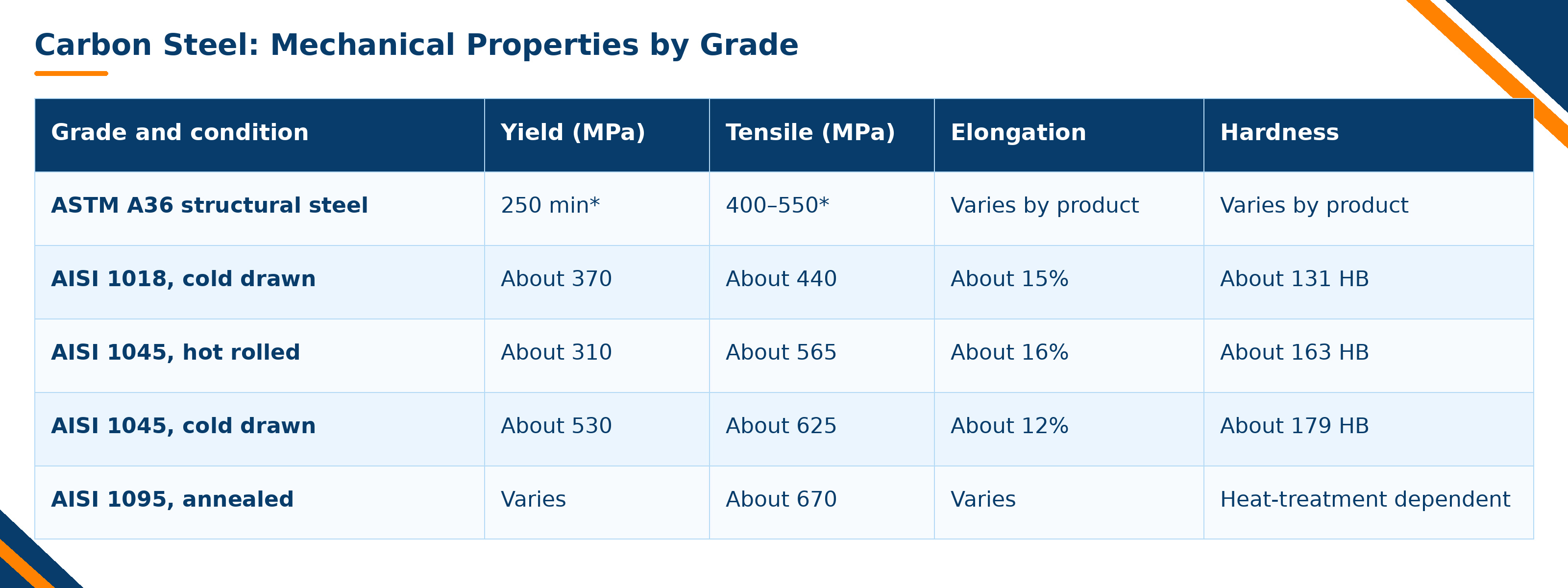
Representative published values for specified conditions, rounded for readability; they are not guaranteed design values.
*A36 values are subject to the relevant standard and thickness. Request a mill test certificate for the actual material.
Notice how the condition matters: a cold-drawn bar and a hot-rolled bar of the same grade can have different strength values.
For a broader explanation of grade labels, see Zarea’s steel grades.
For buyers, three further questions are practical: can the steel be machined to the required tolerance, can it be welded using an approved procedure, and will it need a corrosion-protection system?
Those answers are often more useful than the broad label “carbon steel”.
Carbon Steel vs Alloy Steel and Stainless Steel
Plain carbon steel, alloy steel, and stainless steel are overlapping families of engineering materials, not simple good-better-best choices.
Alloy grades such as AISI 4140 contain specified additions that support particular hardenability and strength requirements.
Their properties still depend on heat treatment and cannot be assumed from the grade name alone.
Stainless steel resists many forms of corrosion because its chromium-rich surface forms a passive film, but it is not rust-proof in every environment.
It is often economical and suitable for structural or mechanical work when the right grade and protection are chosen.
Compare specifications, exposure conditions, and total installed cost rather than assuming one family is always stronger.
Protecting Carbon Steel From Rust
Ordinary carbon steel can corrode when moisture and oxygen reach its surface. How quickly that happens depends on exposure, salts, coatings, and maintenance.
Outdoor and coastal installations need particular attention, but even indoor steel can rust if stored damp.
The usual protections are simple.
1) Paint or powder coat for visible steel and fabrication.
2) Hot-dip galvanising, a zinc coating, for outdoor structures and fencing.
3) Oil or wax for tools, bearings and machined surfaces.
4) Dry storage. Keep steel off the ground, covered and ventilated, not under plastic that traps damp.
Weathering steel is a special low-alloy material designed to develop a protective patina under suitable exposure conditions.
It should not be treated as ordinary uncoated carbon steel, and its performance depends on the environment.
Carbon Steel in Pakistan: What You Will Actually Buy
For construction buyers in Pakistan, reinforcing bar is one common carbon-steel purchase.
ASTM A615 Grade 60 has a specified minimum yield strength of 60,000 psi (approximately 420 MPa).
That is a different product specification from ASTM A36 structural steel; neither should be substituted for the other without engineering approval.
Zarea lists Grade 60 bars from manufacturers such as Aziz Steel and Hunza Steel.
Compare the current per-kilogram prices and available bar sizes, then check minimum order and delivery charges.
A listing is a starting point for a quotation, not a substitute for the mill certificate.
Other listed options include Sheikhoo Steel and Five Star Steel. At an illustrative Rs 282/kg, 2,000 kg would cost Rs 564,000 before delivery and other charges.
The Five Star listing shows inconsistent minimum-order information, so confirm its terms directly before relying on them.
For more brands and available sizes, compare the Steel category rather than relying on one listed price.
Buyers who want to understand the upstream supply chain can also read Zarea’s guide to industrial raw materials, which explains the role of scrap and other steelmaking inputs.
How to Choose the Right Grade
Start with the job the steel must perform. Will the component be welded or bent? Does it carry a static load or repeated impacts? Will it be exposed to moisture?
Then match the design specification, grade, dimensions, condition, and test documents to those requirements.
1) Fabrication and welding. Low-carbon grades may suit brackets, sheet work and frames, provided the specified grade, thickness and welding procedure match the design.
2) Reinforced concrete. Order the specified reinforcing-bar grade, size and standard. General mild-steel plate or angle is not a substitute.
3) Shafts and moving parts. Medium-carbon grades such as 1045 may suit these applications when the required condition and heat treatment are documented.
4) Blades and springs. Some high-carbon grades are appropriate, but hardness, toughness, and heat treatment must be considered together.
5) Heavy-duty machine parts. Alloy grades such as 4140 may be suitable when the engineering specification calls for their particular properties.
For a bulk order, request the relevant mill test certificate, confirm the grade and bar size, and compare prices on the same delivered basis.
Zarea’s guide to building and construction material suppliers covers additional checks for larger purchases.
FAQs
Is Carbon Steel Better Than Steel?
Carbon steel is a type of steel, not an alternative to it. Whether it is the right choice depends on the grade, required strength, weldability, corrosion exposure, and budget.
Will Carbon Steel Rust?
Yes. Ordinary uncoated carbon steel can rust when exposed to moisture and oxygen. Paint, galvanising, suitable oils, and dry storage can reduce corrosion, depending on the application.
What is Carbon Steel Used For?
Low-carbon grades are common in sheet metal and fabricated structures; medium-carbon grades are used in some shafts and gears; high-carbon grades appear in selected blades, springs and tools. Reinforcing bars are a major construction application.
Is Carbon Steel a Real Metal?
Yes. Carbon steel is a real iron-based metal alloy. It is not carbon fibre. Its mechanical properties depend on its composition, processing, and heat treatment.
Wrap Up
This is widely used in construction, manufacturing, and machinery because of its strength, versatility, and affordability.
Low carbon steel is easier to weld and shape, while medium and high carbon steel offer greater hardness and wear resistance for specific applications.
Before buying carbon steel in Pakistan, check the steel grade, required specifications, corrosion protection, and mill test certificate to ensure the material suits your project.