Industrial Raw Materials: Key Examples, Uses & Applications
Industrial raw materials explained: main categories, direct vs indirect materials, and what 2026-27 tariff changes mean for Pakistani buyers.
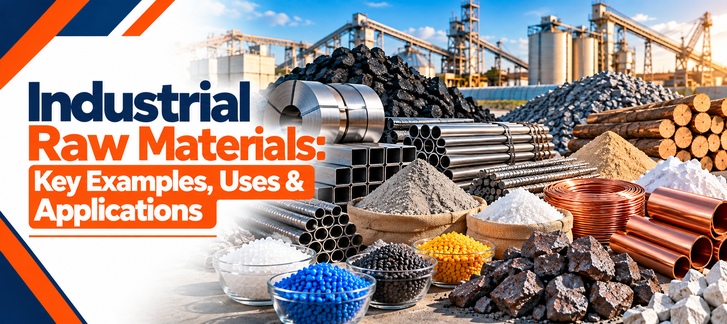
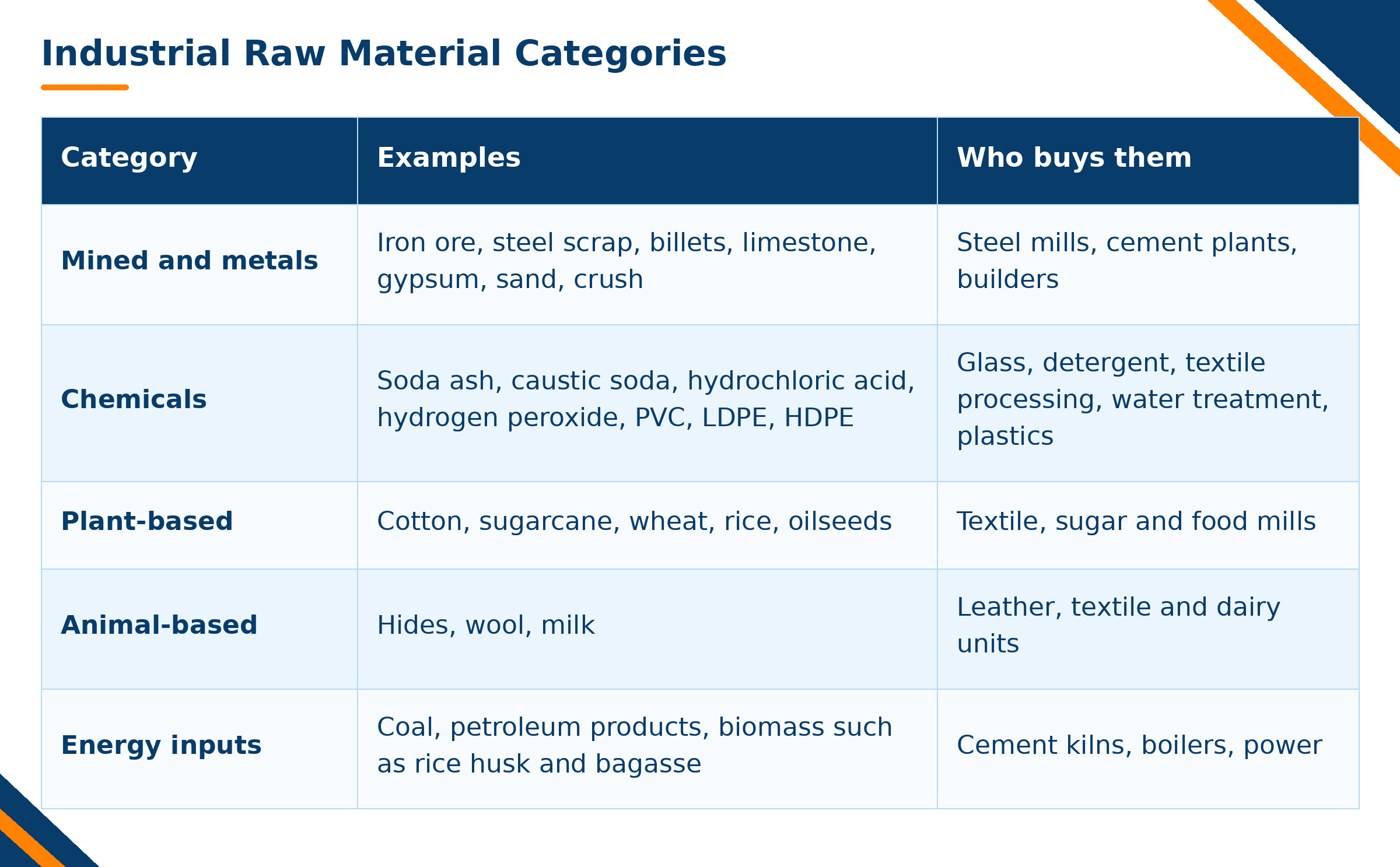
Industrial raw materials are what a factory starts with before it makes anything. Iron ore or scrap turns into steel, limestone into cement, cotton into yarn. Some of it is mined, some is grown, some is pumped out of the ground, and in Pakistan, a big chunk of it is imported.
Buyers usually split these into direct and indirect materials. Direct ones end up in the finished product. Indirect ones, like lubricants or cleaning supplies, only keep the plant running.
Below we look at steel, textiles, cement and chemicals, and what the 2026-27 budget changed on tariffs. There’s also a list of questions to ask a supplier before you order. Prices and duties move quickly, so check the latest numbers before you commit.
What Are Industrial Raw Materials?
Definition: Industrial raw materials are natural or processed inputs used to manufacture goods. Common examples include iron ore and steel scrap for steel making, cotton for textiles, limestone for cement, and soda ash for glass production.
Industrial buyers select these materials based on specifications, quality, availability, and total delivered cost.
These materials sit at the beginning of the production chain, moving from raw materials to intermediate goods and then finished products. Basic raw materials, such as iron ore, cotton, crude oil, and timber, come directly from natural sources with little or no processing.
Main Categories of Industrial Raw Materials
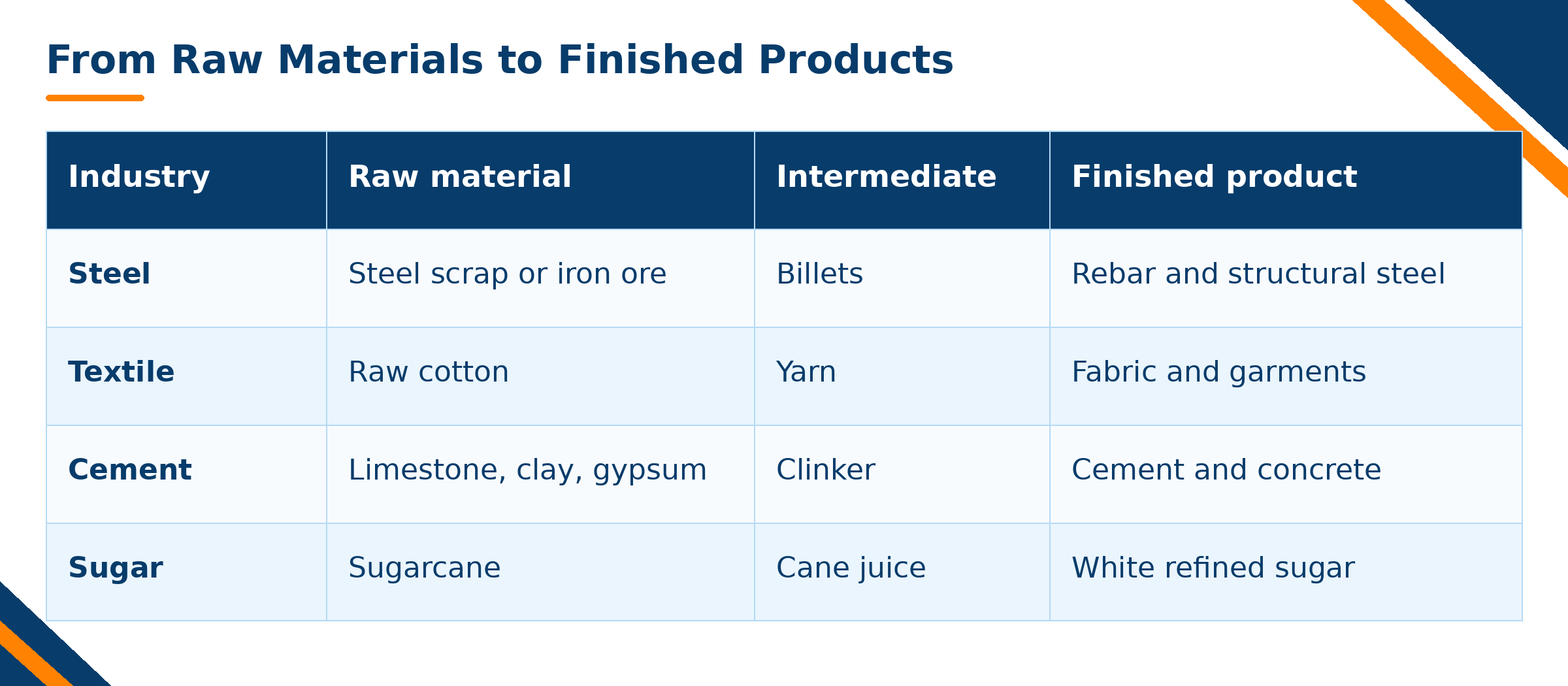
Most raw materials get sorted by where they come from, which gives you three buckets: things dug out of the ground, things grown on land, and things that come from animals.
Buyers tend to add two more: chemicals and energy. They don’t fit neatly into the first three because they cut across them, but you still have to buy them, so they get their own line.
Steel Raw Material
Steel starts as either iron ore or scrap, and in Pakistan it’s mostly scrap. PACRA’s September 2025 sector study puts scrap imports at about 2.8 million tonnes in FY25.
The same study says raw material was roughly 88.8% of the sector’s total cost in FY24, so it’s most of what you’re paying for. When you compare offers in the steel category, check one thing first: is that price for billets or for finished bars? They’re not the same product.
Cement and Construction Minerals
Cement is made from limestone, clay, and gypsum, but you buy it by grade, mainly ordinary Portland cement (OPC) or sulphate-resistant cement (SRC). If you’re ordering in bulk, the cement category lets you compare brands side by side.
Chemical Raw Materials
Chemicals go into all sorts of plants. Soda ash ends up in glass, detergents, and water treatment, while caustic soda is used for pH control, neutralising acids and cleaning, going by how suppliers list it.
Read the specification before you look at the price, because purity and pack size change what you’re really getting. Zarea’s chemicals category keeps them all in one place.
Plant-Based, Animal-Based and Energy Inputs
Cotton, sugarcane and wheat keep Pakistan’s textile, sugar and food industries running. Hides and wool, the animal-based side, mostly go to leather and textile units.
Factories also rely on energy inputs such as coal, rice husk and bagasse to run boilers, kilns and other equipment. These fuels support production, although they do not usually become part of the finished product.
Direct vs. Indirect Materials
The split matters for costing and for buying. Direct materials become part of the finished product and can be traced to it, like cotton in yarn or billets in rebar. Indirect materials support production but don’t end up in the product, or can’t be traced to a unit without extra cost.
Glue, tape, lubricants, and gloves are the usual examples. In the books, direct materials move into work-in-process, while indirect ones are charged to manufacturing overhead, as Shopify’s explainer sets out.
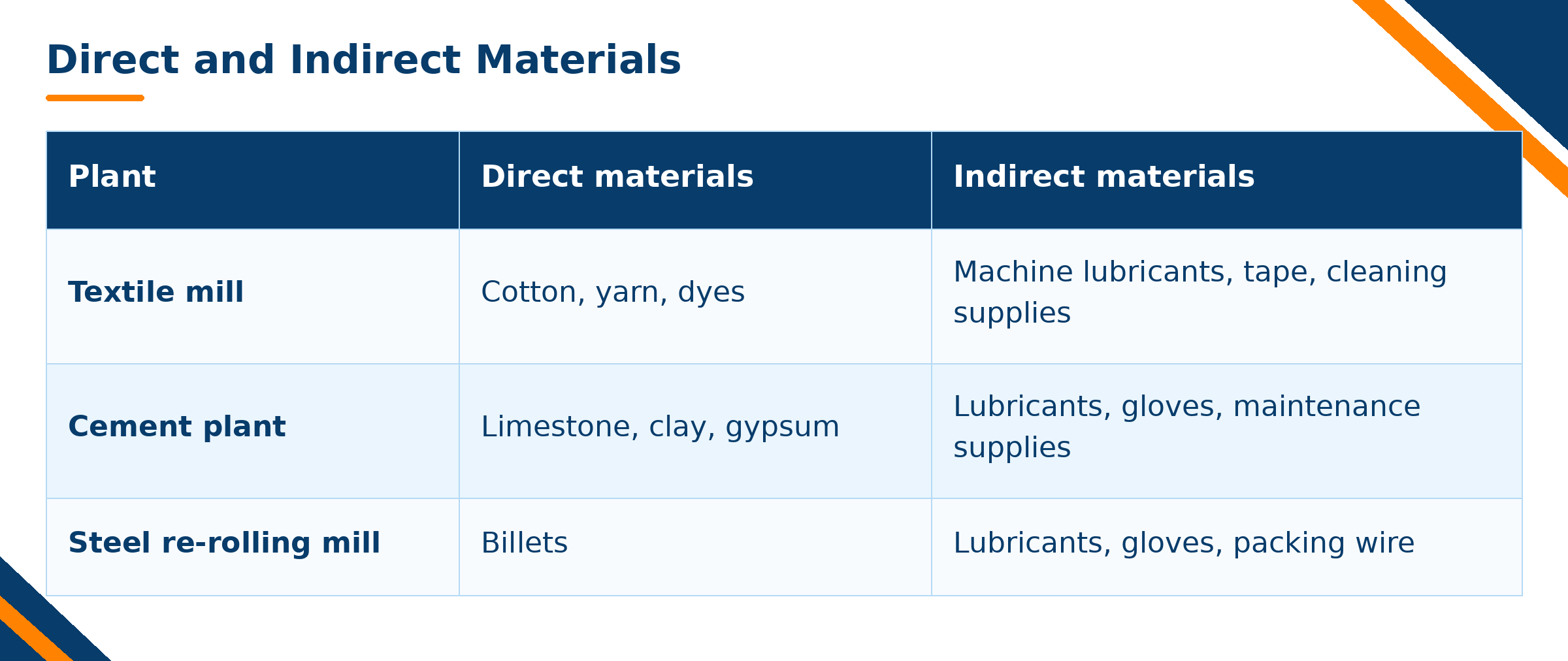
The split matters for costing and for buying. Direct materials become part of the finished product and can be traced to it, like cotton in yarn or billets in rebar. Indirect materials support production but don’t end up in the product, or can’t be traced to a unit without extra cost.
Glue, tape, lubricants, and gloves are the usual examples. In the books, direct materials move into work-in-process, while indirect ones are charged to manufacturing overhead, as Shopify’s explainer sets out.
Sector Insights and Policies
Policy is what’s changing fastest this year. The National Tariff Policy 2025-30 plans to bring duties on industrial inputs down in stages. Budget 2026-27 made a start: customs duty was cut on 92 tariff lines, additional customs duty dropped on more than 3,000 lines, and regulatory duty was capped at 20% on 359 lines, according to the Business Recorder budget summary and Profit.
The same summary says manufacturers pay 3% VAT when imported raw material is sold in the same state.
Don’t take the duty cut at face value, though. A Friday Times commentary from October 2026 argues that sales tax and advance income tax on imports can eat up some of the relief.
So when you ask a supplier for a quote, ask for the delivered price with all taxes included, not just the duty rate.
Steel got its own change a year earlier.
The FY26 budget put most melting scrap at 0% customs duty and brought billets down to 5%. Re-rollable scrap stays at 5%, as BigMint reported.
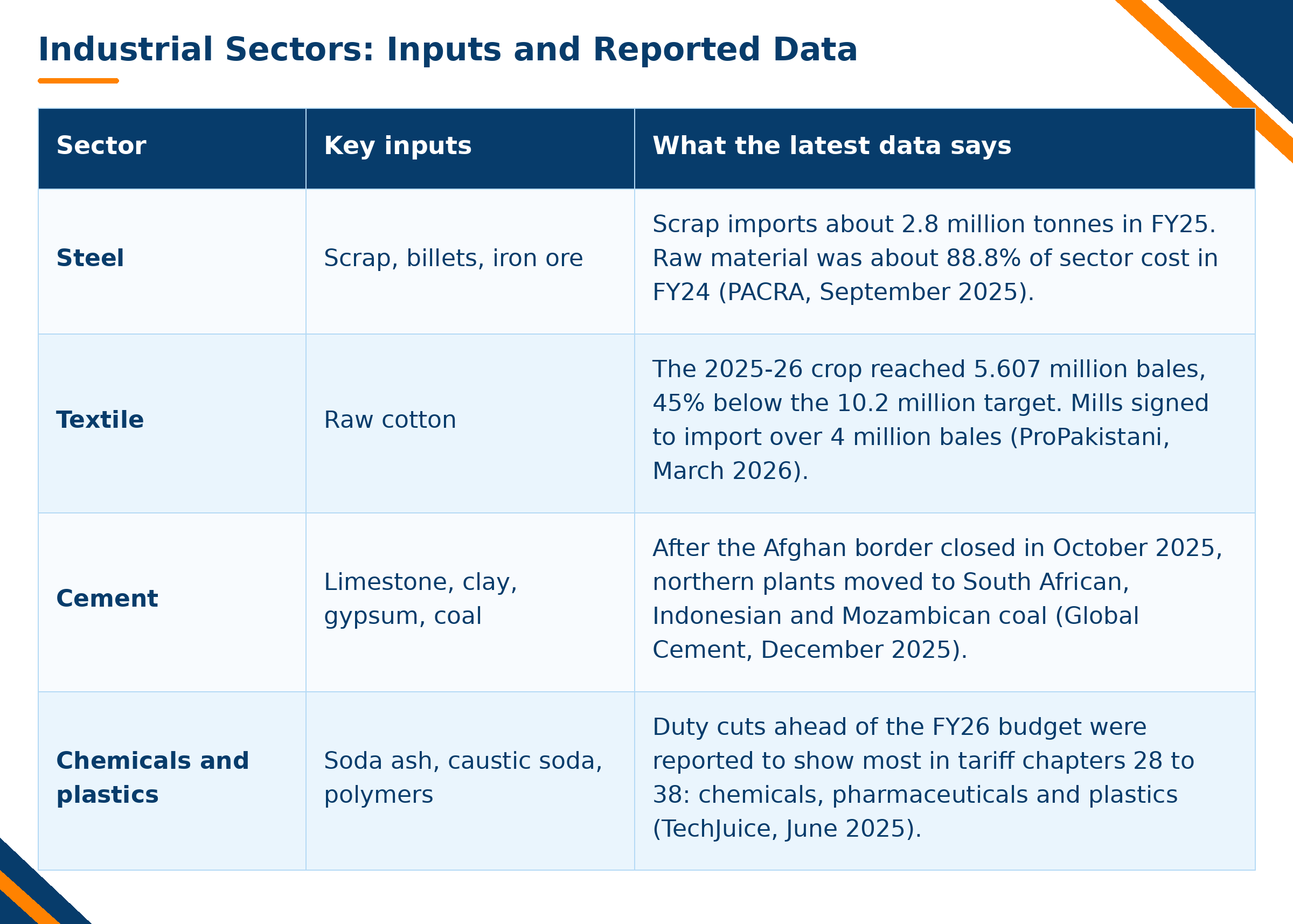
Pakistan holds an estimated 1.5 to 2 billion tonnes of identified iron ore, but only a small fraction is proven and commercially usable, and Pakistan Steel Mills has been idle since June 2015, Business Recorder reported in 2025. That is why scrap imports, and the policy around them, drive the steel raw material market.
Cotton shows the same squeeze. Industry estimates put spinning demand at 14 to 15 million bales a year, so imports fill the gap when the crop falls short. If you buy cotton or yarn, the cotton and yarn category is a place to compare listings.
Heat-heavy industries add fuel to the raw material list. If you buy coal by specification, start with the coal category and our guide to the types of coal. Global prices matter too, and our explainer on energy commodity prices covers the part that comes from outside Pakistan: fuel, freight, and currency.
How to Source Industrial Raw Materials in Pakistan
The cheapest quote is rarely the cheapest order. Before you buy any manufacturing raw materials in bulk, get these in writing:
The specification. Grade for steel and cement, purity and packaging for chemicals, moisture and ash for biomass, staple length and grade for cotton.
The price date and what it includes. Freight, taxes, and duties can change the real cost.
Minimum order and delivery terms. These decide whether a deal fits your storage and cash flow.
A way to verify the supplier. Ask for references, and test a sample before a large order.
A fallback supplier. Imported inputs, especially, can stall at the port or move with the exchange rate.
Listings show how much the terms vary. On Zarea, a Bestway OPC cement listing carries a minimum order of 200 bags with delivery charged by location, while the rice husk listing shows moisture of 12–14%, dust of 6–8%, and a 13-metric-ton minimum. The caustic soda listing is sold in 25 kg bags. Check each page for current terms, because they change.
Prices can change quickly, so check Zarea's daily commodity prices before negotiating. If you're sourcing biomass fuel or agricultural feedstock, you can also explore the agriculture biomass category to compare available materials and supplier listings.
Frequently Asked Questions
What are 10 raw materials and their products?
Cotton ends up as fabric. Iron ore gets melted down for steel, and scrap steel is rerolled into rebar. Limestone is the main ingredient in cement. Sugarcane gives you sugar, wheat gets milled into flour, and wood pulp becomes paper.
Petrol and plastics both start as crude oil. Glass needs sand plus soda ash. And natural rubber? Mostly tyres.
What are the raw materials used in industries?
It depends on which industry you mean. A steel mill buys scrap, iron ore or billets. Cement plants go through limestone, clay and gypsum, and they burn a lot of coal too.
Textile mills want cotton or synthetic fibre, while sugar mills only care about cane. Glass and chemical plants buy minerals like soda ash. Food processing is mostly wheat, rice, and oilseeds.
What are the types of raw materials?
Most people group them by where they come from. Mined ones are things like iron ore, limestone and sand. Plant-based ones are cotton, wood and sugarcane.
Animal-based means hides, wool, and milk. Accounting looks at it differently. If the material ends up inside the product, it’s direct. If it only keeps production going, like machine lubricant, it’s indirect.
What are basic raw materials?
They’re what you take straight from the ground, a field, or a forest with little or no processing. Ores, crops, crude oil, timber, sand. Basic raw materials come directly from natural sources, such as mines, farms, and forests, with little or no processing.
Examples include iron ore, cotton, crude oil, timber, and sand. Depending on their intended use, these materials may be processed into intermediate goods or used more directly in production.
Wrap-Up
Industrial raw materials get a lot easier to handle once you sort them two ways. First by where they come from: mined, grown, animal, chemical or energy. Then by what they do, which is either direct (goes into the product) or indirect (just keeps the plant running).
After that, hold every supplier to the same checklist: the specification, the delivered price, the minimum order and the date of the quote. If one of them is missing, you can’t compare properly.
Keep an eye on policy too. Duties and taxes on inputs changed again this year, and they’re not done moving.