Electrical Wiring: Parts, Systems, Cable Sizes and Safety Rules
Electrical wiring in Pakistan explained: compare cable sizes, wiring systems and safety checks, plus practical advice on choosing cables for your home.
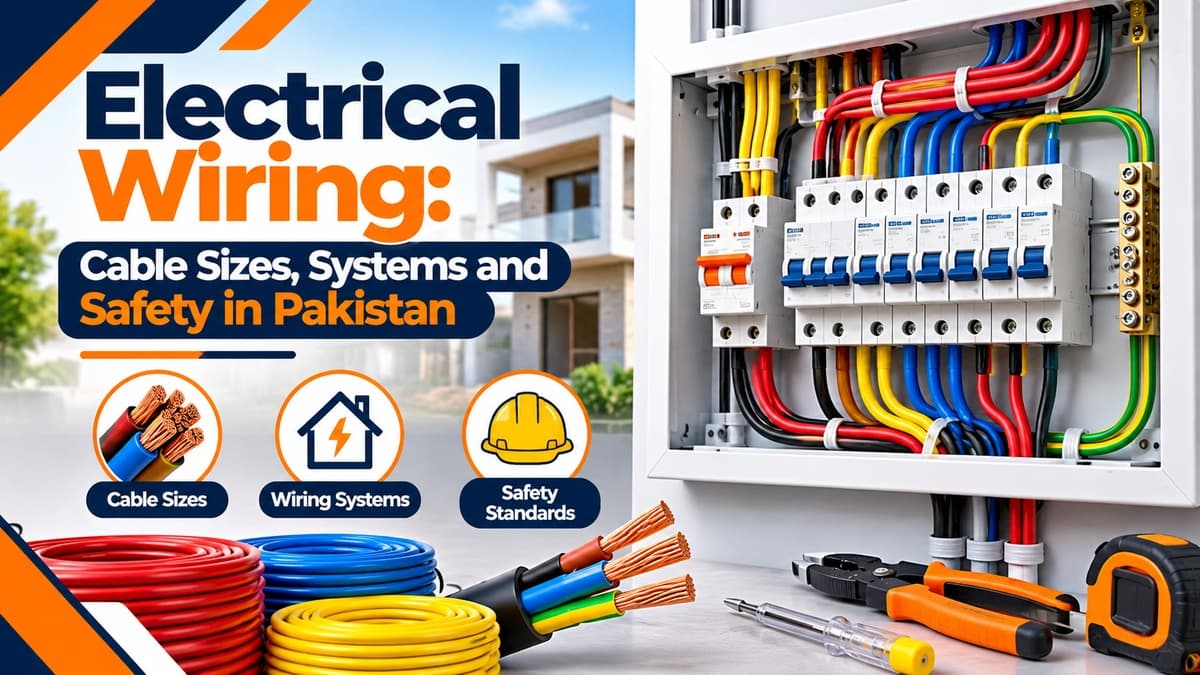
Good electrical wiring starts with a plan, not a cable purchase. In a home, the distribution board feeds separate circuits for lighting, sockets, and larger appliances. Cable size, circuit protection, earthing, and installation conditions all affect safety.
A cable that works well in one location may not be suitable in a hot conduit carrying several loaded circuits.
This guide explains the main parts of a wiring installation, compares common cable-routing methods, and shows how electricians assess cable sizes and voltage drop. It also covers three-phase labels and practical buying checks for Pakistan.
The tables are educational examples, not ready-made circuit designs. A qualified electrician must assess the site, apply the relevant local rules and test the finished work.
Quick answers
Home wiring uses live and neutral conductors where required, with a protective earth and suitable circuit protection. Some circuits and systems have different arrangements.
Cable sizes such as 1.5, 2.5, 4, 6 and 10 mm² are common, but appliance type alone does not determine the right size.
Three installation types: surface wiring, concealed conduit wiring, and trunking or cable tray.
L1, L2, and L3 identify the three line conductors in a three-phase supply; nominal voltages depend on the supply system.
The essentials are proper circuit design, protective devices, reliable earthing, and testing by a qualified professional.
How Electrical Wiring Works in a Home
Electricity enters through the service connection and is distributed to individual circuits by the distribution board. The live conductor supplies the load, while the neutral provides a return path in a typical single-phase circuit.
A protective earth normally carries no operating current; it helps protective devices disconnect the supply if a fault makes exposed metalwork live. Not every circuit has the same conductor arrangement.
Most of the wiring disappears behind plaster or ceilings, making early decisions important. Cable cross-sectional area, insulation type, installation method, temperature and grouping all influence the current a cable can safely carry.
Essential Parts of a House Wiring System
Copper Cables: Solid, Stranded and Flexible
For fixed wiring, installers commonly use appropriately rated copper conductors with insulation suited to the installation. Solid, stranded and fine-stranded flexible conductors serve different purposes.
A flexible appliance lead is not automatically suitable for concealed fixed wiring. Always check the cable marking, relevant standard and manufacturer datasheet before buying. Building and finishing.
Avoid judging a cable by appearance alone. Copper-clad aluminium and aluminium have different electrical and termination requirements from copper. Check the declared conductor material, actual cross-sectional area, certification, and suitability for the intended circuit.
Surface, Concealed and Trunking Wiring Compared
The route matters as much as the cable. Homes commonly use concealed conduit, while surface conduit and trunking can be practical for renovations or commercial buildings.
Concealed conduit gives a neat finish, but replacing cables later depends on the conduit layout, bends, and available space. Surface installations are easier to access, although they need suitable mechanical protection. In every case, the installer must account for moisture, heat and damage risks.
Electrical Wiring Cable Sizes: What Affects the Choice?
Start with the connected load, protective device and installation method, then check temperature, cable grouping, voltage drop and fault protection. The table below reproduces example values attributed to BS 7671 Table 4D2A for specified PVC-insulated copper cable arrangements.
They are not universal ratings: a different cable construction or installation method can change the result.
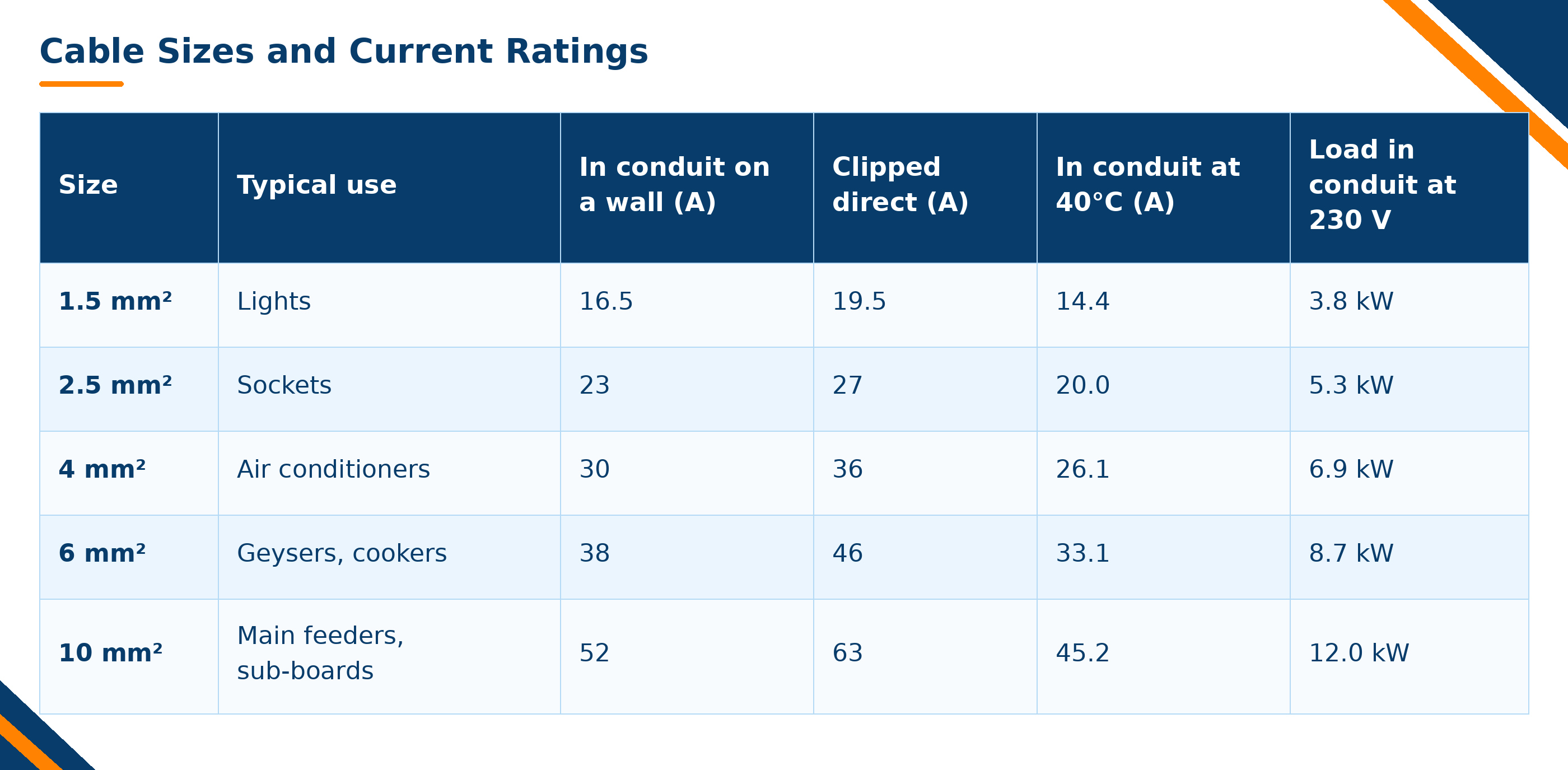
Do not treat the table as a shopping chart. In hot weather, cable current-carrying capacity can fall, especially where circuits are grouped.
The protective device must be coordinated with the cable and installation conditions; its selection also depends on the circuit design and fault protection requirements.
Worked Example: Checking Voltage Drop
For an illustrative 20 m circuit carrying 16 A, a tabulated value of 18 mV/A/m gives 18 × 16 × 20 = 5,760 mV, or about 5.8 V. That is roughly 2.5% of 230 V.
With an 11 mV/A/m value, the result is about 3.5 V. The correct limit and calculation method depend on the applicable rules, circuit, and installation; a designer must check the full run.
Lighting and Socket Circuits: 1.5 mm² and 2.5 mm²
A 1.5 mm² copper cable may be suitable for some lighting circuits, but its suitability depends on the wiring method, circuit load, protective device, and local conditions. Check the Newage product specification rather than choosing from the appliance label alone.
Newage Cables 1.5 mm standard wiring cable socket circuits can serve very different loads. A 2.5 mm² cable is common in some installations, but circuit arrangement, socket rating, cable route, and protective device must all be checked.
The Newage listing is a product example, not a substitute for design. Newage Cables 2.5 mm standard wiring cable.
Air Conditioners and Heaters: When 4 mm² or 6 mm² May Be Needed
Air conditioners often benefit from dedicated circuits. Before selecting a 4 mm² cable, an electrician should check the equipment nameplate, manufacturer instructions, starting characteristics, cable run, and installation conditions. Fast Cables 4 mm standard wiring cable.
Water heaters and cookers can draw substantial current. A 6 mm² cable may suit some circuits, but the required size is determined by the actual appliance load and design checks, not by the appliance category, along with Fast Cables 6 mm wiring cable.
Main Feeders and Sub-Boards: Assessing 10 mm² Cable
A feeder may carry several circuits, so its design starts with maximum demand, diversity, protection and the route between boards. A 10 mm² cable is only one possible option; larger or smaller conductors may be appropriate after calculation. Fast Cables 10 mm wiring cable.
Where Flexible Cable Is Appropriate
Flexible cable is intended for equipment and connections that require movement, provided its rating and construction suit the use. Do not substitute an appliance flex for fixed wiring inside walls unless the relevant installation rules and manufacturer specifically permit it. Fast Cables 2.5 mm flexible cable.
Single-Phase vs Three-Phase Wiring in Pakistan
A typical low-voltage supply is described nominally as 230 V phase-to-neutral and 400 V phase-to-phase at 50 Hz. Many homes use single-phase connections, while larger properties and motor loads may need three-phase. Actual supply conditions and service arrangements should be confirmed with the utility and installer.
Understanding L1, L2 and L3 Labels
L1, L2 and L3 identify the three line conductors in a three-phase system. In a typical 230/400 V system, each phase measures about 230 V to neutral and about 400 V to another phase.
Some three-phase circuits do not use a neutral. Identification and testing must be carried out by a qualified person.
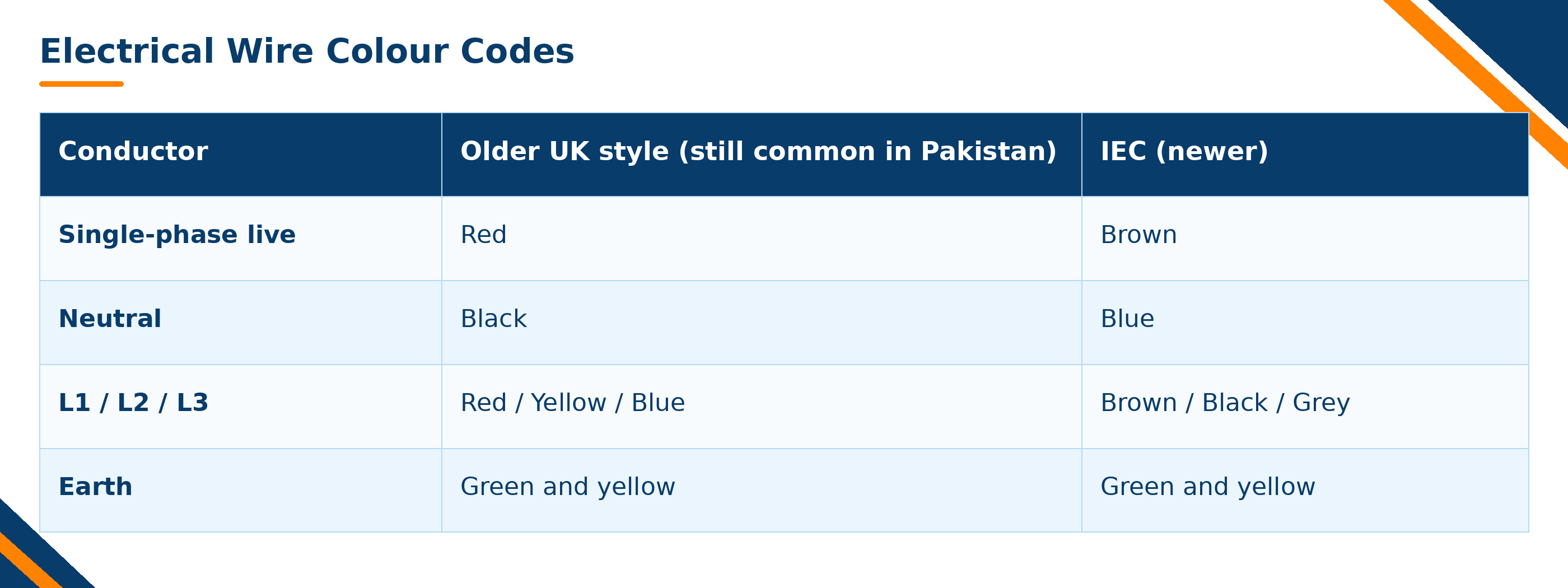
Colour conventions vary by age, equipment and installation. Older colour schemes may be present alongside newer IEC-marked equipment. Never identify a conductor solely by insulation colour; an electrician must verify it using appropriate safe testing procedures.
For a balanced three-phase load at the same line current and nominal voltage, the apparent-power calculation is √3 × 400 × 32 ≈ 22.2 kVA. A 230 V single-phase calculation at 32 A gives about 7.4 kVA. Actual usable power depends on power factor and system conditions.
Electrical Wiring Safety Checks Before Installation
Have a qualified electrician isolate the supply, secure it against reconnection, and prove the circuit is dead using approved test procedures.
Coordinate cable size, installation conditions and circuit protection; do not select a breaker by appliance name alone.
Ask the electrician to assess RCD/RCBO protection, including 30 mA additional protection where required by the applicable rules.
Provide effective protective earthing and bonding as required by the installation design.
Buy correctly rated cable from a traceable supplier and check markings and documentation.
Keep connections in suitable accessible enclosures or use a permitted maintenance-free system where applicable.
Protect cable routes against heat, moisture, abrasion and accidental damage.
Avoid overloaded extension leads and poorly rated multi-plug adaptors.
Ensure terminals are correctly specified and tightened to the manufacturer’s instructions.
Have the installation inspected and tested, including appropriate continuity, insulation and protective-device tests, before use.
How to Check Electrical Cables Before Buying
Ask for the manufacturer, conductor material, nominal cross-sectional area, insulation type, voltage rating, and applicable standard. Check the packaging and cable markings against the datasheet. Appearance or coil weight alone cannot prove conductor quality or compliance.
Bulk cable listings may have minimum order quantities and delivery charges that vary by seller and location. Confirm the current terms on the individual Zarea product page. For a home project, ask the electrician for a circuit schedule and quantities before ordering.
Frequently Asked Questions About House Wiring
Can I use the same cable size for lights and sockets?
Not automatically. Lighting and socket circuits can have different loads, protective devices, and installation conditions. A qualified electrician should calculate the requirements rather than applying one size across the house.
Does a thicker electrical cable always make a circuit safer?
No. Cable sizing matters, but so do correct protective devices, sound connections, earthing, and installation methods. Oversizing one conductor cannot fix a poorly designed or incorrectly protected circuit.
Why does cable temperature matter in Pakistan?
High ambient temperatures and grouped cables can reduce the current a cable can safely carry. The installer must apply the relevant correction factors and consider the actual route before selecting a size.
Will an on-grid solar system keep house circuits powered during an outage?
Not necessarily. A standard grid-tied solar inverter normally disconnects when the grid fails. Backup operation requires equipment designed and installed for that purpose, with appropriate isolation and protection.
Wrap Up
Good wiring is rarely about one “best” cable. It comes from matching the load, cable, route, protective device, and earthing arrangement, then checking the installation through proper testing.
Before buying cable or closing up walls, get a qualified electrician to review the circuit plan, confirm the applicable standards, and document the test results.