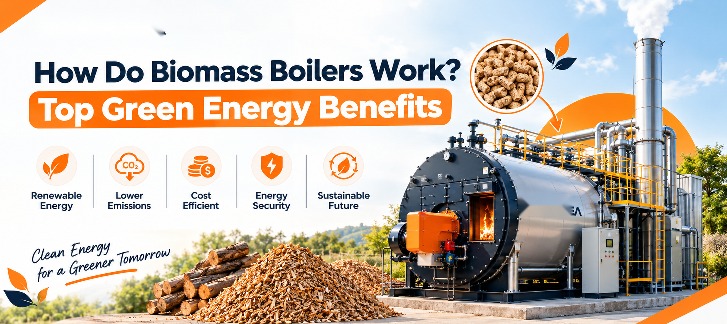
How Do Biomass Boilers Work? Top Green Energy Benefits
Discover how biomass boilers work and explore the top green energy benefits of switching to renewable heating. Lower your carbon footprint and energy bills today!
Introduction:
Finding a heating system that balances economic reality with environmental responsibility. So it can feel like a tightrope walk. Because traditional fossil fuels are vulnerable to volatile market prices. While these fuels also carry a heavy carbon footprint with them.
First you have to enter the biomass boiler. Because this renewable heating alternative offers a practical and high-efficiency path to energy independence. Whether you are looking for small-scale residential biomass boiler setups. Or are you looking for a heavy-duty industrial biomass boiler for commercial operations? But before that, you must understand how this technology works. Because it is the first step toward a cleaner future.
What is a Biomass Boiler?
A biomass boiler is a type of unique heating system. Because it burns organic materials to generate heat and hot water for use. While standard boilers rely on finite fossil fuels like natural gas and heating oil. Sometimes they also rely on liquid petroleum gas (LPG) and biomass systems that run entirely on renewable energy. Or it can consume biological materials sometimes.
The mechanics are remarkably straightforward. Solid biomass fuel is fed into a specialized combustion chamber. Once ignited, the burning material heats a integrated water element. This hot water is then circulated through your building's central heating system—whether that means traditional radiators or modern underfloor heating loops. It also supplies your taps with domestic hot water.
While manual log-burning models exist, modern systems are highly automated. Digital control panels monitor heating demands, adjusting the automated fuel feed via a motorized auger to maintain consistent temperatures with minimal human intervention.
Advantages of Biomass As Fuel:
Switching away from fossil fuels offers you several distinct advantages. Because it's made of biological matter. That's why it's an exceptionally smart fuel choice for you overall.
1) Carbon Neutrality: Biomass is widely considered a carbon neutral fuel in the industry. So when trees and plants grow somewhere else. They absorb carbon dioxide (CO2) from our atmosphere. Therefore, when they are burned as fuel in a boiler. Then they released that exact same amount of CO2 back into the air. This cycle creates a closed loop and is unlike fossil fuels. Therefore this cycle introduces ancient and trapped carbon into our modern atmosphere.
2) Economic Stability: The cost of wood pellets and chips or wood logs remains significantly more stable than gas and oil. Therefore this kind of fuel can often be sourced locally. While it also shields consumers from global geopolitical energy crises.
3) Waste Reduction: So much of the fuel used in these systems is a by-product of local forestry management. Or it is also a by-product of the manufacturing industry. Therefore, some leftover sawdust and fallen timber are also repurposed into valuable energy or agri waste into energy. Same as wood scraps they do the same job instead of rotting in a landfill.
Types of Biomass Fuels:
The types of biomass fuel is not a one-size fuel that fits all solution. Because it depends on the size of your property and your heating infrastructure. So you will generally choose between three primary fuel formats according to your needs:
1) Wood Pellets: These are compressed cylinder type pellets that are made from recycled sawdust. Or it can manufactured from wood waste. Pellets are not only uniform in shape but also in their moisture content. So pellets have these qualities which make them ideal for automated systems. Because this system is self-feed that uses an internal hopper as well.
2) Wood Chips: This material is sourced from forestry waste and wood thinned chips. While this material is typically used in high-capacity settings.
3) Logs: Plain firewood is the most traditional option for logs. Log-burning systems depend on manual loading, which requires a large and dry storage area to keep them safe. But they are incredibly cost-effective for bulk purchases. Especially if you have access to cheap or free local timber supplies in your area.
Want to Know About Biomass Boilers? How They Maximize Efficiency:
When evaluating any heating system, performance metrics are everything. A common question homeowners and facility managers ask is: Just how efficient are these systems?
Modern biomass boiler efficiency is genuinely impressive. Because its efficiency frequently ranges between 85% and 95%. This means nearly all of the energy stored within wood fuel is successfully converted into usable heat for your property.
Advanced engineering makes this possible. Advanced hi-efficiency models deploy a secondary combustion mechanism in a boiler. While this mechanism reignites the gases that are produced during the primary wood combustion phase. Furthermore, it incorporates a thermal storage unit into a well-insulated water reservoir. This reservoir enables the system to maintain its peak operational efficiency for extended periods. Because there's an accumulated surplus of heated water for immediate distribution. You can use it when your home requires warmth.
Wrong Perception: Debunking the Myths:
There are several stubborn misconceptions that prevent people from embracing biomass and agri biomass technology. Despite some of their growing popularity and usage. Let’s set the record straight about the two most common myths.
Myth 1: "Biomass causes heavy air pollution"
People often equate biomass heating with old and smokey wood stoves. But in reality, modern automated boilers use sophisticated oxygen sensors and computer-controlled fans. They can do it to ensure nearly complete combustion. This precision engineering keeps particulates emissions incredibly low in boilers. Because they meet strict modern clean air standards.
Myth 2: "Wood burning drives deforestation"
High-quality wood pellets and chips are not sourced from clear-cutted pristine forests. Instead, they are made from residual waste that is generated from sawmills. Or they are harvested from certified and sustainably managed woodlands. Those woodlands where new trees are continuously planted to replace those harvested trees.
The Future of Biomass Boilers:
Where global energy grids are transitioning away from fossil fuels. Same as their role in biomass is set to expand dramatically with them. Because fossil fuels' future will always belong to hybrid biomass energy ecosystems. We are already seeing biomass systems paired with solar thermal panels and heat pumps to create completely self-sufficient, off-grid heating networks.
On a larger scale, the adoption of the industrial biomass boiler is accelerating across manufacturing plants, agricultural facilities, and district heating schemes. By localizing energy production and utilizing regional agricultural byproducts, communities are building highly resilient, circular economies that are entirely insulated from fossil fuel shortages.
Biomass technology investment is more than just an alternative way to warm a building. Because it is a proven and high-efficiency commitment to your sustainable living. While this commitment protects both our financial bottom line and our planet as well.
Wrap Up:
Transitioning to a biomass-based heating system represents a strategic investment. While this investment effectively reconciles our environmental stewardship with our financial viability. Because you are meaningfully decreasing your environmental impact with it. While establishing enduring energy autonomy as well. Only when you substitute renewable wood pellets and chips into a biomass boiler. Or you substitute wood logs for unstable and high-carbon fossil fuels. The choice is yours. Whether you are talking about residential retrofits or large-scale industrial biomass boiler installations. Or you are talking about contemporary systems that deliver exceptional efficiency. Because it minimizes both energy consumption and operational expenses for yourself.
As environmental regulations become more stringent or your energy infrastructure transforms over time. But adopting renewable thermal solutions establishes your facility as a leader. Especially when you talk about sustainable energy adoption in biomass fuel. Because this initiative fundamentally shifts your energy consumption from a conventional linear model to a regenerative one. Or it can shift your energy consumption to a closed-loop framework.
Although initial deployment demands thorough assessment and adequate space for fuel storage. Yet, cumulative advantages always flourish with them. This includes predictable fuel costs. Because it reduce greenhouse gas emissions as well. Where it also reduces consistent high-performance heating in your boiler. Because they position biomass technology as a dependable choice. Same as they position it as an evidence-based approach to achieving environmental and operational excellence at the same time.
FAQ's:
What is a biomass boiler?
A biomass boiler represents a heating apparatus which combusts organic materials that are classified as biomass fuel. This includes wood pellets, wood chips, timber logs. This system functions as an alternative to conventional fossil fuels. Because it delivers centralized heating and domestic hot water services.
What are the disadvantages of biomass boilers?
Biomass boilers present several significant drawbacks. These encompass substantial initial capital expenditure on installation. While it also has some considerable spatial demands on fuel storage capacity. Additionally, some routine manual maintenance operations are also required in the. Especially including the removal of accumulated ash from collection bins, which are required for this kind of operation.
Is a biomass boiler worth it?
A biomass boiler typically represents a worthwhile investment for individuals residing in off-grid rural locations. Particularly when the property currently depends on heating oil or liquefied petroleum gas for thermal energy. Additionally, the installation proves advantageous when the premises provide adequate space. Especially for storage of wood pellets, wood chips, or timber logs to store them well.