Portable Solar Panels: How to Choose the Right One
What portable solar panels actually do, which wattage fits camping vs backup power, and when to step up to a full solar system.
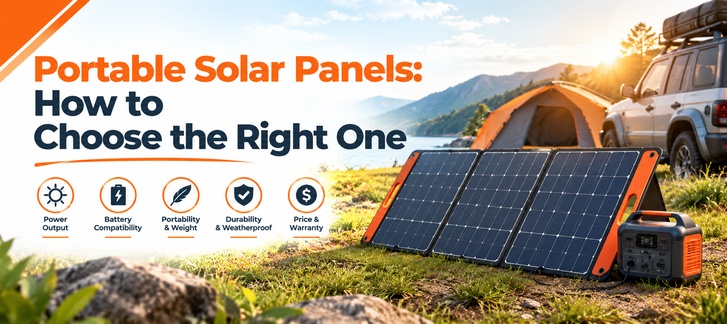
A portable solar panel is pretty much exactly what it sounds like: a small, lightweight, usually foldable photovoltaic unit built to generate electricity wherever the grid isn't.
Charging a phone on a hike, running a power bank at the campsite, topping up a portable power station when the power goes out- that kind of thing. Nothing about it is bolted down to a roof. That's really the whole point of it.
Where it gets a bit messier is that "portable solar panel" ends up covering a lot of ground, everything from something that folds small enough to fit in a jacket pocket to a briefcase-sized unit you'd only carry as far as the car to the campsite and back.
Most people end up buying the wrong size for what they actually need, which is really the reason this guide exists: to walk through the main types, what's actually worth comparing, and where a genuinely portable panel stops and a full-size off-grid setup begins.
What Counts as a Portable Solar Power Panel?
Really, it comes down to three things: size, weight, and how it actually connects to whatever you're charging. Rooftop panels are rigid, heavy, wired permanently into an inverter and the grid, not going anywhere once installed.
Portable ones are the opposite, built to be picked up and carried, usually foldable, and they output through USB ports, DC connectors, or MC4 connectors depending on what's on the other end.
For anyone who wants the fuller picture, this guide to the different types of solar panels covers where portable units sit next to the rooftop and ground-mount kind.
Worth saying too, "portable" isn't really one size. It runs from something you'd barely notice clipped to a backpack strap all the way up to a fold-out array that takes both hands and a flat bit of ground to set up.
Portable Solar Panels for Camping, Broken Down by Size
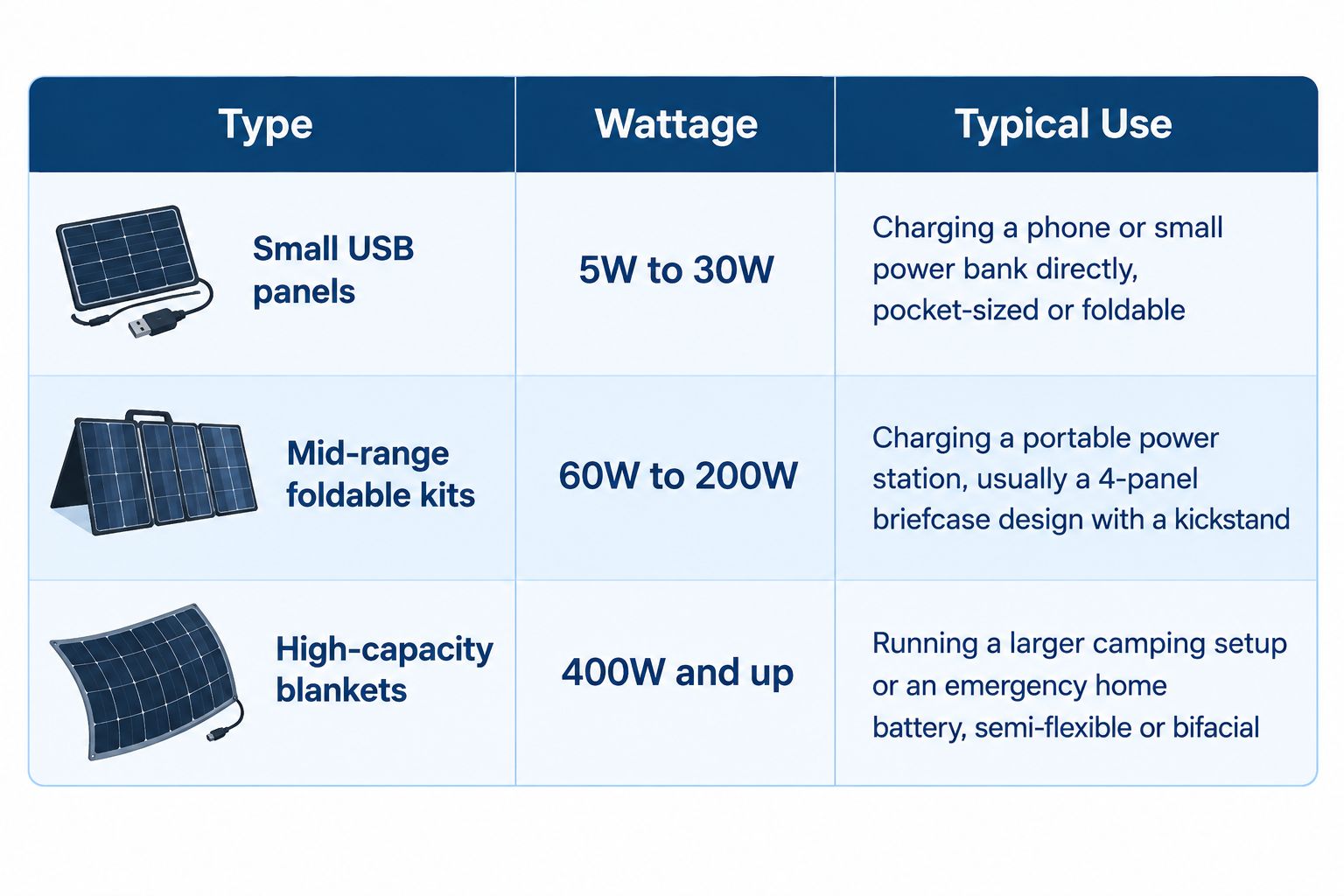
A 20W panel does the job for keeping a phone topped up on a weekend hike. It won't come close to running a cooler or charging a laptop at any reasonable speed.
That's where the wattage jump to a mid-range kit starts to matter, and it's the size most people actually mean when they search for portable solar panels for camping.
For anyone using a portable panel as a stopgap during a power cut rather than purely for a trip, it's worth understanding how that differs from a proper backup setup at home. This breakdown of off-grid vs. on-grid solar walks through that distinction in more depth.
1- Portability vs. Power
This is really the core trade-off with every portable panel. A 30W unit fits in a backpack without you noticing it's there. A 200W panel generates a lot more usable power but is realistically something you carry a short distance from a car, not on a multi-day trek.
There isn't a version that's small, light, and high-output all at once; that combination doesn't really exist yet at a price anyone reasonable would pay.
2- Weather Resistance
Anything that's going to sit outside needs an IP rating that actually matches how it'll be used. IP65 handles rain and dust reasonably well. IP68 goes further and is worth paying for if the panel's going to see genuinely rough weather rather than the occasional light shower.
3- Connector Compatibility
Before buying anything, check what the panel actually plugs into. USB-C output suits phones and small electronics directly. MC4 connectors are standard for pairing with a portable power station or larger battery bank.
Getting this wrong means buying an adapter after the fact, or worse, a panel that simply can't
connect to the power station you already own.
What Actually Makes One of the Best Portable Solar Panels for You
There's no single best portable solar panel out there, just the right one for whatever you're actually trying to do with it. Someone charging a phone on a weekend hike and someone trying to keep a fridge and a few lights running through a multi-day power outage need completely different setups, even if both of them would describe what they want as "a portable solar panel."
For phones and small electronics on the move, a 20 to 30W folding panel does the job just fine and won't weigh your pack down.
For a weekend at the campsite charging a power bank or small power station, a 60 to 100W kit is the realistic sweet spot.
For emergency backup at home or a longer stretch off-grid, 200W or more starts to make sense, though at that point weight isn't really the main concern anymore.
When Portable Isn't Big Enough Anymore
Here's the honest bit a lot of portable solar guides skip. If you need enough power to run a fridge continuously, back up a home during load-shedding, or supply an off-grid property, no portable panel gets you there, no matter how many high-capacity blankets you chain together.
At that point you're not looking for something to fold into a bag; you're looking at a proper fixed solar installation, and that's a different category of product entirely.
Zarea's solar category lists full-size panels from major manufacturers for exactly this kind of setup, sold for bulk and installation use rather than as something you'd pack for a hike.
Panels from Canadian Solar, Trina Solar, JA Solar, Jinko Solar, and LONGi Solar are all rigid, high-wattage panels built for rooftop or ground-mount setups, and they're usually sold in bulk rather than as a single portable unit you'd toss in a backpack.
Worth being upfront about that, since these are genuinely different products from what someone picturing a folding camping panel usually has in mind.
Pairing panels with the right battery matters just as much as the panels themselves, which this comparison of Pakistan's top solar batteries covers in more depth.
Frequently Asked Questions
Do portable solar panels really work?
Yes, within what they're actually built for. A small portable panel will genuinely keep a phone or power bank charged on a sunny day, and a mid-range folding kit will keep a portable power station topped up over a camping trip.
What they won't do is replace a proper household power supply, and cloudy weather, poor panel angle, or shade cuts output noticeably. Judged against what they're designed for rather than what people sometimes assume they can do, they hold up well.
What can I run off a 1000 watt solar panel?
With decent sun, roughly 4 to 5 peak hours a day, a 1000W setup produces somewhere around 4 to 5 kWh over the course of a day. Paired with a battery, that's enough for a small fridge, LED lighting, phone and laptop charging, and a few small appliances used intermittently, though not all running flat out at the same time.
It's worth remembering the panel alone only generates power while the sun's actually on it, so running anything after dark or on demand means the power needs to be stored in a battery first.
How long do portable solar panels last?
A well-built portable panel will usually give you several years of regular use, but here's the catch: the same foldable, lightweight design that makes it portable in the first place also makes it less rugged than a rigid panel bolted to a roof.
How you store and handle it between trips ends up mattering more than most people assume. Panels tossed folded up while still wet, or crushed at the bottom of a bag, tend to wear out a lot faster than ones that get dried off and packed properly.
What size portable solar panel do I need for camping?
For a typical weekend camping trip, something in the 60W to 100W range usually covers you, phones, a power bank, maybe a small light setup, without being a pain to lug around.
If you're bringing along a portable power station and want it charging faster, or you're running a bit more gear, you're better off looking at 100W to 200W instead.
Wrap Up
The right portable solar panel really just comes down to matching wattage to what you're actually trying to charge, not chasing whatever the biggest available option is.
A 20W panel is perfect for a phone on a hiking trail and completely wrong for backup power at home, and the reverse is just as true.
Figure out the actual load first, then shop for the panel, rather than the other way around.