Transit Trade: How It Works and Why It Matters for Pakistan
What transit trade actually means, how APTTA works, and how Pakistan's transit routes to Afghanistan and Central Asia have shifted in 2026.
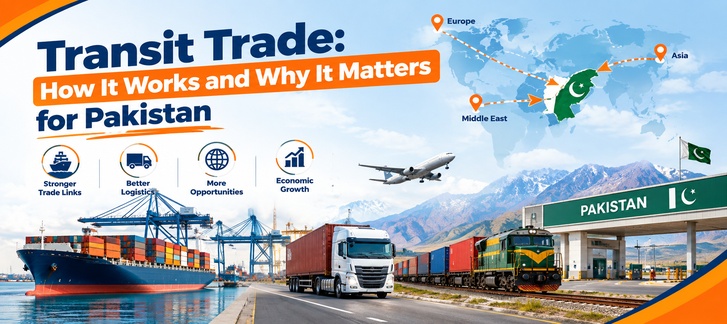
Transit trade is when goods move through a country that's neither where they were made nor where they're actually headed, passing through on their way to a final destination without ever entering the local economy.
A shipment bound for landlocked Afghanistan that comes off a ship in Karachi and rolls straight across the border by truck never becomes part of Pakistan's domestic market; it's just passing through, and that distinction is what the entire system is built around.
For a country like Pakistan, sitting next to a landlocked neighbour and within reach of Central Asia, this isn't a minor customs technicality. It's a genuine strategic asset, and one that's been shifting noticeably through 2026 as new routes open up and old ones face pressure from alternatives.
This guide covers how transit trade actually works, Pakistan's specific role in it, the agreement that governs most of it, and what's actually changed recently.
It's worth separating this from ordinary cross-border commerce too.
Anyone actually setting up an import-export business is buying and selling goods that enter and exit their own country's economy directly, which is a different process from goods simply passing through on their way somewhere else.
What Is Transit Trade?
Here's the simple version, once you drop the customs-speak: goods move through a country that's not where they came from and not where they're going; that's the transitor travelling by truck, rail, or plane.
Sometimes they sit for a while in a bonded warehouse or free port along the way. They're never sold or used there, so they skip that country's import duties while they're just passing through.
Because they're never released for sale or consumption inside that transit country, they typically bypass local import duties and tariffs entirely while they're passing through.
This is different from a re-export, where ownership of the goods actually changes hands within the transiting country before they move on.
In genuine transit trading, the goods usually stay under the ownership of a party based outside the country they're passing through, which is also why transit shipments generally don't show up in that country's own import or export statistics the way a normal trade transaction would.
How Transit Trade Services Actually Work
I like to think of transit trade as a land bridge; it connects a landlocked country to the sea, or lets cargo dodge a border it couldn't otherwise cross. But that bridge doesn't hold up on its own.
You need the goods sealed under customs bond for the entire trip, somewhere at the port or border to store cargo without duty kicking in, and a legal agreement between the countries that actually lets any of this happen in the first place.
In practice, this is why most businesses don't try to handle it themselves. A transit trade service takes care of the paperwork, the bonded transport, the customs coordination, because one small mistake- a missing seal, an expired bond, a document that's slightly off- can leave a shipment sitting at the border for days.
Zarea's own trade services cover exactly this kind of international trade facilitation, so businesses can move goods across borders without having to manage every customs relationship on their own.
Pakistan's Role as a Regional Transit Trade Corridor
Geography does most of the heavy lifting here. Karachi and Port Qasim are simply the shortest sea route landlocked Afghanistan has, and Gwadar gives the region a second deep-water port further west, one that could eventually cut the overland distance to Central Asia compared to the old route through Afghanistan.
Between the three of them, Pakistan ends up sitting right in the middle, linking South Asia's coastline to a set of landlocked countries that would otherwise be looking at longer, pricier, more roundabout routes to reach the sea.
It's worth remembering this is just one piece of a bigger picture, though. Goods don't just appear at a port; they've usually come from somewhere much further back in the chain.
Our explainer on the commodity chain concept walks through that whole journey, from raw production to the end buyer, with transit corridors like Pakistan's being one stop along the way rather than the whole story.
The Transit Trade Agreement Behind Most of This: APTTA
Most of this trade runs on a deal called APTTA, the Afghanistan-Pakistan Transit Trade Agreement, signed back in 2010 and in effect since 2011. Before that, an older 1965 agreement was in place, and it wasn't exactly fair: Afghanistan got duty-free passage through Pakistani ports, but Pakistan never got the same courtesy going the other way toward Central Asia. APTTA was basically Pakistan's fix for that imbalance.
Under APTTA, Afghan cargo can move through Pakistani territory using Afghan-owned trucks all the way to Pakistani seaports and the Wagah border, rather than transferring cargo to Pakistani carriers partway through.
In return, Pakistan gained a legal route to reach Uzbekistan, Tajikistan, and the other Central Asian republics through Afghan territory, something the 1965 agreement never provided for.
Volumes through this corridor haven't stayed flat, though. Political shifts in Afghanistan, border closures during periods of tension, and the growing availability of alternative routes through Iran have all pulled some transit trading away from the traditional Pakistan corridor in recent years, even as the underlying agreement remains in place.
Cargo volumes aside, it's the underlying commodity prices that actually decide whether a given route is worth using at all. Zarea's daily commodity prices track exactly this kind of shifting local data across categories that regularly move through these corridors.
Recent Expansion: New Routes and Shifting Regional Dynamics
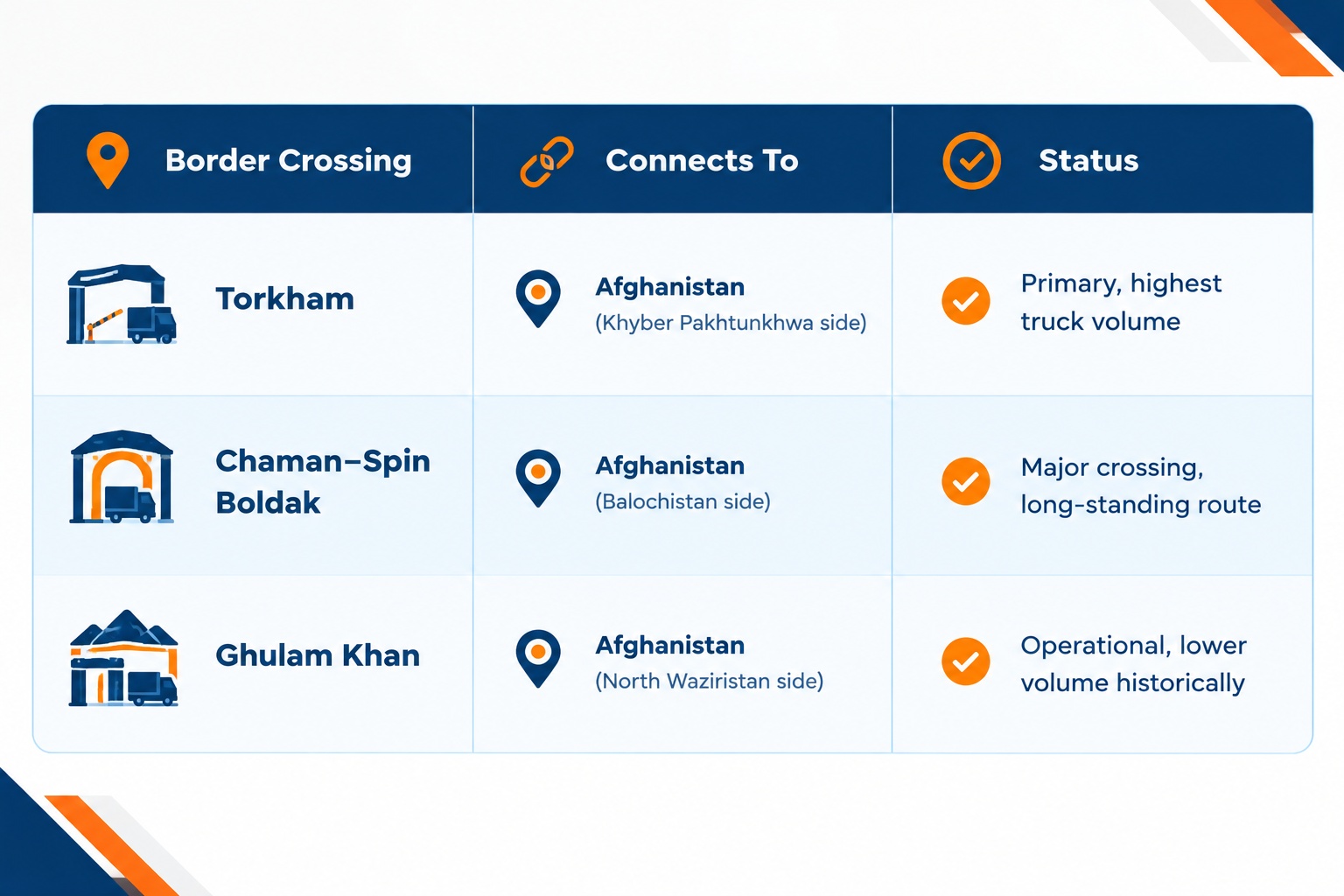
With Torkham shut and no real sign of when that changes, Pakistan went looking for other ways to move goods. Uzbekistan was one answer. Back in February 2026, the two countries sat down and agreed to speed up cooperation on trade, investment, and connectivity, with a $2 billion trade target attached and real talk about alternative transport corridors. Nobody pretended the old route wasn't the reason this conversation was happening.
The bigger, more practical change came from the Ministry of Commerce. From March 24 to June 21, 2026, exporters shipping through Iran toward Central Asia and Azerbaijan got a break, no bank guarantees, no letters of credit required.
Mostly agricultural goods qualified: rice, potatoes, meat, onions, maize, fruit, a few pharmaceuticals thrown in. And officials didn't dress it up as some grand trade strategy, they said plainly it was about the Afghan border being closed.
A good chunk of what would normally travel through these corridors is exactly this kind of produce. Zarea's guide to agricultural commodities covers how these goods get classified and priced before they ever reach a border crossing.
Coal tells a similar story, just in the other direction. Afghan coal coming into Pakistan used to be a steady piece of cross-border trade, and it's been squeezed along with everything else now that the border's largely shut.
One thing worth checking before this goes live: Zarea's own Afghan coal listing should be confirmed against current sourcing, since this is exactly the kind of supply chain the closures have hit.
Correcting a Common Mix-Up: There Is No "Export Policy Order 2026"
This is worth addressing directly, since the search term comes up often enough to cause real confusion. As of the Ministry of Commerce's own published records through mid-2026, the document actually in force is still the Export Policy Order, 2022, the same one referenced on the Ministry's official policy page as recently as May 2026. There's no separate, standalone "Export Policy Order 2026" that has replaced it.
What has genuinely happened in 2026 is a series of amendments and time-limited notifications issued under that existing 2022 Order, including the Iran and Central Asia export easing measure mentioned above.
The cleanest way to think about it: there's no brand-new policy document. It's still the 2022 Export Policy Order doing the governing, just with a few relief measures bolted on as regional trade conditions keep shifting.
Frequently Asked Questions
What are the key points of the Pakistani Export Policy Order 2026?
There's no such thing, actually, no separate Export Policy Order 2026. The Ministry of Commerce's own policy listings still point to the 2022 Export Policy Order as the document in force. What's actually changed this year are a few amendments and temporary notifications tacked onto that same 2022 order, the biggest one being a March-to-June exemption that dropped the bank guarantee and letter of credit requirements for exports going through Iran to Central Asia and Azerbaijan.
What is meant by transit trade?
Transit trade means goods moving through a country other than where they were produced or where they're ultimately headed, without entering that transit country's own economy for sale or consumption. They typically move under customs bond and bypass local import duties, since they're only passing through on the way to a final destination elsewhere.
What is the trade of commodities?
Commodity trade is the buying and selling of raw or semi-processed goods, things like grains, metals, energy products, and agricultural produce, generally treated as interchangeable regardless of which specific supplier produced them. It's related to transit trade in that a large share of what physically moves through transit corridors, coal, grain, fuel, is commodity cargo rather than finished consumer goods.
What is a transit shipment?
A transit shipment is a specific consignment of goods moving through a country under customs control, on its way from an origin outside that country to a destination outside it as well. It travels under bond or seal, gets tracked by customs the entire way through, and is cleared for onward movement rather than for local delivery.
Wrap Up
Transit trade only looks like a dry customs concept until you see how much regional weight it actually carries, Pakistan's ports, its border crossings, and the agreements governing them are quite literally what connects a landlocked Afghanistan and parts of Central Asia to the rest of the world's shipping lanes.
That role has been shifting through 2026, not disappearing, as new routes through Iran and renewed Central Asian cooperation open up alongside the traditional corridor rather than replacing it outright.