Activated Carbon: What It Is, How It Works, Uses and Price
Discover what activated carbon is, how it works, its types, uses, and prices. Compare grades and learn how to choose the right one.
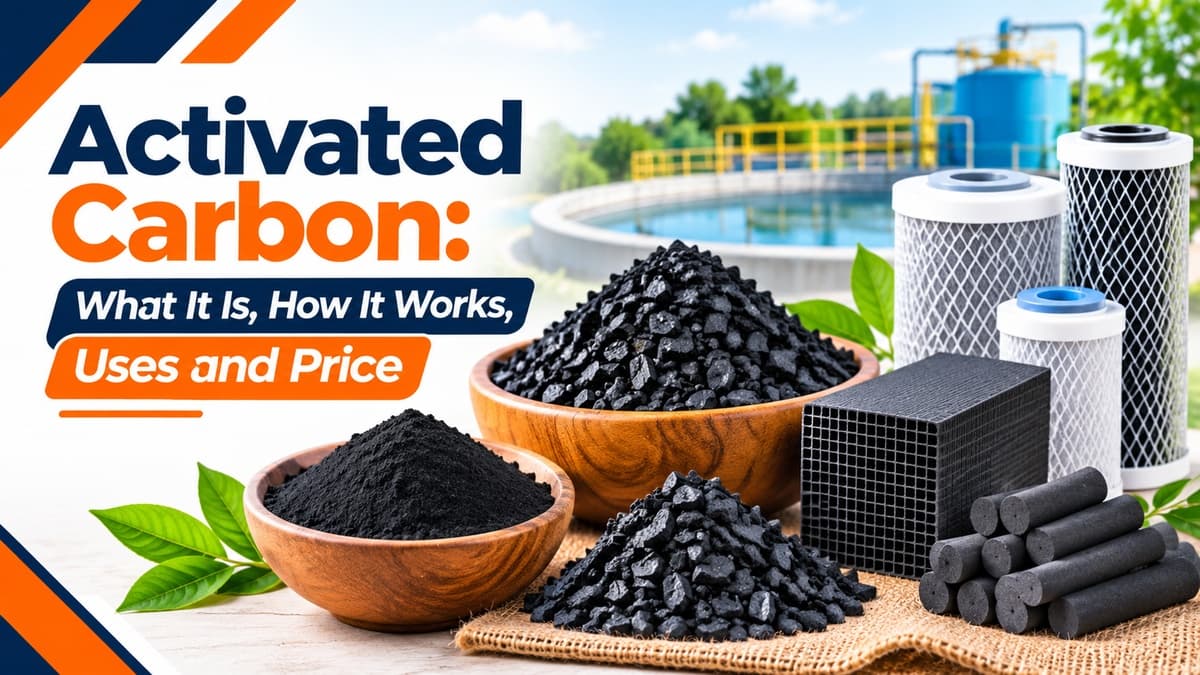
Activated carbon is charcoal processed to fill it with microscopic pores, giving it an enormous internal surface area, typically 500 to 1,500 square metres per gram.
Chlorine, dyes, solvent vapours, and many organic compounds stick to that surface instead of passing through, so it cleans water, air, food ingredients, and even gold-bearing solutions.
In 2026, supplier-published prices for bulk powder and granular grades run from about $375 to $4,000 a tonne FOB China, depending on the raw material and the grade.
This guide explains what it is, how it works, the main types, the uses that matter, what it does and doesn’t do for your body, current prices, and what to ask a supplier before you order.
The science comes from published research and clinical references, and the price data comes from suppliers, so treat prices as signposts and ask for a live quote.
Quick Answers
1) What it is: carbon with a huge network of tiny pores, made from coconut shell, coal, wood, or other plant material.
2) How it works: by adsorption. Molecules stick to the surface of the pores rather than soaking into the carbon.
3) Main forms: powdered, granular, and pelletised, plus impregnated and fibre grades for special jobs.
4) Main uses: drinking and wastewater, air and gas cleaning, gold recovery, food decolourising, and emergency poisoning treatment.
5) Price signpost: coal-based granular carbon from roughly $500 to $1,200 a tonne FOB China, coconut shell from about $1,500 to $4,000.
What is Activated Carbon?
Activated carbon, also sold as activated charcoal, is a porous form of carbon with a large internal surface area. The iodine number (ASTM D4607) is a useful quality indicator for some grades, but it is not a direct measurement of BET surface area and cannot, by itself, predict removal of every contaminant.
Compare iodine number alongside pore-size distribution, ash, hardness, and application-specific test results.
Almost any carbon-rich material can be turned into it. The commercial mainstays are coconut shell, coal, and wood pellets, and farm leftovers such as rice husk, bagasse, olive stones, and nutshells are used too.
Pakistan has plenty of husk and bagasse, so those are the feedstocks to watch, though coconut shell still leads on hardness. You can see what’s trading in rice husk on Zarea.
Activated Carbon vs. Ordinary Charcoal
Ordinary charcoal is what you get when wood burns with little air. It’s carbon, but its pores are poorly developed, and it carries ash and tar. Activation is the extra step that opens the pores up.
Lab notes from the Indian Institute of Science describe gasifier char at around 500 m²/g, which plain steam activation lifted above 800 m²/g.
So the difference isn’t colour; it’s pore structure and consistency. Fuel charcoal and briquettes are made to burn, and filter carbon is made to adsorb.
Poison Control warns that burnt food and barbecue briquettes should never be mistaken for activated charcoal. Our guide to biomass briquettes covers the fuel side.
How Activated Carbon Works: Adsorption
Activated carbon works by adsorption, not absorption. Absorption is water soaking into a sponge. Adsorption is molecules sticking to a surface.
Contaminants in water or air drift into the pores and cling to the carbon by weak physical attraction, so they leave the stream while the carbon stays solid.
Pore size decides what gets caught. Using the standard IUPAC size classes:
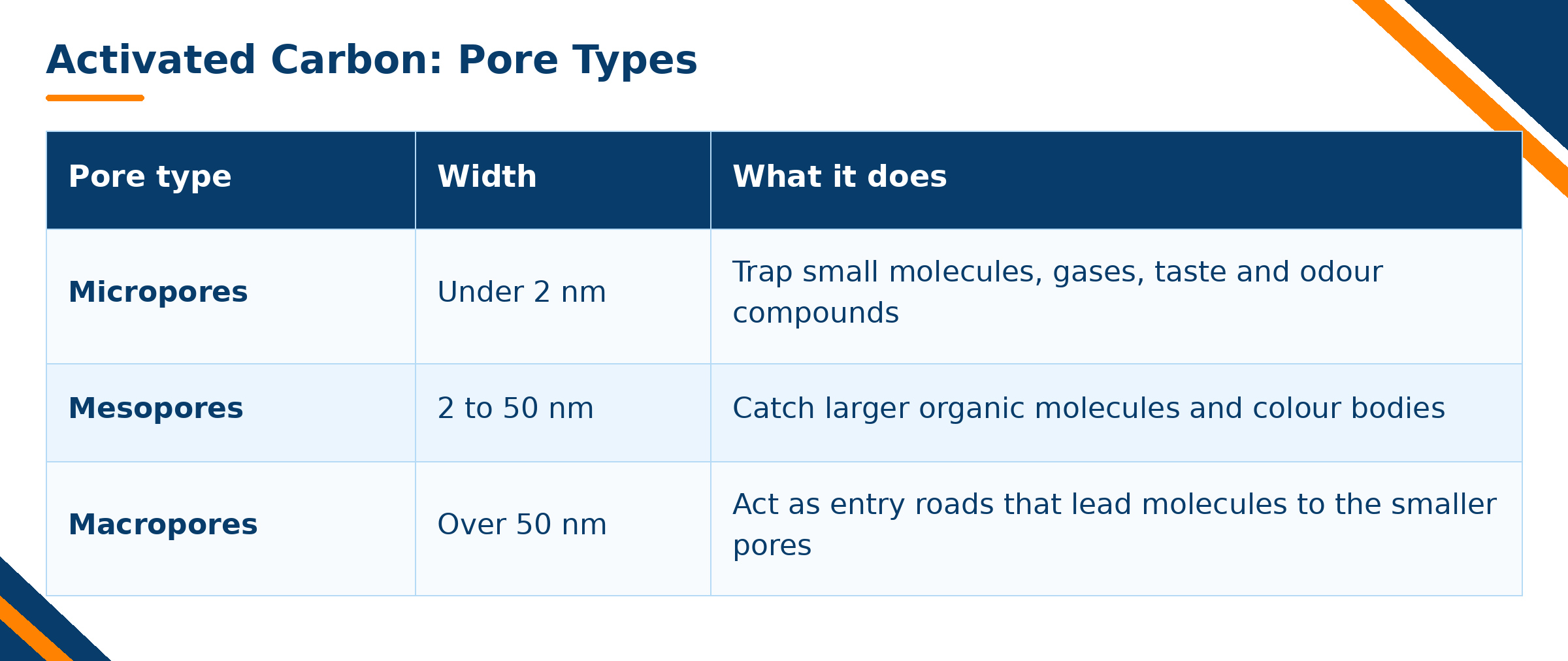
It catches chlorine, many organic chemicals, pesticides, solvent vapours, colour and odour. It misses dissolved salts and hardness minerals.
In medicine, highly ionic salts such as iron and lithium, and small polar molecules such as alcohols, are poorly adsorbed.
Water plants therefore treat carbon as one stage in a chain, with other steps such as pH correction using chemicals like caustic soda.
Capacity isn’t endless. Once the pores fill, contaminants start passing through, which operators call breakthrough.
At that point, the carbon is replaced, or sent away for thermal reactivation, and it’s worth tracking how long a batch lasts so you can plan the next order.
Types and Forms of Activated Carbon
Two choices drive most of the price and performance: the raw material and the physical form. Start with the raw material.
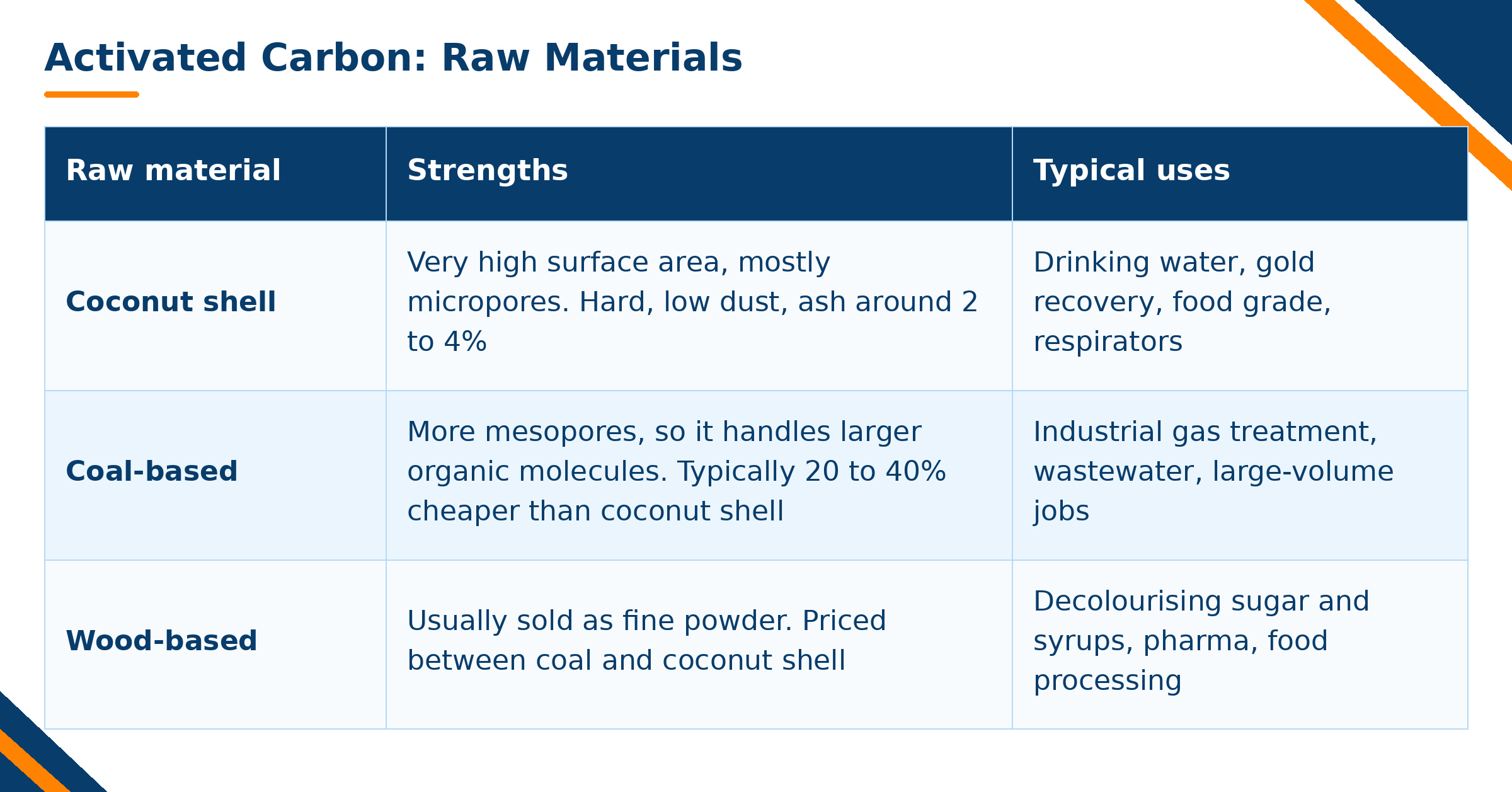
Coal-based carbon starts with bituminous coal or anthracite, so its cost tracks the coal market.
If you follow that side, Zarea’s coal category is useful background.
Then comes the form.
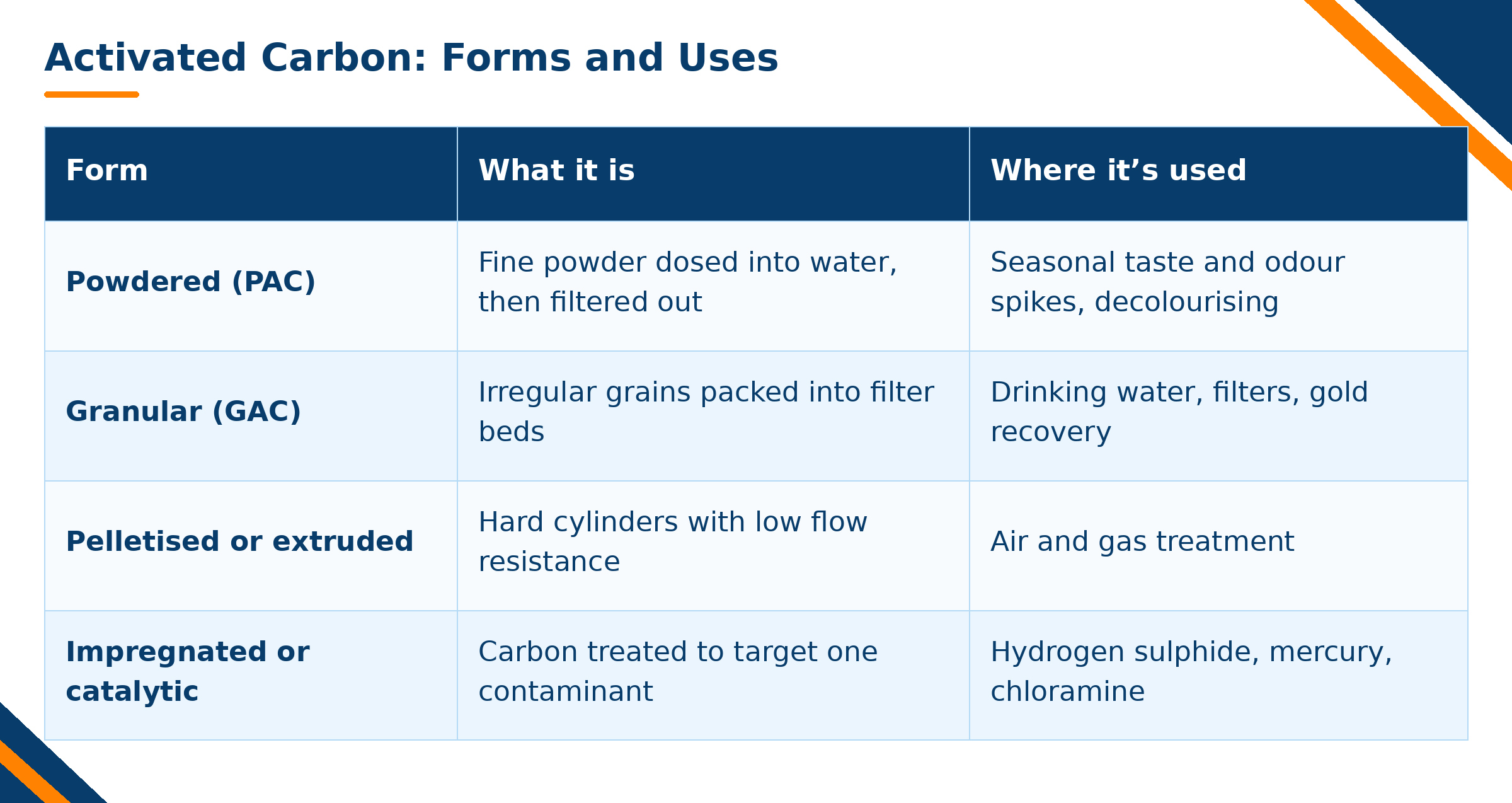
Grain size is quoted in mesh. A coarse 4x8 mesh suits aquariums and pools, while 12x40 is a common size for point-of-use water filters.
If you want more raw-material context, the Agriculture Biomass category shows the shells, husks, and residues that carbon makers start from.
Sugar mills produce one of those feedstocks. Research on bagasse-based carbon has reported iodine numbers around 880 mg/g, and you can read about the raw material in our guide to sugarcane bagasse.
How the Pores are Made: Carbonising and Activation
There are two stages. First, the raw material is carbonised, meaning heated with very little oxygen at roughly 200 to 500°C until it becomes char.
Then comes activation, which is where the pores are opened up.
1) Physical activation uses steam or carbon dioxide at around 800 to 1,000°C. Steam reacts with carbon to form carbon monoxide and hydrogen, eating out new pores. It needs control: the Indian Institute of Science notes the iodine number rises at first, then falls as micropores merge into larger ones.
2) Chemical activation soaks the material in agents such as potassium hydroxide, then heats it at about 600 to 800°C and washes it. Both routes lose a lot of material. A supplier guide puts coconut shell yield at 20 to 25%, and coal at 35 to 45%.
Can You Make Activated Carbon at Home?
Not properly. You can make charcoal at home, but a charcoal fire doesn’t activate it. Real activation needs steam, carbon dioxide, or chemical agents at several hundred degrees, followed by washing, and the pore structure needs lab testing.
Homemade carbon is untested, so don’t use it for drinking water, air filters, or medicine. If you need it, buy carbon with a test report.
Activated Charcoal Uses by Industry
Activated carbon uses fall into four groups: water, air and gas, process industries, and medicine.
1) Water treatment
Water treatment is the use most people meet first. Granular carbon beds take out chlorine, taste, odour, pesticides, and light organics from drinking water, and powdered carbon is dosed during taste and odour events.
Suppliers also point to tightening rules on PFAS as a driver of demand. For drinking-water contact, look for NSF/ANSI 61 certification.
2) Air and gas
Carbon beds remove odours and solvent vapours from air, and impregnated grades target hydrogen sulphide and mercury. Coconut shell carbon is also used in respirators because it’s hard and low in dust.
3) Process industries
In gold mining, gold dissolved in the leach solution is adsorbed onto hard granular carbon, which is why mining is a major buyer. Carbon also decolourises sugar, syrups and edible oils, purifies plating baths, and supports pharmaceutical and petroleum processing.
What Activated Carbon Does for Your Body
In medicine, activated charcoal may be used by clinicians after certain poisonings to reduce absorption of substances still in the digestive tract.
Whether it helps depends on the substance, dose, timing, and risk of aspiration; it is not routinely recommended for every ingestion.
It does not reliably bind alcohols, iron, lithium, or corrosive acids and alkalis. Never administer it at home unless a poison specialist or clinician specifically instructs you to do so.
Claims that activated charcoal detoxes the body or cures hangovers are not supported by strong clinical evidence. It can also interfere with oral medicines.
For suspected poisoning, seek emergency medical help or contact a poison-control service immediately; do not wait to try charcoal.
Consumer filter carbon is not a medical product.
Activated Carbon Price in 2026 and What Drives It
There is no single activated carbon price: raw material, form, adsorption performance, certifications, and order size all matter. One supplier-published guide reports second-quarter 2026 indicative figures of about $1,688 per tonne in China, $2,302 in the United States, $2,743 in Germany, and $2,887 in South Korea.
These are not independently verified transaction averages or directly comparable delivered quotes.
The following 2026 ranges are indicative supplier-advertised FOB China prices, not verified market averages.
Rupee equivalents use an illustrative exchange rate of Rs 280 per US dollar, not a live rate, and exclude freight, duties, taxes, and local margins.
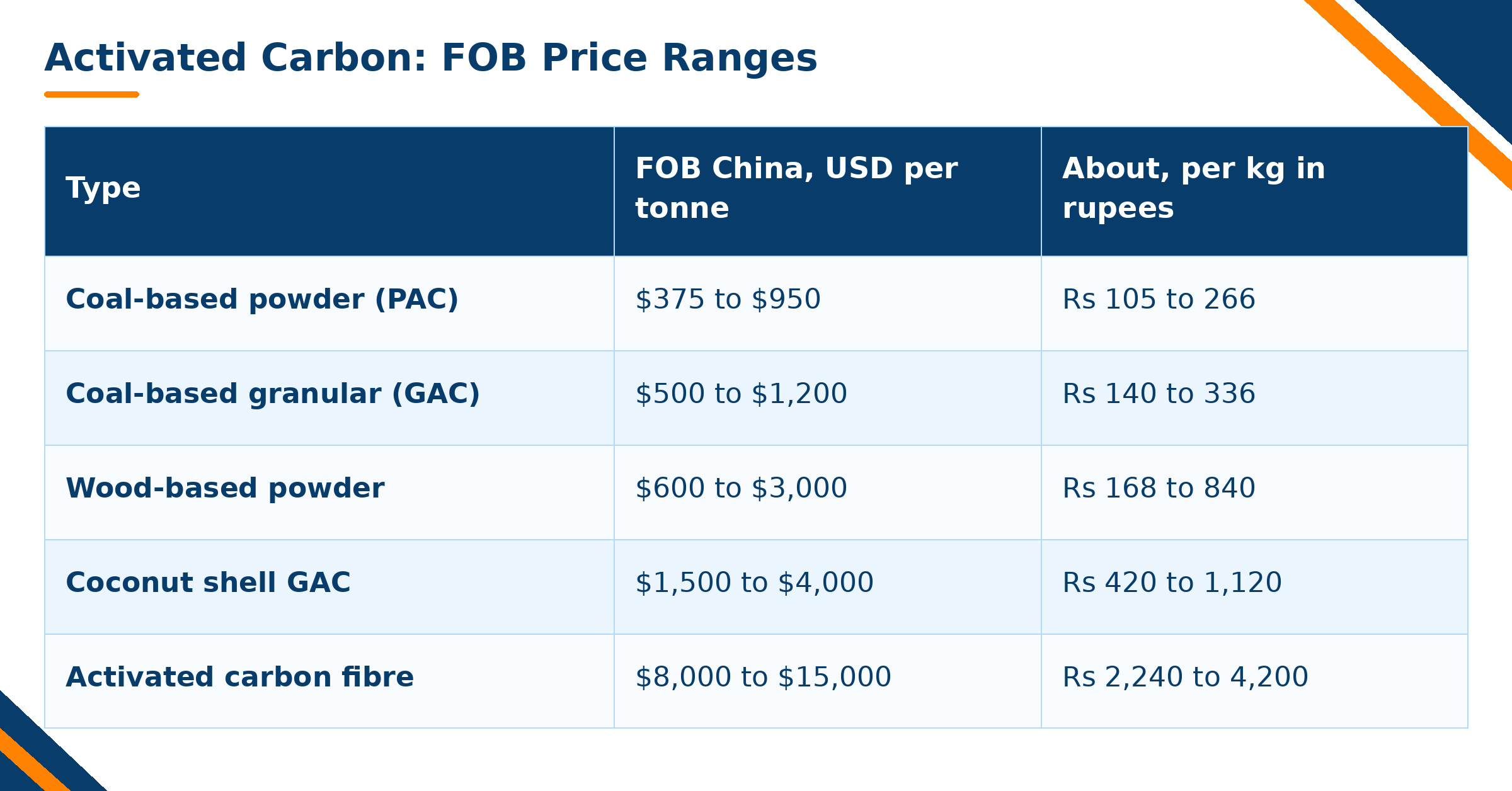
Four things move the price. Raw material is first, and coconut shell has been tight: Yanshan reports coconut shell charcoal nearly doubled in price between December 2024 and July 2025.
Second is the iodine number, because Tanke says a coal-based granular grade rated 1,000 mg/g can cost $200 to $350 a tonne more than one rated 800.
Third is ash, since low-ash coconut carbon can cost $150 or more above a 10% ash product. The fourth is certification, mesh size and order volume.
A warning from one manufacturer is worth repeating. A quote far below the market range, such as coconut shell carbon at $800 a tonne, may be coal-based carbon labelled as coconut, or a loose spec.
Always ask for the iodine number and the raw material in writing.
The local listings below illustrate why pack size and grade must be checked before comparing prices.
Several do not specify weight, and some may refer to retail or cosmetic products rather than industrial filtration media.
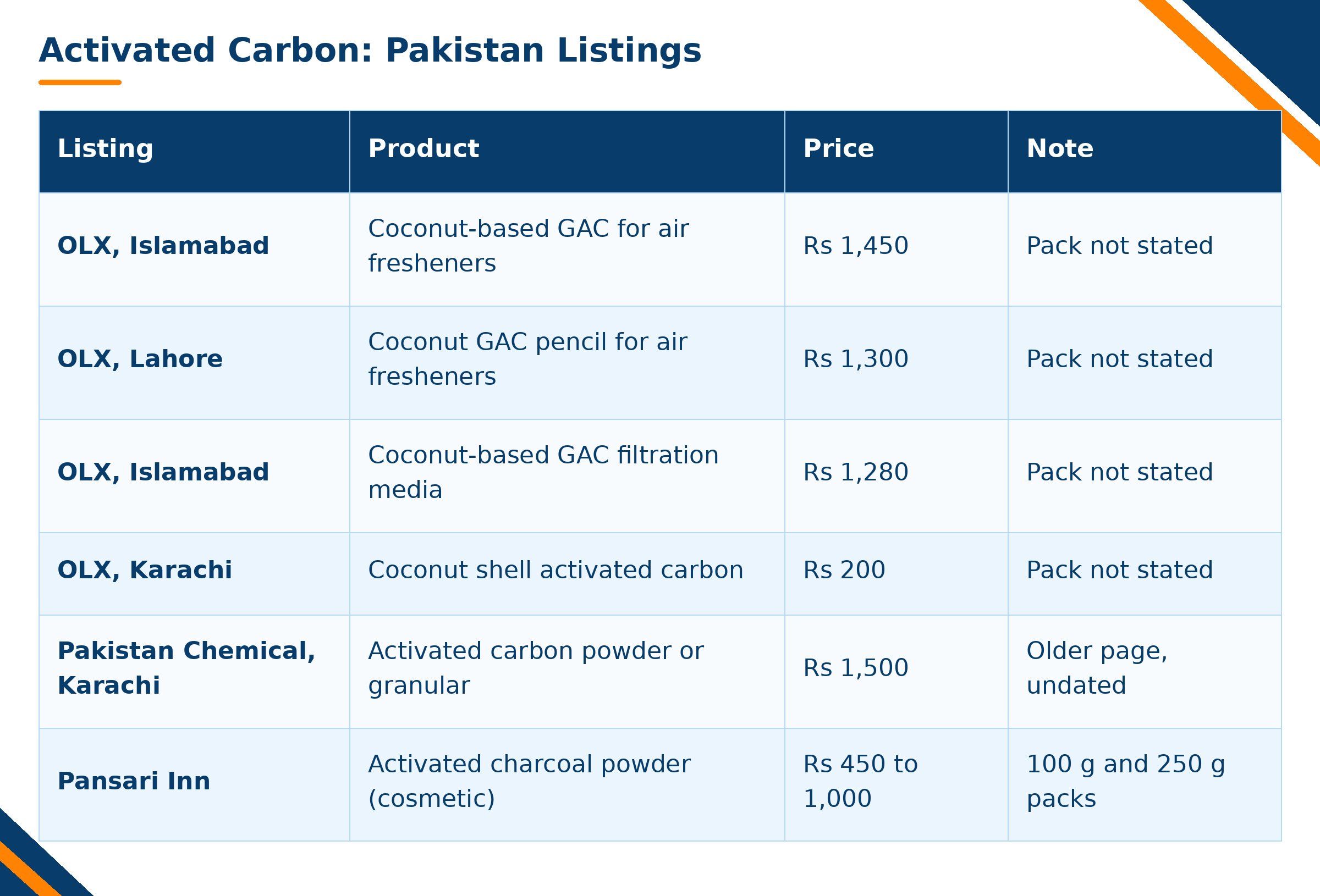
For local commodity rates in general, watch the daily price page on Zarea.
How to Choose the Right Grade
No single grade is best. Match the carbon to the target contaminant, required flow rate, and operating conditions, then compare suppliers against the same checklist.
For water applications, request a contaminant-specific performance test and check whether the certification covers the intended use; an iodine number alone does not establish treatment performance.
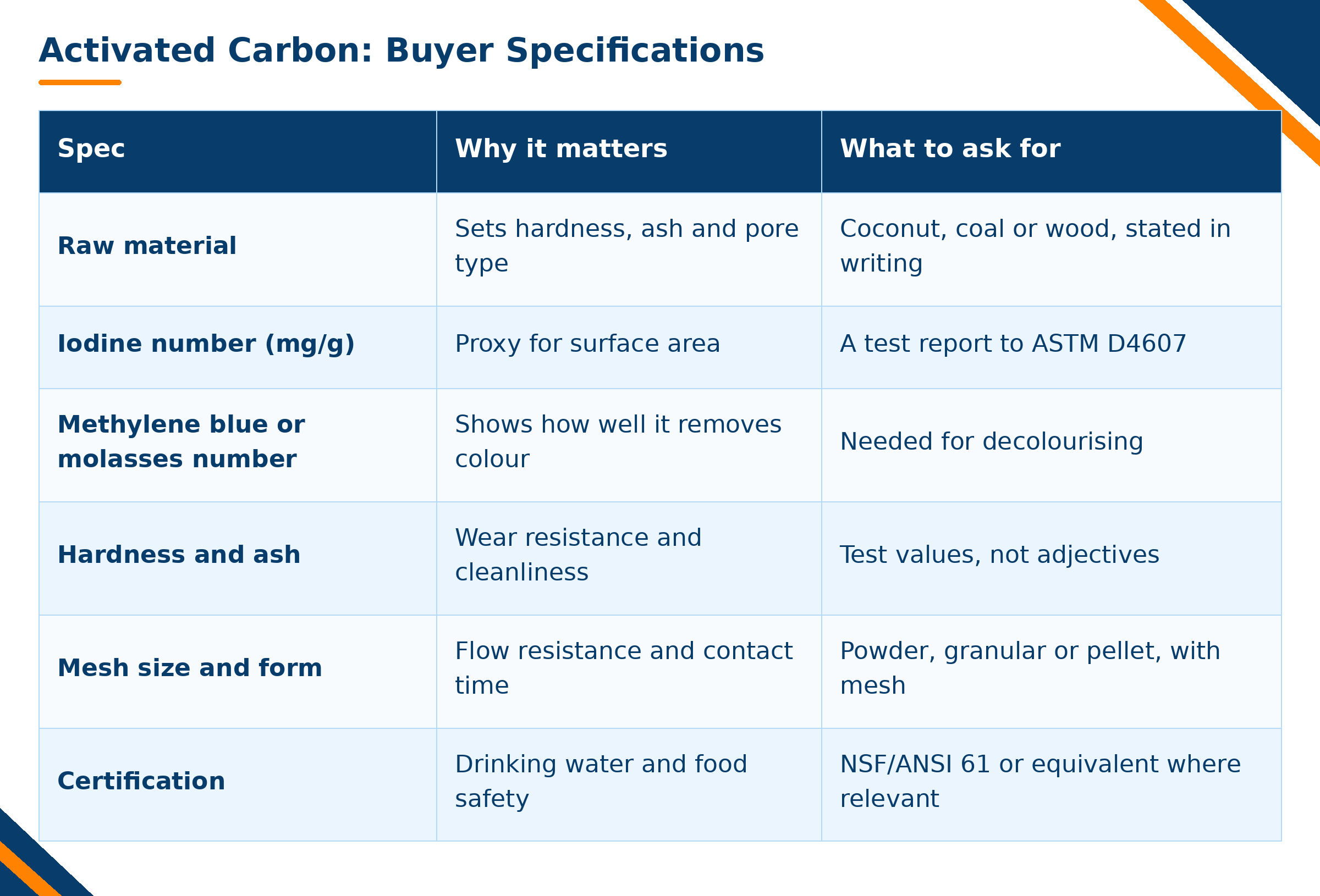
Run a small pilot before a large order. Test a representative sample in your actual water, air or process stream, recording flow, contact time, pressure drop and breakthrough.
Ask for a certificate of analysis and safety data sheet.
Fine dust can irritate the lungs; wet activated carbon can deplete oxygen in enclosed vessels, so confined-space entry requires specialist controls.
Spent media may contain hazardous captured substances and must be managed accordingly.
Buying Activated Carbon in Pakistan
It’s easy to find in small packs. Classified ads, chemical dealers, and herbal shops all sell it, mostly for filters, aquariums, air fresheners, and cosmetics.
Bulk buyers such as water-treatment contractors and processors usually need a defined spec, and that’s harder to find on a classified ad.
Start with Zarea’s chemicals category to see which treatment chemicals are listed.
If you need it in volume, ask for a quote against your spec through the import and export service. Give the raw material, form, mesh, iodine number, quantity, and delivery city.
If you make, import, or process carbon and want buyers, the become a supplier page explains how to list.
Ask for delivered pricing every time, because freight, duty, and the exchange rate can change a ranking between two quotes.
FAQs
What is Activated Carbon Used For?
It is used to reduce selected taste, odour and organic contaminants in water, capture vapours in air-treatment systems, recover gold from processing solutions and decolourise some food ingredients.
Medical-grade activated charcoal may be used by clinicians for certain poisonings, but it is not suitable for every substance or situation.
What is the Difference Between Activated Carbon and Normal Carbon?
Activated carbon has been treated with steam or chemicals at high temperatures to open a dense network of tiny pores, giving it hundreds to over a thousand square metres of surface per gram.
Normal carbon, such as charcoal, has poorly developed pores and carries ash, so it adsorbs far less and is mostly used as fuel.
What Does Activated Carbon Do for You?
In properly designed water and air filters, it can reduce certain contaminants; performance depends on the grade, contact time, and maintenance. In a clinical setting, it may reduce absorption of some swallowed toxins, but it is not a home detox treatment and can interfere with medicines.
Seek urgent professional advice for suspected poisoning.
Wrap-Up
It’s a surface, sold by the tonne. Match the raw material and form to the job, and judge it by test numbers instead of colour or brand. Prices vary tenfold between grades, so a cheap quote is only cheap if the spec holds up.
Ask for the iodine number, the raw material, and a sample, and compare suppliers on the same delivered terms.
For health questions, remember that medical-grade activated charcoal has limited, situation-specific uses under professional supervision; ordinary filter carbon and fuel charcoal must never be swallowed.