Agricultural Extension: Purpose, Methods and How it Works
Agricultural extension explained: its core purpose, main methods, how Pakistan’s Punjab system works, and how it differs from agricultural expansion.
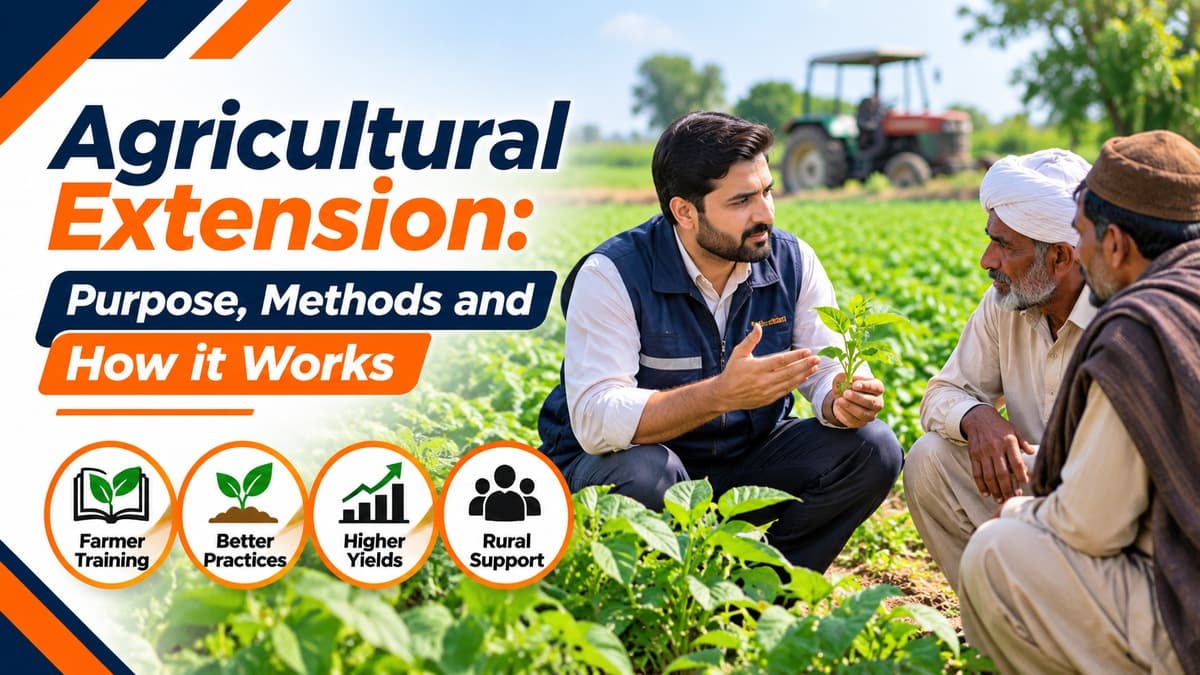
Agricultural extension, also called agri extension or agricultural advisory services, is the system of advice, training, and information that connects farmers with research, markets, and new technology.
The Global Forum for Rural Advisory Services (GFRAS) defines it as all institutions that help farmers gain knowledge, information, and technology; access markets, research, and education; and build technical and management skills.
In Pakistan, provincial agriculture departments run it, and Punjab alone has more than 10,000 extension staff.
This guide explains the core purpose of agricultural extension, the main extension methods, and the local framework in Pakistan, and it clears up a common mix-up between extension and agricultural expansion.
It also shows how farmers can reach the service and what the numbers say about the gap. Figures are dated and sourced, and older ones are labelled.
Zarea is a commodity marketplace, not an extension agency, and nothing here replaces advice from your local agriculture office.
Quick Answers
1) Agricultural extension takes research-based knowledge to farmers and brings their problems back to researchers.
2) The main methods are individual (farm visits, calls), group (demonstrations, field days, farmer field schools), and mass (radio, TV, SMS, apps).
3) In Punjab, field assistants cover clusters of 5 to 7 villages, with officers at the tehsil, district, and provincial level.
4) A former Director General put the ratio at about one graduate extension officer for every 9,500 farm families in Punjab.
5) Extension is advice. Agricultural expansion means farming more land, which FAO links to almost 90% of global deforestation.
What is Agricultural Extension?
Agricultural extension is a system of education, training, and advisory services that helps farmers improve crop production, adopt modern farming techniques, and make informed agricultural decisions.
It connects farmers with agricultural research, practical knowledge, new technologies, and market information.
In Pakistan, agricultural extension services are mainly provided by provincial agriculture departments through field visits, farmer training programs, demonstration plots, and digital advisory platforms.
These services guide farmers on seed selection, fertilizer application, irrigation, pest management, and sustainable farming practices to improve productivity and farm income.
Core Purpose
The idea behind agricultural extension is simple. Research stations, universities, and companies create better seed, better methods, and better markets, and farmers need to hear about them in a form they can use.
Extension is the bridge. It also works in reverse: FAO describes extension as receiving information from the education system and feeding field observations back to it.
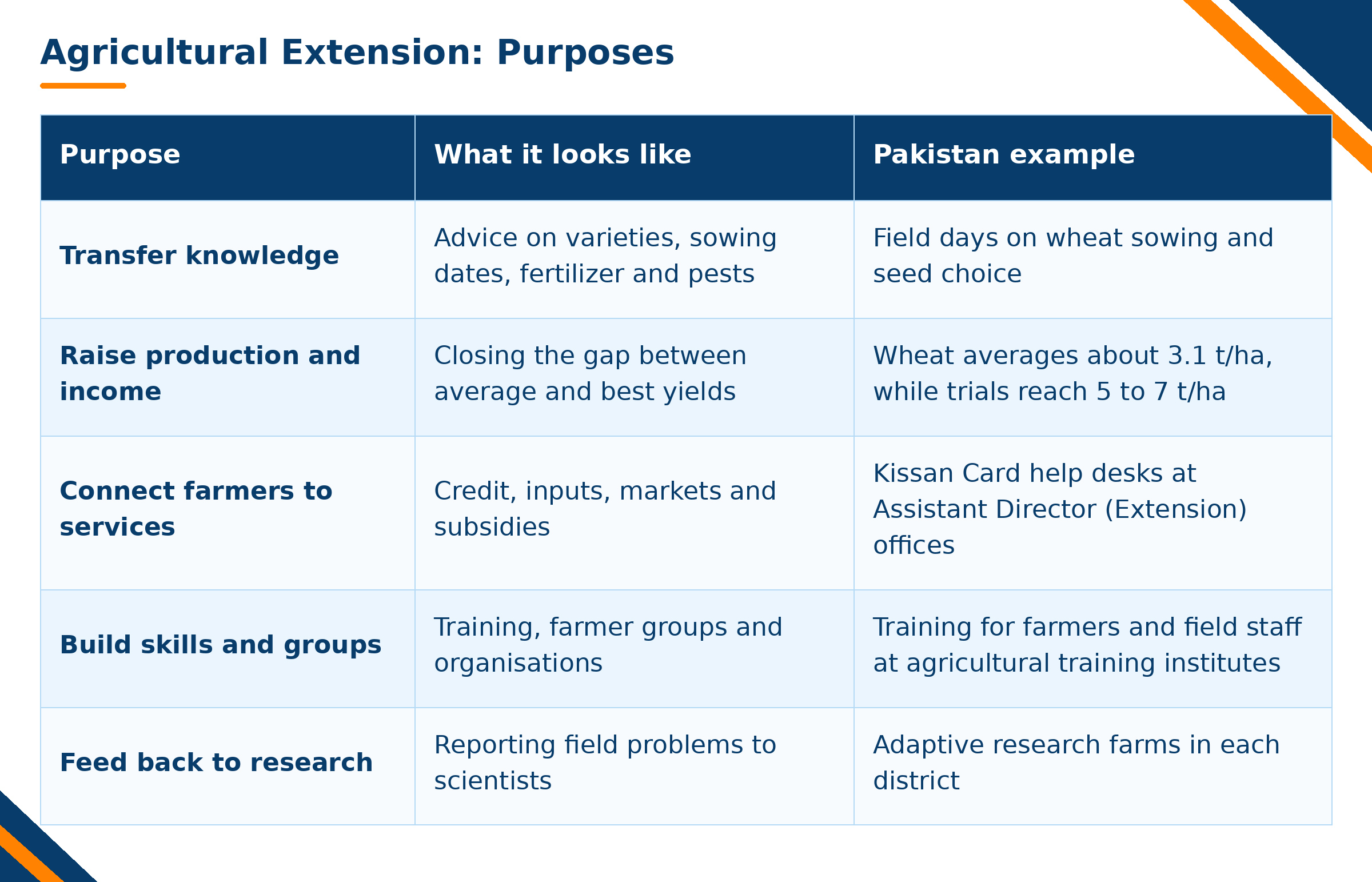
The yield gap is the clearest sign of why this matters. The Economic Survey 2025-26 reports wheat at 29.61 million tonnes on 9.48 million hectares, or about 3.1 tonnes a hectare, and press analysis cites trials at 5 to 7 tonnes.
Better inputs are part of closing it. The Survey also reports 767,930 tonnes of improved seed distributed in 2025-26, and you can compare certified options in the seed category.
Seed alone doesn’t close a yield gap. Timing, fertilizer, irrigation, and pest control matter too, which is where good advice earns its keep.
For a concrete market example, the wheat grain shows how a major crop is offered commercially; a listing is not evidence that a seed or practice will raise yields.
Main Extension Methods
Extension methods are usually sorted by how many farmers they reach at once. The three groups, as laid out in a Penn State agricultural extension text and in GFRAS guidance, are individual, group, and mass.
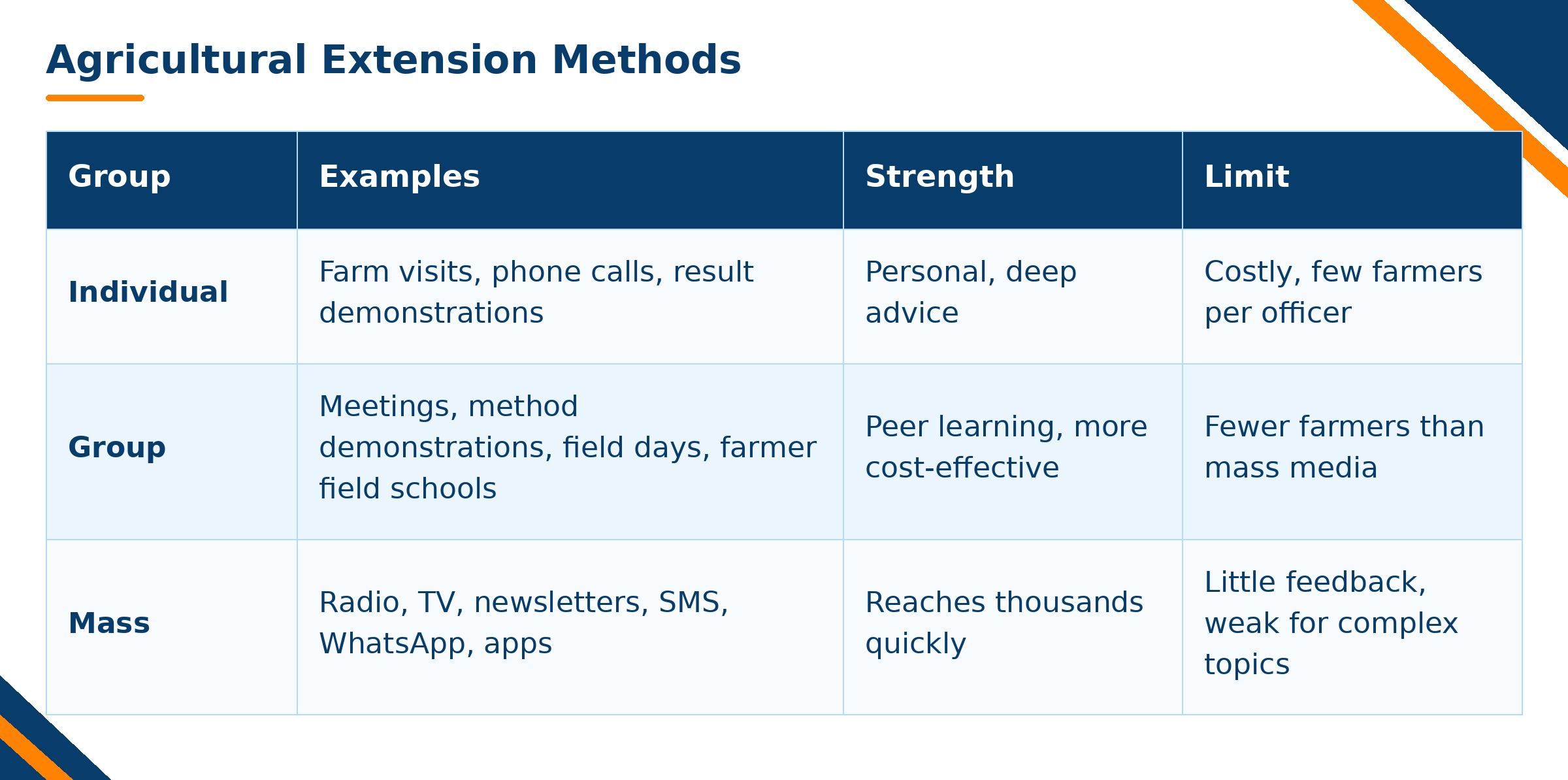
Each method has a job. Mass media can reach large numbers at once, but offer little chance for farmers to ask questions, according to FAO. Group methods reach fewer farmers but allow interaction.
A farmer field school is the most intensive group method. In it, groups of 20 to 25 farmers meet through a whole season to learn and experiment, as the Penn State text describes.
Individual extension is mainly a dialogue between an agent and a farmer. Many farmers still need that, GFRAS says, but group methods are cheaper per farmer.
Digital Agri Extension
Phones are the newest channel. Text alerts, WhatsApp groups and short videos can reach farmers cheaply, and Punjab has built several systems around them.
A Punjab Agriculture Department mobile application tracks field staff performance, farmer contacts and pest scouting.
Another system, Kissan Indraj, registers farmers using land records from the Punjab Land Records Authority, according to a former Director General.
Digital tools work best alongside field visits, not instead of them, because many farmers need advice they can check face to face.
The same is true for market information, and the daily price page is one example of a price source that farmers can check on a phone.
For a wider view of tools beyond messaging apps, see agriculture innovations; technology works best when advice is locally tested.
Local Frameworks
Agriculture is a provincial subject in Pakistan, so each province runs its own extension system. Punjab’s is the biggest and the best documented.
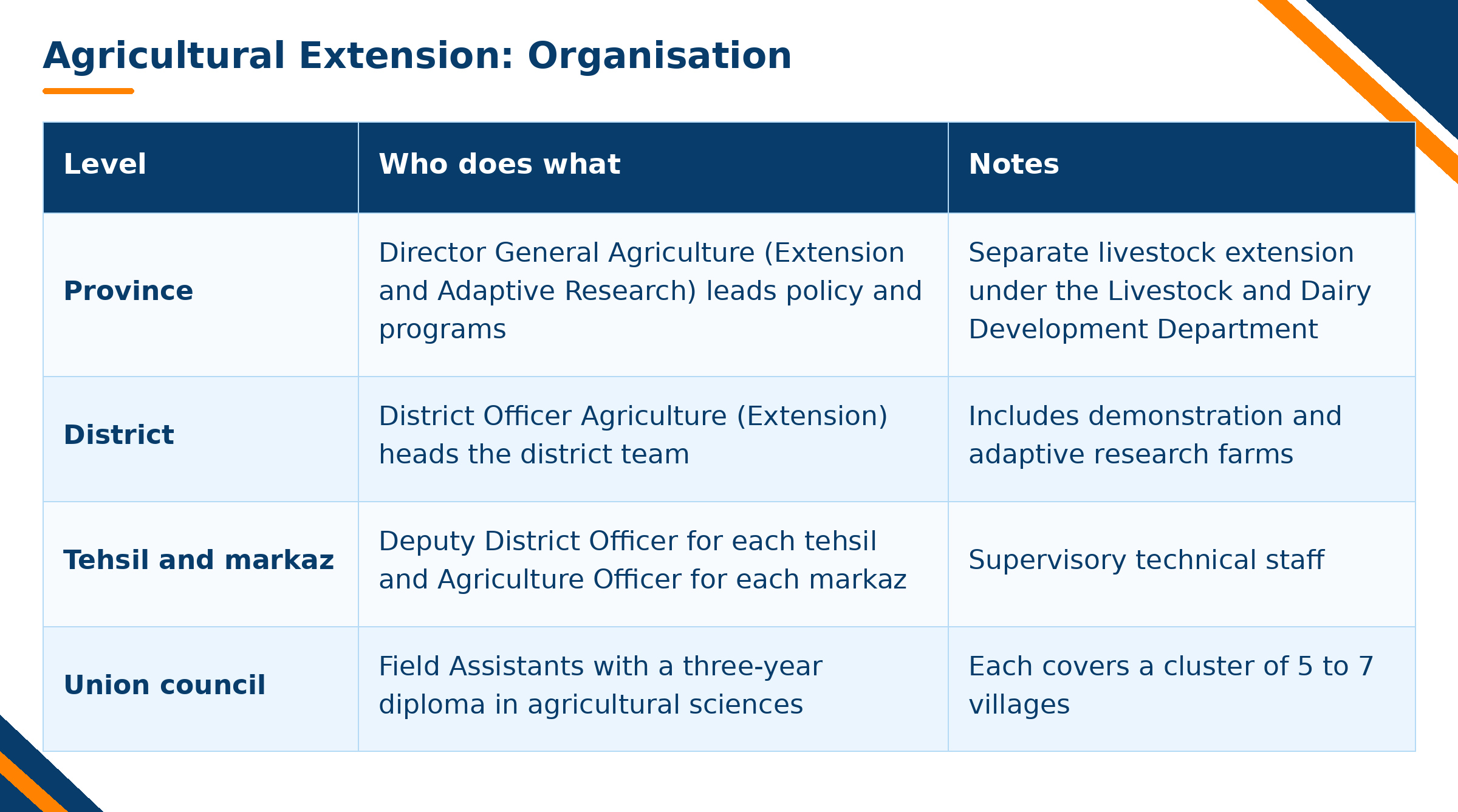
The Punjab system has more than 10,000 staff, a former Director General of Extension wrote, serving over 4 million farming families. The ratio of graduate extension officers is about 1 to 9,500 farm families.
That article is a few years old, but the pattern still holds: the service is large on paper and thin on the ground. A World Bank study of Punjab’s innovation system also found that extension staff is mostly non-professional and that training and monitoring need strengthening.
The Punjab Agriculture Department also runs the programs farmers use most. They include the Chief Minister’s Kissan Card, the Green Tractor Program, the Hi-Tech Farm Mechanization Financing Program, and model agriculture malls.
Kissan Card help desks sit at Assistant Director (Extension) agriculture offices, and the Agriculture helpline is 0800-17000, according to the department’s guidance.
Research sits alongside, with the Ayub Agricultural Research Institute in Faisalabad and the agricultural universities. In practice, input dealers and company field staff also act as informal advisers, which is useful but not neutral, so cross-check their recommendations.
Where Extension Advice Meets Inputs and Markets
Extension advice usually ends in a purchase or a sale: a fertilizer, a seed, a pump, or a crop. These are the places where Zarea’s listings touch that advice. Zarea doesn’t give agronomy advice, and a price listing is not a recommendation.
Fertilizer and Soil
Balanced fertilizer is one of the most common extension messages. In July to March 2025-26, Pakistan’s nitrogen offtake was 3.035 million tonnes against 712,000 tonnes of phosphate, which works out, by our arithmetic, to about 4.3 kg of nitrogen for every kg of phosphate.
Farmers who want a price reference for phosphorus can look at a DAP listing on Zarea, and the wider fertilizer category. Match what you buy to a soil test and your extension officer’s advice.
As a product example, compare the labelled composition and pack details of Sona DAP fertilizer before choosing an input; fertilizer rates should come from a soil test and crop-specific advice. The discussion of input efficiency is explored further in fertilizer technology and crop yields.
Extension also promotes biological options. Our guide to how biofertilizers protect soil and boost plant yields covers one of them.
Water and Energy
Irrigation advice is shifting to solar. Pakistan’s 7th Agricultural Census 2024 counted 959,865 solar pumps, or 52% of all tubewells and lift pumps. Farmers weighing the switch can see equipment options in the solar category after checking system size with an engineer.
For equipment comparisons, browse the solar equipment category; a qualified installer should size any pumping system against the water requirement and available sunlight.
Markets
Extension also helps farmers decide when and where to sell. Bulk listings such as wheat show how a crop is quoted, and the grains and pulses category lists other staples.
Crop residues and feed materials are also represented in the agriculture biomass category; this is a market reference, not agronomic guidance.
Agricultural Extension vs Agricultural Expansion
The two words look alike, and search results often mix them up. Agricultural extension is the advisory service described above. Agricultural expansion means increasing the land under farming, usually by clearing forest, grassland, or wetland.
Expansion adds area. Intensification raises yield on the same land. Extension is a main tool of intensification, because advice on seed, nutrients, and water is how yield rises without new land.
The environmental cost of expansion is why this matters. FAO’s 2021 remote sensing survey found that agricultural expansion drives almost 90% of global deforestation, with 52.3% of forest loss going to cropland and 37.5% to livestock grazing between 2000 and 2018.
FAO’s 2025 report adds that global agricultural output has quadrupled since 1961 with limited land expansion, and that between 2001 and 2023 cropland grew by 78 million hectares while pasture shrank by 151 million.
Pakistan’s cropped area is already about 24.2 million hectares, so the easiest gains are on existing land, as the wheat yield gap shows. That is why many agricultural economists see extension, not new land, as the cheaper path to more output.
For a closer comparison of yield-focused farming and its trade-offs, read intensive agriculture.
How Farmers Can Get Extension Support
1) Call the Agriculture helpline on 0800-17000 with a specific question.
2) Visit the Assistant Director (Extension) agriculture office or the Agriculture Officer at your markaz.
3) Join a field day or demonstration plot. Ask what the demonstration showed locally and whether the results apply to your own farm.
4) Ask for a soil test before you decide on fertilizer. When contacting an officer, prepare the crop and variety, village, sowing date, irrigation source, recent fertilizer applications, and clear photos of any symptoms. Ask whether a soil or water test is needed before buying inputs.
5) Use agricultural universities and research institutes for variety and pest questions.
6) Treat WhatsApp and social media advice with caution unless it comes from an official or university source.
Frequently Asked Questions
What is the Role of Agricultural Extension?
Agricultural extension carries research-based knowledge, technology, and market information to farmers and teaches them practical skills. It also links farmers with credit, inputs and markets, and it brings field problems back to researchers.
In Pakistan, it is delivered by provincial agriculture departments through field staff, demonstrations and, increasingly, digital channels.
Is Agriculture an Extension?
No. Agriculture is the practice of growing crops and raising animals. Agricultural extension is a separate service that advises and trains the people who do it. If you meant expansion, that is a different idea: increasing the area of land under agriculture.
What are some negative effects of the expansion of agriculture?
Deforestation is the biggest. FAO says agricultural expansion drives almost 90% of global deforestation. Other effects include loss of biodiversity and habitat, higher greenhouse gas emissions, heavy water use, soil erosion and degradation, and pollution from fertilizer and pesticide runoff.
Raising yield on existing land is one way to reduce the pressure.
What is meant by agricultural expansion?
Agricultural expansion means increasing the area of land used for farming, usually by converting forest, grassland, or wetland to cropland or pasture. It differs
from intensification, which raises yield on the same land, and from extension, which is the advisory service that helps farmers do that.
Wrap-Up
Agricultural extension is the link between what research knows and what a farmer does. It works best when it mixes personal visits, group learning, and digital tools, and when the officers have the time and training to do it well.
In Pakistan, the framework exists but is stretched, so farmers do better when they ask specific questions, use more than one source, and check advice against a soil test.