Biomass Gasification: How It Works, Reactors & Plants
Learn how biomass gasification works, the main gasifier types, what a plant includes and where it fits in Pakistan. Compare it with pyrolysis.
Biomass gasification, at its core, takes something solid- rice husk, wood chips, bagasse, whatever's on hand- and heats it with barely any air, oxygen, or steam until it breaks down into a gas you can actually burn.
That gas has a name: syngas, sometimes called producer gas. From there you've got options. You can burn it straight in a boiler or kiln, run it through an engine for electricity, or go further and clean it up into fuels and chemicals.
Just don't mix this up with plain old burning; it's not the same thing, and it's not pyrolysis either- pyrolysis skips oxygen entirely.
What follows covers how a gasifier actually works, what comes out the other end, the main reactor types, what you'd find inside an actual gasification plant, and where this fits into Pakistan's picture.
The numbers are pulled from research papers and agency reports, all listed at the end, and wherever real plants don't quite match the textbook version, we'll say so.
What Is Biomass Gasification?
Definition: Gasification is a thermochemical process. You heat biomass in a closed vessel and keep the oxygen short, so the fuel can’t burn completely. Instead of ending up as flame and ash, most of its carbon and hydrogen leave as gas, which is how IIT BHU course material explains it.
Almost every biomass unit runs on air rather than pure oxygen, since an oxygen plant doesn’t pay off at small scale, as the Global Syngas Technologies Council notes. The catch is that air brings nitrogen along, so the gas comes out lean.
In Pakistan, two things drive the interest: a lot of crop residue, and industries that want a fuel other than furnace oil or levy-hit gas. Our article on agri waste into energy covers the farm end of that supply chain.
How It Works
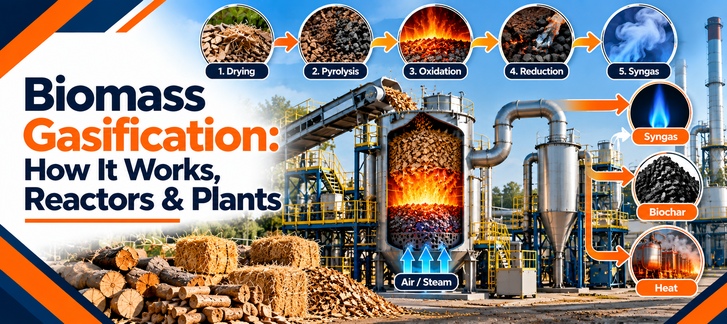
Inside the gasifier, the fuel goes through four stages: it dries out, breaks down under heat, partly burns, then turns into gas. In reality, those stages overlap. They're not clean steps.
A fixed-bed gasifier is the one exception; there, the stages actually sit apart, stacked in separate zones. Exact temperatures depend on the design and the fuel, so the table below is a general guide, not a fixed spec.
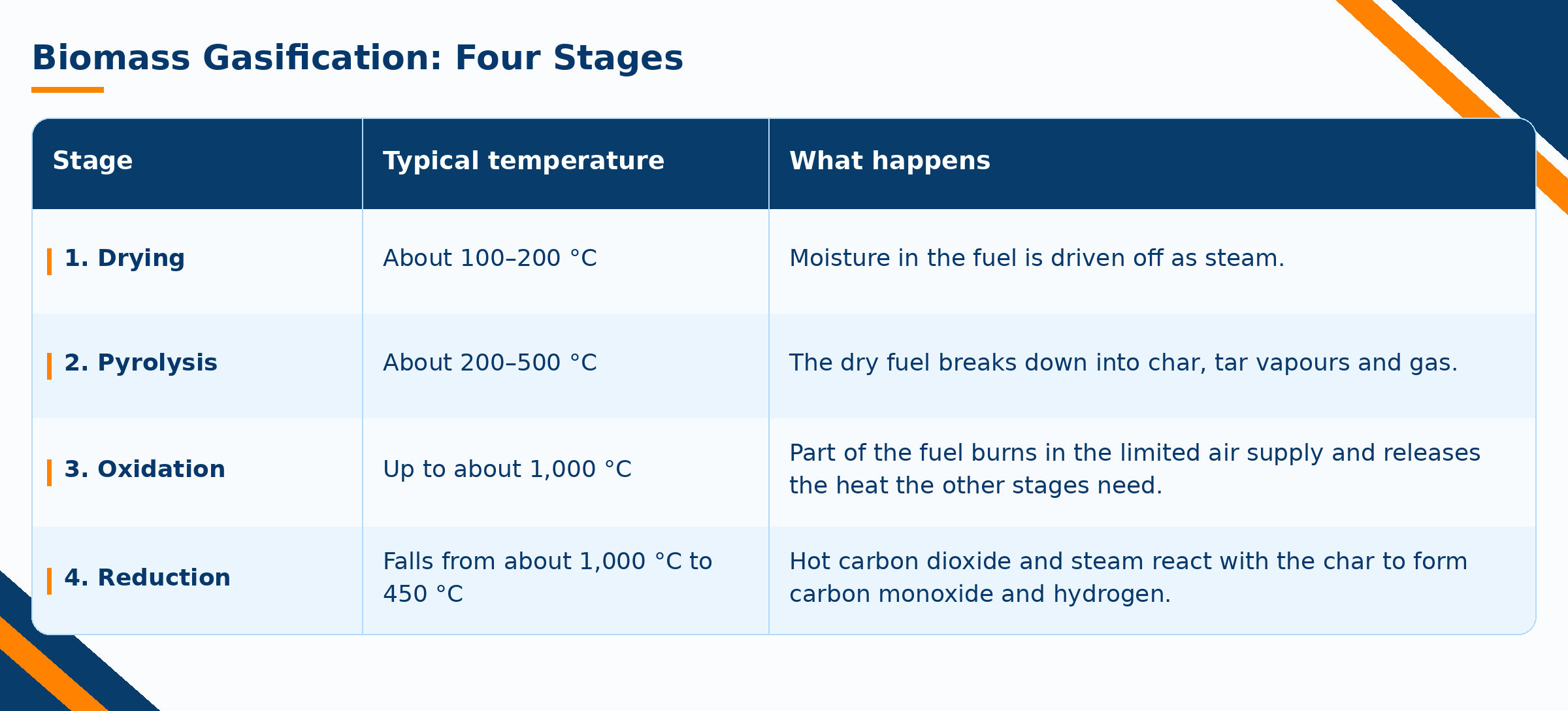
Moisture is what trips up most first-time buyers. Wet fuel soaks up heat from the oxidation and reduction zones, and the gas gets poorer for it, as an Indian university e-text on gasification explains. That’s why many plants dry and size the feed before it goes in.
Zarea’s white corn cob listing gives different moisture ranges for new and old material. Check the actual batch against your gasifier’s requirements before buying.
The gasifying agent matters too. Air is cheap but leaves nitrogen in the gas. Steam can give a hydrogen-richer gas, though you spend energy raising the steam. Indirect gasification splits combustion and gasification into two reactors and gives a nitrogen-free gas, which IEA Bioenergy Task 33 points out.
Main Products & Outputs
The gas is what you’re after. A typical air-blown producer gas from biomass runs about 15–29% carbon monoxide, 5–15% carbon dioxide, 5–12% hydrogen and 50–65% nitrogen, with a little hydrocarbon on top, according to Nepal’s alternative energy agency (AEPC).
Its calorific value lands around 1,200 to 1,500 kcal per cubic metre. That’s a weak gas, so burners and engines have to be sized and tuned for it.
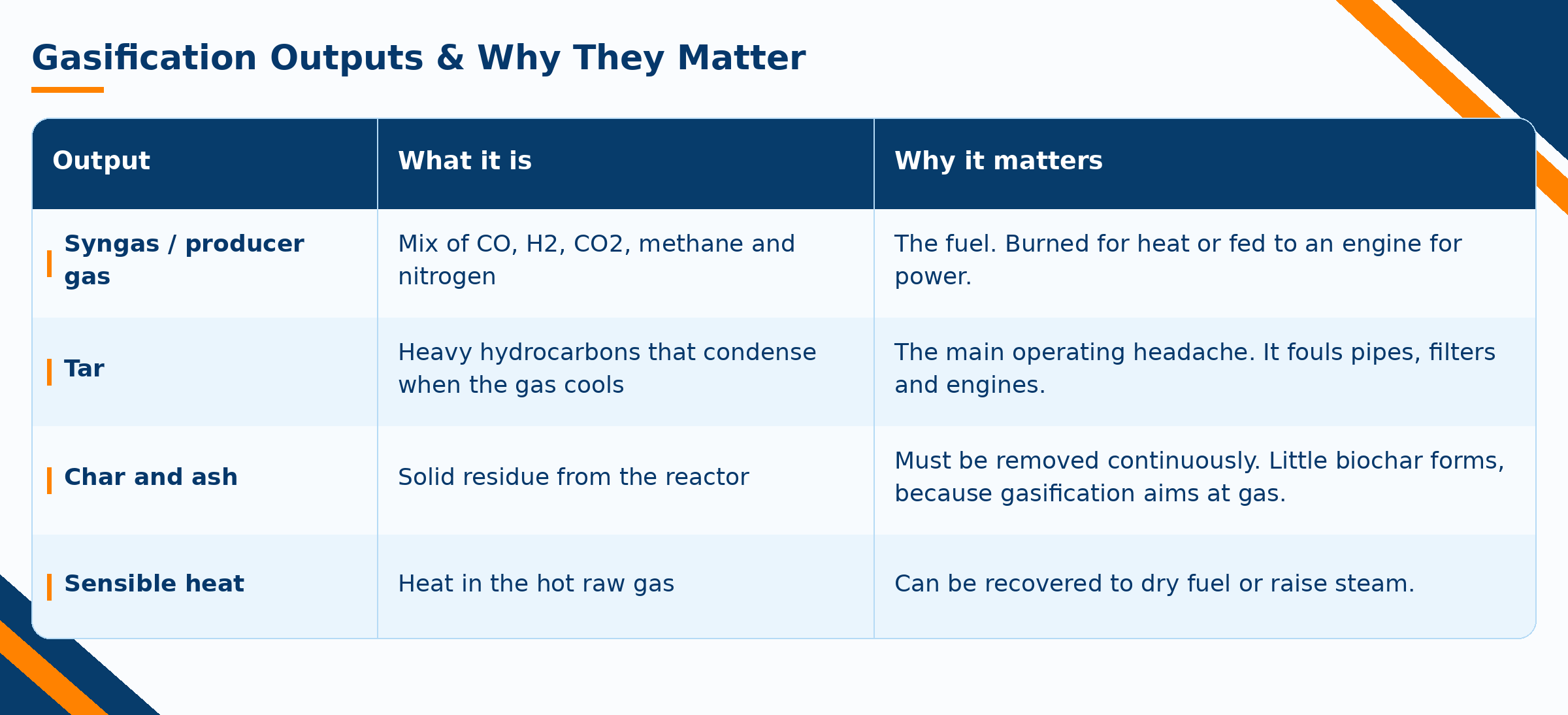
If biochar is what you want, gasification is the wrong route. Biochar Today points out that slow pyrolysis is the better method because gasification turns most of the carbon into CO and CO2.
Common Reactor Types
Gasifiers are sorted by how the fuel meets the gasifying agent. Most small biomass gasifier units are downdraft because the gas carries little tar, while most medium and large plants are fluidized bed, says IEA Bioenergy Task 33. Tar is the number to watch.
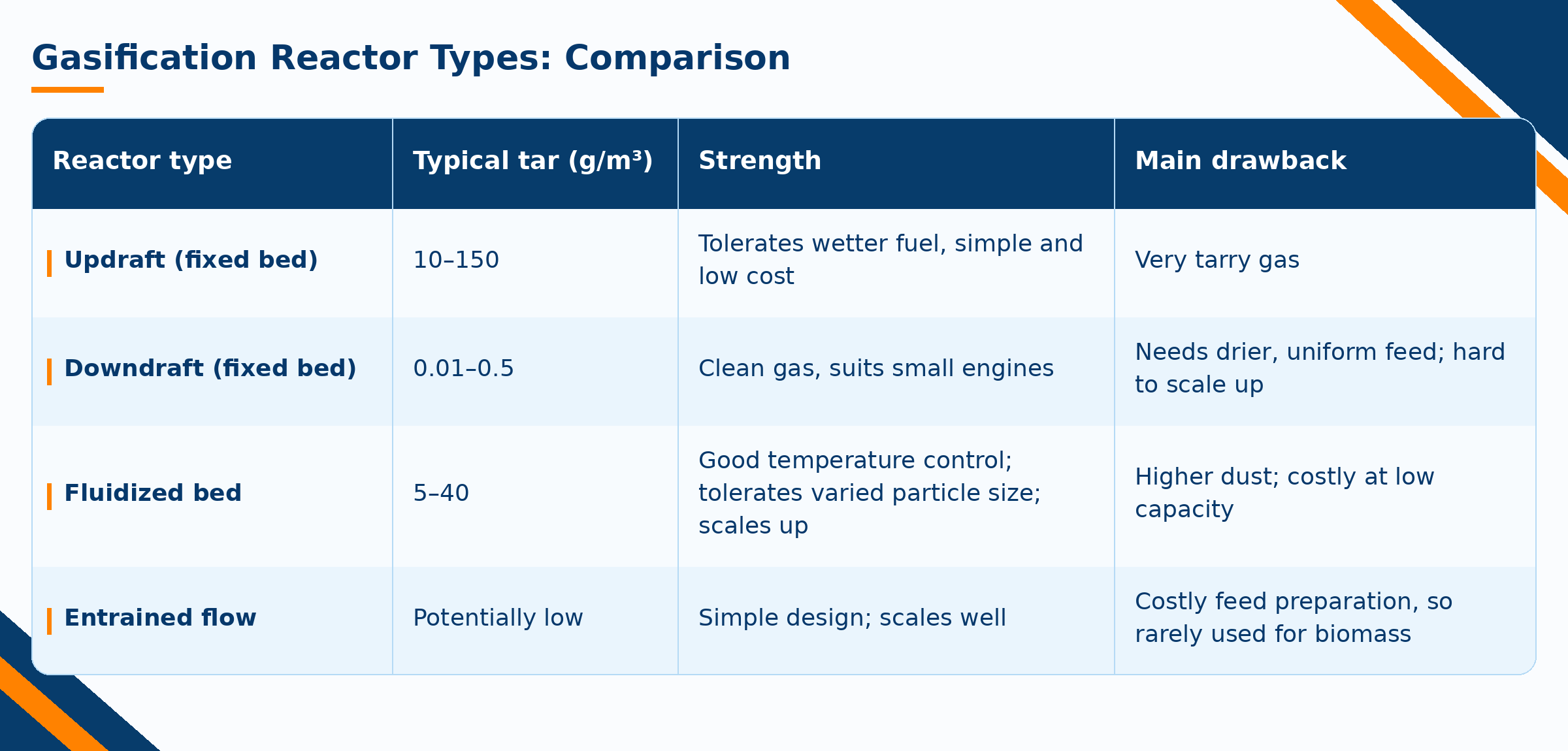
The tar ranges come from a 2024 ACS Omega review, and the pros and cons from an RSC Books comparison. Read the tar figures as a rough guide. The same review shows very wide spreads between studies, because fuel, temperature, and how the plant is run all shift the result.
Biomass Gasification Plant: What’s Inside
A biomass gasification plant is a lot more than the gasifier. Most include:
Feed handling and drying, to cut moisture and even out particle size
The gasifier itself, in one of the designs above
Gas cooling and cleaning: a cyclone for coarse dust, filters for fine particles, then scrubbing or tar cracking
Something to use the gas: a burner, boiler, or gas engine
Ash and char removal, plus controls and a flare for start-up and shutdown
Pakistan has some evidence on the economics, mostly from studies. A paper in the journal Energy modelled a textile mill in Raiwind, Punjab, running on rice husk gasification, and found it a possible alternative to furnace oil or gas-fired captive power, with the best results when gasification power covers peak hours (Naqvi et al.).
UNIDO and the Global Environment Facility have also backed a 1 MW rice husk gasification project for agro-processing SMEs, per a British Council report from 2015. Whether a plant works for you starts with how much residue sits within a short haul, and the figures on biomass in Pakistan are a good place to start.
Choosing Feedstock for a Gasifier
A Pakistani review in Frontiers in Chemical Engineering looked at wheat straw, rice husk, sugarcane bagasse and corn cobs as gasifier feedstocks, because they pair decent heating value with plenty of supply (Frontiers).
Wood chips and sawdust are the other usual choices. Our overview of biomass fuel types shows who produces each one in Pakistan.
Before you settle on a feedstock, get these from the supplier in writing:
Moisture content, and how it varies between loads
Ash and silica content, since both affect residue handling
Particle size and dust share
Monthly volume they can supply on a steady basis
The date of the quoted price, and what it includes
Here’s a real example: a rice husk listing on Zarea shows moisture of 12–14%, dust of 6–8%, a 13-metric-ton minimum order, and delivery charges that depend on location. Compare those figures with what your gasifier maker allows, since downdraft units in particular are fussy about moisture.
Biomass Gasification vs Pyrolysis vs Combustion
All three start with heat but differ in how much oxygen they use. Pyrolysis uses none and runs at roughly 400–800 °C, giving bio-oil, biochar and gas.
Gasification runs hotter, at about 700–1,100 °C, with a small addition of oxygen or steam, which tips the yield toward gas. That comparison comes from the DTU thermochemical conversion group.
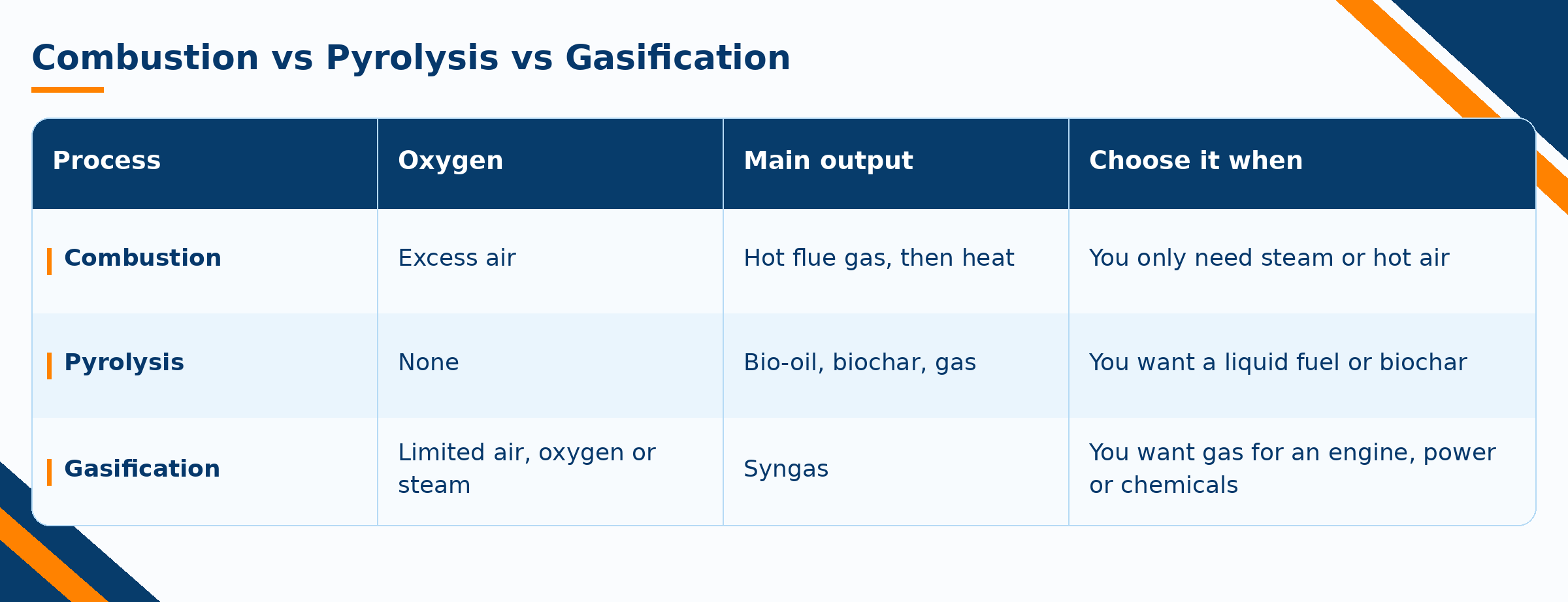
If all you need is heat, direct combustion is simpler and cheaper. Burning biomass briquettes in a suitable boiler skips gas cleaning altogether. Gasification starts to make sense when you need a gas, usually to run an engine.
Applications
The uses of biomass gasification fall into three groups, as a review by Molino and colleagues lays out:
Heat. Producer gas burns in boilers, dryers and kilns in place of coal, furnace oil or gas.
Power. Cleaned gas runs gas engines or turbines, including combined heat and power. For Pakistani industry this is the use people talk about most, as a captive alternative to furnace oil or gas generation.
Fuels and chemicals. With heavy cleaning and upgrading, syngas can become hydrogen, second-generation biofuels and chemicals, but that needs far bigger scale than the first two.
If you’re weighing gasification against conventional fuels, the energy and petroleum category lists coal, furnace oil and related products for comparison.
Challenges to Know Before You Invest
Gasification is proven technology, but it’s less forgiving than a boiler. Four problems come up again and again:
Tar and gas cleaning. Tar left in the gas fouls filters and engines. Removing it costs money and needs a trained operator.
Fuel quality. Swings in moisture, size and ash change the gas, so the feed has to stay consistent.
Supply logistics. Residues are seasonal and bulky. Contracts with several suppliers in the agriculture biomass trade lower the risk of running short.
Limited local track record. A lot of the Pakistani evidence is feasibility work, not long-run plant data, so ask any vendor for operating references.
The feasibility study should also cover sourcing, emissions and residue management. Our guide to the environmental effects of biomass energy provides broader context for these considerations.
Frequently Asked Questions
What are the key differences between biomass gasification and pyrolysis?
Okay so pyrolysis, no oxygen at all, temps around 400-800°C, and you mainly get bio-oil and biochar out of it, with some gas too. Gasification is hotter, 700-1,100°C roughly, and it does use a little oxygen or steam, which is why most of what comes out is syngas instead of liquid or char. Basically, if you want bio-oil or biochar, pyrolysis is your thing. If you want gas for heat or power, go gasification.
What are the four types of biomass?
Wood and wood waste is one. Agricultural crops and waste, husk, bagasse, straw, that's another. Then municipal solid waste. And biogas, which includes landfill gas. Though honestly some people split this up differently, throwing in energy crops or algae, so don't be shocked if you see a different four somewhere else.
What are the five steps involved in gasification?
Most places say four: drying, pyrolysis, oxidation, reduction. If there's a fifth, it's usually the gas cleaning and cooling part, getting rid of dust and tar before you actually use the gas. A few sources count feedstock prep as step one instead, so the numbering isn't really fixed.
What is the largest source of biomass?
Wood, by far, both globally and in the US specifically. Pakistan's different, though; it's mostly about crop residue here: rice husk, bagasse, wheat straw, corn cobs- that's the real conversation.
Wrap-Up
Biomass Gasification isn't for every situation. It makes sense when the end goal is actually gas, not just heat, and when you've got a reliable supply of dry, consistent feedstock sitting near the plant, not trucked in from somewhere far off.
Beyond that, the reactor choice should follow your scale, not the other way around, and gas cleaning needs money set aside for it from the start, not bolted on later when problems show up.
Talk to more than one vendor too, and ask specifically for plants they've actually run, not just what's in the sales deck.
And sometimes the answer is simpler than any of this.
If a boiler already gets the job done, burn the biomass directly and skip the extra complexity. It's really only when you're after power from rice husk or similar residues that a feasibility study earns its cost.