How to Optimize the Procurement Process: Steps & Strategies
Learn the procurement process step by step, from identifying a need to paying the invoice, plus how procurement management actually works.
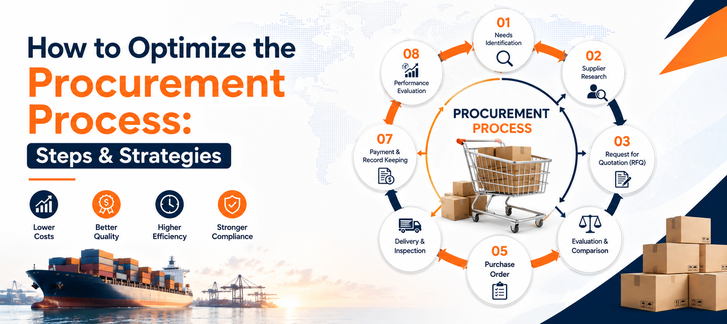
The procurement process is the series of steps a business follows to identify a need, find and evaluate suppliers, negotiate terms, place an order, receive goods or services, and complete payment.
The real thing is chasing a supplier who hasn't replied to your quote request in three days, double-checking whether that invoice actually matches what got delivered, and hoping nobody made a verbal promise on pricing that isn't written down anywhere.
That's really what the procurement process is: how a business figures out what it needs, finds someone to supply it, agrees on terms, and gets the thing delivered and paid for. Simple enough on paper.
The part most guides skip is that it isn't a straight line you walk once, it's a loop. The same steps repeat for every single purchase, and how well you run that loop is basically the difference between reliable pricing and steady deliveries, or spending half your week putting out fires over late shipments and invoices that don't add up.
That's what this piece gets into: the procurement lifecycle stage by stage, where direct and indirect procurement actually differ, and how digital tools are quietly changing what procurement management looks like day to day.
What Is the Procurement Process?
Definition: Boiled down, procurement is how a business turns "we need this" into actually having it, whether that's raw material heading into production, office supplies, or a service contract someone signed off on.
People throw "purchasing" around like it means the same thing, and it doesn't, really. Purchasing is just the transaction itself: you place the order, you pay for it, done.
Procurement is everything that happens around that moment, working out what's actually needed, checking who's worth buying from, hashing out the deal, and making sure what shows up is what you actually agreed to.
The CIPS frames it as the full set of steps a procurement team takes to get the right goods and services into the business, and notes that the exact process looks different depending on the size of the organisation and what's actually being bought.
The Procurement Lifecycle: From Need to Payment
Calling it a "lifecycle" rather than a straight line is deliberate. A procurement lifecycle repeats, every purchase, big or small, cycles through roughly the same stages: recognising a need, sourcing it, contracting for it, receiving it, and paying for it, and then the whole thing starts again for the next requirement.
CIPS' own formal framework runs to thirteen stages for organisations that want that level of rigour, covering everything from early market analysis through to supplier relationship management long after a contract is signed.
Most small and mid-sized businesses don't need thirteen steps. What they need is a version of the same lifecycle that's realistic to actually follow day to day, which usually comes down to six or seven core stages.
Key Procurement Steps in Practice
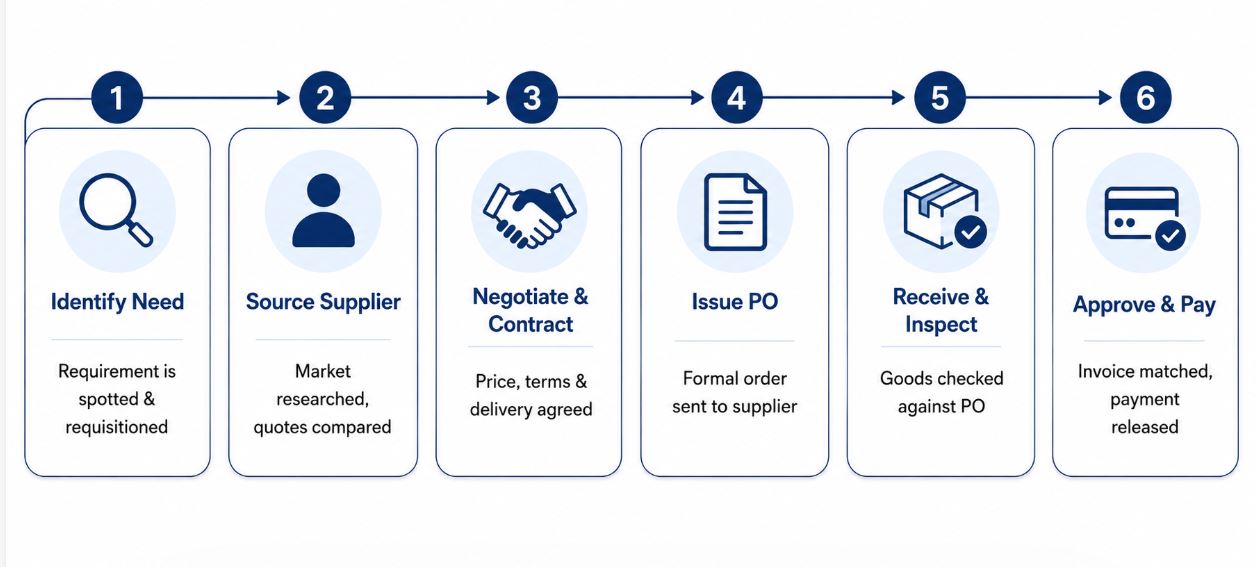
Forget the formal frameworks for a second, here's what actually happens, step by step, on a typical purchase:
Someone flags the need. Usually it's a team running low on something, or a project that suddenly needs materials nobody ordered yet, and if they're smart about it, they'll jot down the actual details, how much, by when, what the budget looks like, so whoever picks this up next isn't left guessing.
That need turns into a requisition. It gets written up as a formal internal request, mostly so there's a paper trail of who asked for what and why, instead of it just being a hallway conversation.
Suppliers get sourced and sized up. Someone goes out, checks the market, pulls quotes, and weighs price against quality and reliability, rather than just going with whoever answered the phone first.
The deal gets negotiated and locked in. Price, delivery timelines, terms, all of it gets nailed down before anyone signs anything.
A purchase order formally documents. The agreed purchase details and authorises the supplier to fulfil the order. Depending on the circumstances and applicable terms, it can also form part of a legally binding contract.
The goods get checked on arrival. Whatever shows up, physical goods or a completed service, gets matched against the PO and packing slip before anyone signs off on accepting it.
The invoice gets approved and paid. Accounts payable lines up the invoice against the PO and what was actually received, then releases payment, and that closes the loop on that particular purchase.
That last step tends to be where everything unravels if the earlier ones weren't handled properly. A PO that doesn't quite match, a packing slip that went missing, a price change someone agreed to over the phone and never wrote down, any one of those can turn what should've been a two-minute invoice approval into a week of emails going back and forth.
Procurement Process Example: Buying Construction Materials
Here's how the steps actually play out on a real purchase, a construction business sourcing cement and steel for a mid-size project.
The need shows up first. A site engineer notices cement stock won't last through the next pour, maybe two weeks out.
That becomes a requisition. How many bags, what grade, and the date it's needed by, written down so nobody's guessing later.
Quotes get pulled from a few suppliers. Not just on price, but whether they can actually deliver that volume on time, since the cheapest quote means nothing if the truck shows up late.
Terms get locked in and a PO goes out. Price per bag, delivery date, who's covering transport.
Delivery gets checked on site. Bags matched against the PO and packing slip before anyone signs off, catching shortages or damage early.
The invoice gets paid once it all lines up. Accounts payable matches what was ordered against what arrived, then releases payment.
Steel tends to follow the same path. Though the stakes are higher, the wrong grade of rebar is a structural problem, not just a scheduling one. That's part of why construction buyers lean harder on supplier vetting here, and why checking current material prices before locking in an order matters so much in a market where costs move often.
When sourcing steel for construction projects, buyers can compare established suppliers and brands such as Aziz Steel, Al Moiz Steel, FF Steel, Mughal Steel, Kamran Steel, and Hunza Steel. Evaluating suppliers based on steel grade, quality, pricing, availability, and delivery requirements can help businesses make more informed procurement decisions.
Direct vs. Indirect Procurement
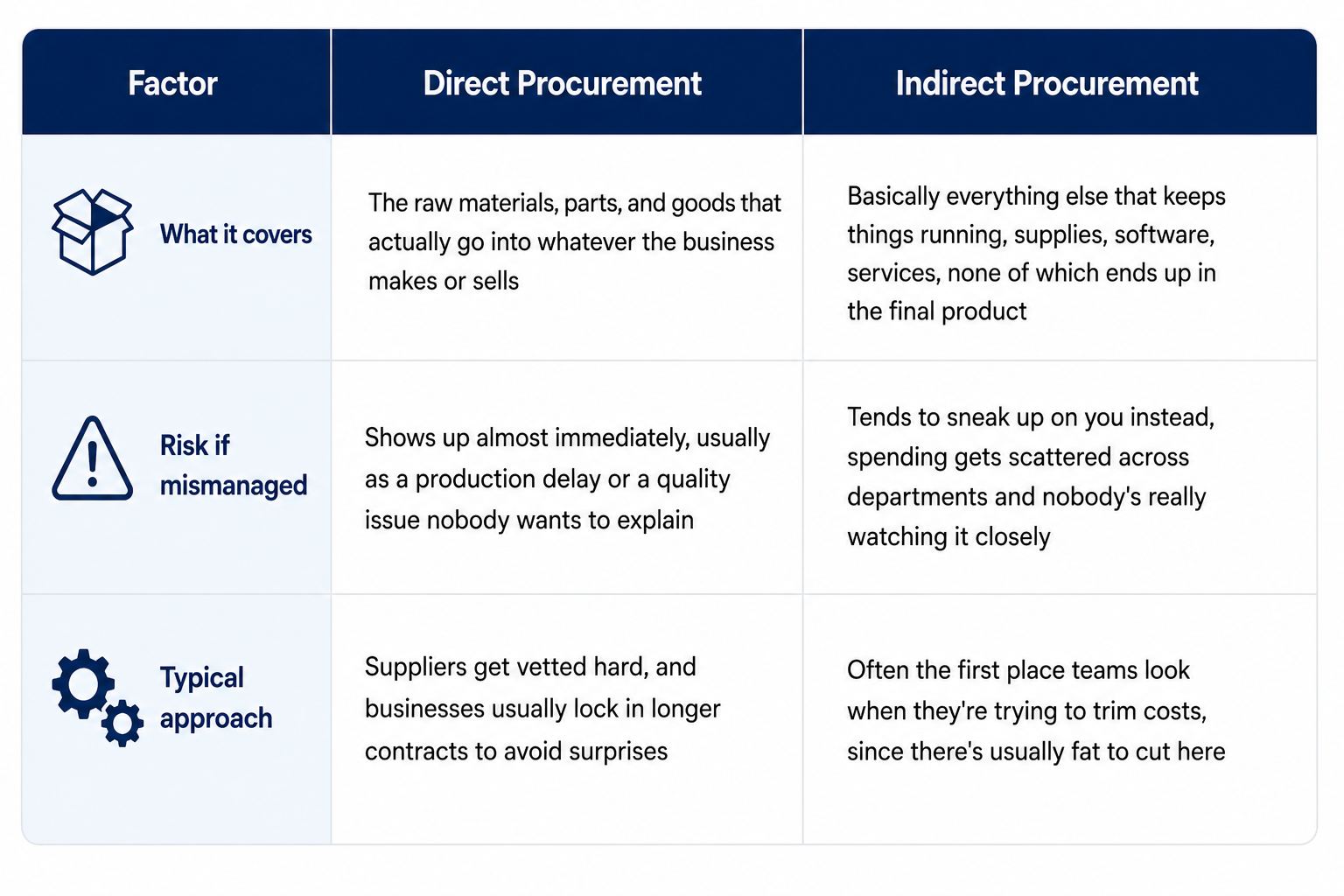
Not all procurement steps carry the same weight, and a lot of that comes down to whether the purchase is direct or indirect.
Procurement Management: Who Owns Each Stage
In a small business, one person might run the entire procurement lifecycle personally, checking stock, calling suppliers, approving the invoice. In a larger organisation, procurement management usually splits across a few roles: a requester who identifies the need, a buyer or procurement officer who handles sourcing and negotiation, and accounts payable who closes out the payment stage.
Splitting it up this way builds in a natural check, since the person requesting a purchase generally shouldn't also be the one approving payment for it, that overlap is exactly where errors and fraud tend to slip through.
Digital marketplaces are increasingly folding into that middle stage. Instead of a buyer manually calling five suppliers for quotes, checking Zarea daily commodity prices before locking in a purchase order, which cuts a step that used to take days down to an afternoon.
How Digital Platforms Are Changing the Procurement Process
A lot of what used to eat up a procurement team's week has quietly moved online, and it's changed a few steps more than people give it credit for.
Supplier discovery. Finding potential suppliers used to mean asking around, checking old invoices, or cold-calling numbers off a business card. Now it's mostly a search and a scroll, which means the field of options is bigger and it takes a fraction of the time to get there.
Price comparison. Instead of ringing three or four suppliers and writing down whatever number they give you, current market pricing is usually just sitting there to check. This wholesale sourcing gets into why that visibility actually changes how buyers negotiate.
Supplier verification. Figuring out whether a supplier is actually reliable used to rely a lot on gut feeling and word of mouth. It still matters, but platforms that surface verified listings give buyers a head start before they even pick up the phone — the fundamentals are the same ones covered in choosing a reliable construction material supplier.
Quotations. Comparing offers side by side used to mean juggling emails and PDFs from five different suppliers. Having that in one place makes it a lot easier to actually compare apples to apples instead of guessing.
Order management. Keeping track of what was ordered, from who, and at what price used to live in someone's inbox or a messy spreadsheet. Digital platforms tend to just hold onto that automatically, which matters more than it sounds like once you're trying to reconcile an invoice weeks later.
Market visibility. Watching how commodity prices move over time, not just at the moment of buying, is the piece that used to be nearly impossible without a lot of manual tracking. Checking current commodity prices regularly is a small habit that pays off the next time it's actually time to order.
Common Procurement Process Challenges
No matter how big the procurement team is, or whether there even is one, the same handful of problems tend to show up sooner or later.
Price volatility: a quote a supplier gives you today can be out of date by the time the order actually ships, especially with anything commodity-heavy.
Supplier reliability: a supplier that looks cheap on paper but keeps missing delivery windows usually ends up costing more once you factor in the delays it causes downstream.
Documentation gaps: honestly, a lot of the friction just comes down to paperwork. A verbal agreement nobody wrote down, or a document that went missing, is usually the real reason an invoice approval drags on for days.
Maverick spending: purchases that happen completely outside the process quietly undo whatever pricing was negotiated and make it hard to even know what the business is really spending.
That price volatility point hits especially hard for buyers in Pakistan sourcing things like construction materials, agricultural commodities, or metals. Even a two-week gap between sourcing and delivery can move the landed cost enough to matter.
Getting into the habit of checking commodity market today before locking in a purchase order is a small thing that saves you from committing to a number that's already stale.
How to Strengthen Your Procurement Process
A few changes tend to make the biggest difference without requiring a full overhaul:
Centralise supplier information. One record showing pricing, past performance, and certifications beats digging through old emails every time you need to reorder.
Standardise your PO format. Nothing gets fulfilled without a documented, approved order — no exceptions for "trusted" suppliers.
Build in a receiving check, every time. Skipping inspection because a supplier is usually reliable is exactly how a bad shipment slips through.
Track pricing trends, not just this one deal. Understanding wholesale pricing patterns for what you buy regularly puts you in a stronger negotiating position than reacting deal by deal.
Separate the requester from the approve. For any purchase over a set threshold, this alone closes off a lot of common procurement fraud.
For a closer look at vetting suppliers specifically, this guide to choosing a reliable construction material supplier covers the same fundamentals in more depth.
Frequently Asked Questions
What are the main steps in the procurement process?
The seven main steps of the procurement process are identifying the need, creating a requisition, sourcing suppliers, negotiating terms, issuing a purchase order, receiving and inspecting the goods or services, and approving payment.
What's the difference between procurement and purchasing?
This trips people up constantly, and I get why, because in casual conversation nobody bothers to separate them. But purchasing is really just the moment of buying, you place the order, you pay for it, that's it.
Procurement is the whole mess around that moment: working out what you actually need in the first place, figuring out who's worth buying from, going back and forth on price and terms, and then checking that what actually arrived is what you thought you were getting. Purchasing's a piece of procurement, not the other way around.
What are the three types of procurement?
Most procurement work falls into direct, indirect, and services. Direct procurement covers whatever goes straight into what you're producing or selling, like raw materials and components.
Indirect procurement is everything that keeps the business running day to day but doesn't end up in the product, think office supplies or software.
Services procurement is its own category for anything you're bringing in externally, like consultants, agencies, or contractors, and it often gets more spend than people realize because it's easy to overlook.
What's the difference between direct and indirect procurement?
Direct procurement is anything that ends up in your actual product, the materials and parts you're building with, so when something goes sideways here, your customers usually notice pretty quickly.
Indirect procurement is more about keeping the lights on, things like supplies, equipment, or software that support the business without being part of what you're selling. A hiccup there is annoying, but it's rarely a crisis the way a direct procurement problem can be.
Who is responsible for procurement management in a business?
It really depends on the size of the operation. In a small business, one person is often doing all of it themselves, sourcing, negotiating, approving payment, the whole thing.
Once a company grows, that usually gets split up, with someone raising the request, someone else handling sourcing and negotiation, and accounts payable closing things out. Splitting it that way isn't just about workload, it also means the person asking for something isn't the same person signing off on paying for it.
Wrap Up
None of the individual procurement steps are complicated on their own. The difficulty is doing all of them consistently, purchase after purchase, without shortcuts creeping in when things get busy.
Get the lifecycle right and the payoff isn't dramatic, it's just quieter: fewer disputed invoices, fewer supply gaps, and a lot less time spent tracking down where a purchase order actually went.