Warehousing Services: Types, Costs & How to Choose
What warehousing services actually include, how warehouse logistics works, typical costs, and how to pick the right storage option.
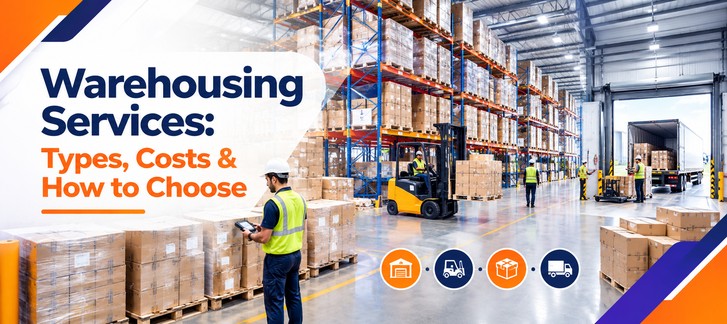
Ask most people what warehousing services actually involve, and they'll picture a big shed full of shelves, stack it in, pull it out when needed. The reality's a fair bit messier than that.
Between the moment goods arrive and the moment they finally leave for a customer, someone's receiving them, tracking exactly what's on hand, picking and packing orders, and making sure everything goes back out the door in the same condition it came in.
Skip any of that, or do it badly, and it tends to cost a business a lot more in delays and damaged stock than the actual storage fees ever would.
So that's really what this guide gets into: what warehousing services cover in practice, the different types of warehouse storage out there, how the day-to-day logistics side actually runs, and what genuinely drives the price when you're comparing warehousing for rent.
What Warehousing Services Actually Cover
A warehouse doing its job well isn't just holding stock; it's actively managing it. Four things tend to make up the core of what a warehousing provider actually offers.
Storage and inventory management. Space allocation for goods, paired with real-time tracking so a business always knows exactly what's on hand and where.
Order fulfilment. Picking, packing, and shipping, whether that's a handful of bulk B2B orders a week or a high volume of individual e-commerce parcels.
Value-added services. Labelling, kitting, cross-docking, and quality checks- the extra handling that turns raw storage into something closer to a finished supply chain step.
Specialised storage. Temperature-controlled space for perishables or sensitive goods, and bonded warehousing for imported goods still waiting on customs clearance.
Types of Warehouse Storage
Not every warehouse is built the same way, and the type that fits one business often doesn't fit another at all.
Public warehouses. Shared, third-party space rented out to multiple businesses, usually the cheapest entry point and the most flexible for short-term needs.
Private warehouses. Owned and operated by a single company, more control but a much bigger upfront investment.
Bonded warehouses. Customs-supervised facilities where imported goods can sit without duty being paid until they're actually released into the market.
Distribution centres. Built for speed rather than long-term storage, goods move through quickly on their way to a final destination.
Climate-controlled facilities. Temperature and humidity are kept within a set range, essential for food, pharmaceuticals, and certain agricultural products.
How Warehouse Logistics Actually Works Day to Day
Nobody really explains this part properly, and it's honestly where a good provider shows itself, apart from a place that's just got empty shelves sitting around.
The moment goods arrive, they get checked against the purchase order right there, not next week, so if something doesn't match up, it gets caught before it's already been shelved and forgotten.
A decent warehouse management system also means staff actually know where something is instead of wandering three aisles over trying to remember where they put it last month.
Cross-docking doesn't get talked about enough either, and it's one of the smarter moves in warehouse logistics when it's done right. Rather than goods sitting in storage at all, they go straight from an inbound truck to an outbound one, sometimes within hours of arriving.
Pull that off, and you're cutting storage costs while speeding up delivery at the same time, but it only works if inbound and outbound schedules are actually coordinated tightly, which is really the difference between a facility that's well run and one that's just average.
That kind of coordination starts to matter a lot more once you zoom out and think about how warehousing fits into the bigger commodity chain connecting production all the way to the end buyer.
Finding a Warehouse for Storage in Pakistan
Location ends up deciding most of this. Karachi handles the bulk of import and bonded storage, and that's not really a preference thing; it's just where the goods actually come into the country through the port, so facilities nearby make sense.
Lahore and Faisalabad carry most of the industrial and textile-related storage demand instead, and if a business's customers are further north, Islamabad or Rawalpindi tend to be the better fit.
Past location, though, it's worth actually digging into a provider's track record on security, whether they're properly licensed for bonded storage if that applies, and whether they'll show you real-time stock levels or just hand you a summary at the end of the month.
Honestly, if a facility can't tell you what's sitting on the shelf right now, it doesn't matter what the brochure says; that's not a modern warehousing setup.
And once a business starts growing past a single city, this stops being just a storage question. It ties straight into distributors scaling their reach across multiple locations, where where you actually put the warehouse matters just as much as what's inside it.
Warehousing for Rent: What It Actually Costs
Pricing varies a lot depending on what's actually being stored and how it's billed, but most providers use one of a handful of common models.
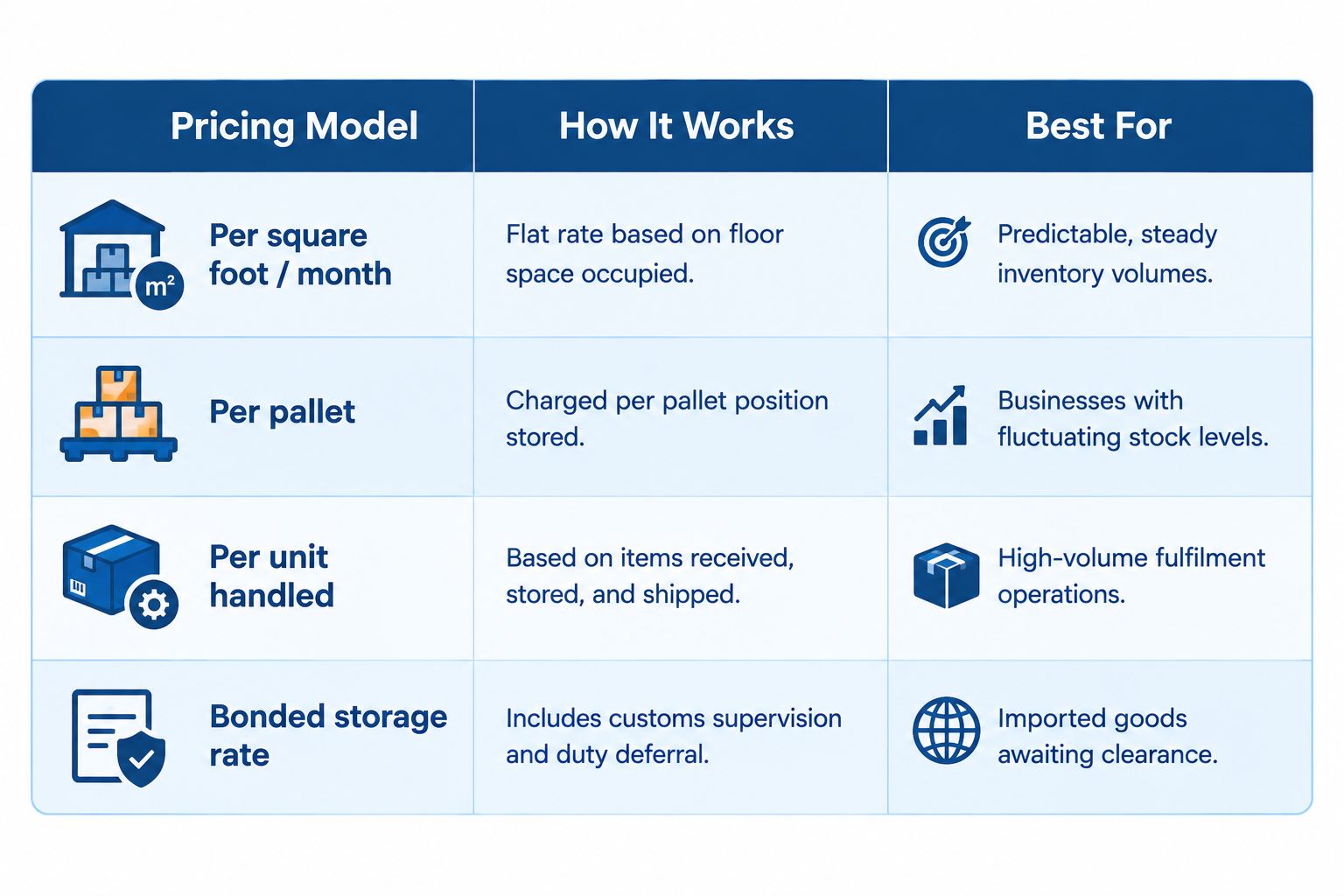
Temperature control, security level, and contract length all push the price up or down from there. A short-term, month-to-month arrangement almost always costs more per unit than a facility locked into a year-long contract, which is worth factoring in before assuming the cheapest quote is actually the cheapest option over time.
How to Choose the Right Warehousing Service
A few questions cut through most of the noise when comparing providers. Does the facility offer real-time inventory visibility, or just a monthly summary? Is the location actually convenient for both inbound suppliers and outbound customers, not just cheap?
Can they handle the specific goods involved, bonded status, temperature control, hazardous material certification, whatever applies? And can they scale up without a business having to switch providers the moment volume grows?
For businesses in agriculture specifically, storage decisions tend to be tied closely to broader agricultural commodities handling requirements, since perishability and seasonal volume swings change what a warehouse actually needs to offer.
Warehousing rarely sits in isolation either; it's usually one link in a longer chain that includes sourcing, transport, and distribution. This agri supply chain management overview covers how those pieces connect for businesses moving agricultural goods specifically.
Zarea's own services sit inside a broader logistics support offering, built to connect storage directly with the buying and selling already happening on the platform, so goods don't have to change hands between multiple disconnected providers just to get from storage to sale.
And for businesses bringing goods in from outside Pakistan, warehousing decisions usually can't be separated from the wider process of setting one up in the first place. This import-export business guide covers what that involves beyond just finding somewhere to store the goods.
Frequently Asked Questions
What's the difference between public and private warehousing?
Public warehouses are shared spaces, basically third-party facilities that rent space out to a bunch of different businesses at once. They're usually cheaper and a lot more flexible if your needs change month to month.
Private warehouses go the other way: one company owns and runs the whole thing themselves, which means more control, but you're also looking at a much higher upfront cost to get there.
What is a bonded warehouse used for?
A bonded warehouse is a customs-supervised facility where imported goods can be stored without import duty being paid until they're actually released for sale. It's commonly used by importers who want to delay duty payment or re-export goods without ever paying domestic duty at all.
How is warehouse storage usually priced?
Most providers charge either per square foot of space occupied, per pallet position, or per unit handled through the facility. Specialised requirements like temperature control or bonded status typically add a premium on top of the base rate, and shorter contracts generally cost more per unit than longer ones.
Do small businesses actually need warehousing services?
Often yes, even at a fairly small scale. Storing inventory at home or in an unmanaged space tends to create the exact problems warehousing services solve: stock damage, no real tracking, and fulfilment delays. Public warehousing in particular makes this accessible even for businesses that aren't moving huge volumes yet.
Wrap Up
Warehousing services are one of those things that only get noticed when they go wrong: a lost pallet, a delayed shipment, stock nobody can actually locate.
Getting the type of storage, the pricing model, and the provider's actual logistics capability right from the start avoids most of that entirely, and it matters just as much for a small business storing a few pallets as it does for a company moving goods at scale.