Captive Power Plant: Types, Working Principle and Benefits
Learn how a captive power plant works, its types, fuel costs, benefits and limitations, with industrial examples and gas levy guidance for Pakistan.
A captive power plant (CPP) generates electricity mainly for the factory or business it serves.
Instead of depending entirely on the national grid, a textile mill, cement factory, or other industrial facility can produce some or all of its electricity on site.
Captive generation can also serve a group of designated consumers under an appropriate arrangement.
For Pakistani manufacturers, the decision usually comes down to reliable supply, fuel availability, and the cost of keeping production running.
This guide explains the main technologies, fuel costs, industrial examples, and the gas levy introduced in 2025.
Captive Power Plant at a Glance
1) What it is: a plant that generates power for the owner’s own site, usually with its own engines, turbines, or solar panels.
2) Working Principle: engines or turbines drive generators; solar panels produce electricity directly. Useful heat can also be recovered from suitable thermal systems.
3) Common Types: gas engines and turbines, coal or biomass steam plants, diesel and furnace oil sets, waste heat recovery, and solar.
4) Pakistan Policy: a gas and RLNG levy was introduced in 2025 for captive generation. Check the applicable notification before estimating costs.
5) Main Trade-off: greater control over supply, with responsibility for maintenance, fuel purchases, and capital investment.
What Is a Captive Power Plant?
Captive power is electricity produced primarily for a business’s own consumption. The installation may operate independently of the grid or alongside it.
An independent power producer (IPP), by contrast, generally generates electricity for sale under commercial supply arrangements.
Captive generation describes who uses the electricity.
Combined heat and power (CHP), also called cogeneration, describes a technology that produces electricity and useful heat from the same energy input.
A captive plant does not necessarily recover heat.
Sugar mills are a familiar example: they can burn sugarcane bagasse to produce steam and electricity during the crushing season.
Textile mills may use gas engines to supply electricity and recover exhaust heat for their processes.
How Does a Captive Power Plant Work?
A conventional thermal plant converts fuel energy into electricity in five main stages. Solar photovoltaic (PV) systems work differently.
1) Fuel Supply: LPG Gas, coal, biomass, or oil is delivered to the engine or boiler.
2) Energy Conversion: An engine or turbine turns a shaft. In steam plants, a steam boiler produces steam to drive the turbine.
3) Electricity Generation: The rotating shaft drives an alternator. Solar PV instead converts sunlight into direct current, which an inverter converts to alternating current.
4) Distribution: Switchgear, protection and controls deliver electricity to the factory and, where authorised, the grid.
5) Heat Recovery: Suitable systems capture exhaust or cooling heat for process steam or hot water.
An islanded plant can operate without the grid.
A grid-parallel plant shares the electrical load with the utility, while a hybrid system combines multiple energy sources.
Backup arrangements depend on the site’s critical loads and operating requirements.
Electrical efficiency measures how much fuel energy becomes electricity.
CHP total efficiency includes useful recovered heat, so it is not directly comparable with electrical efficiency alone.
Actual performance depends on equipment, load, fuel, and heat demand.
Types of Captive Power Plants and Their Fuels
The choice of technology depends on the factory’s electrical load, steam requirements, available fuel, and operating hours.
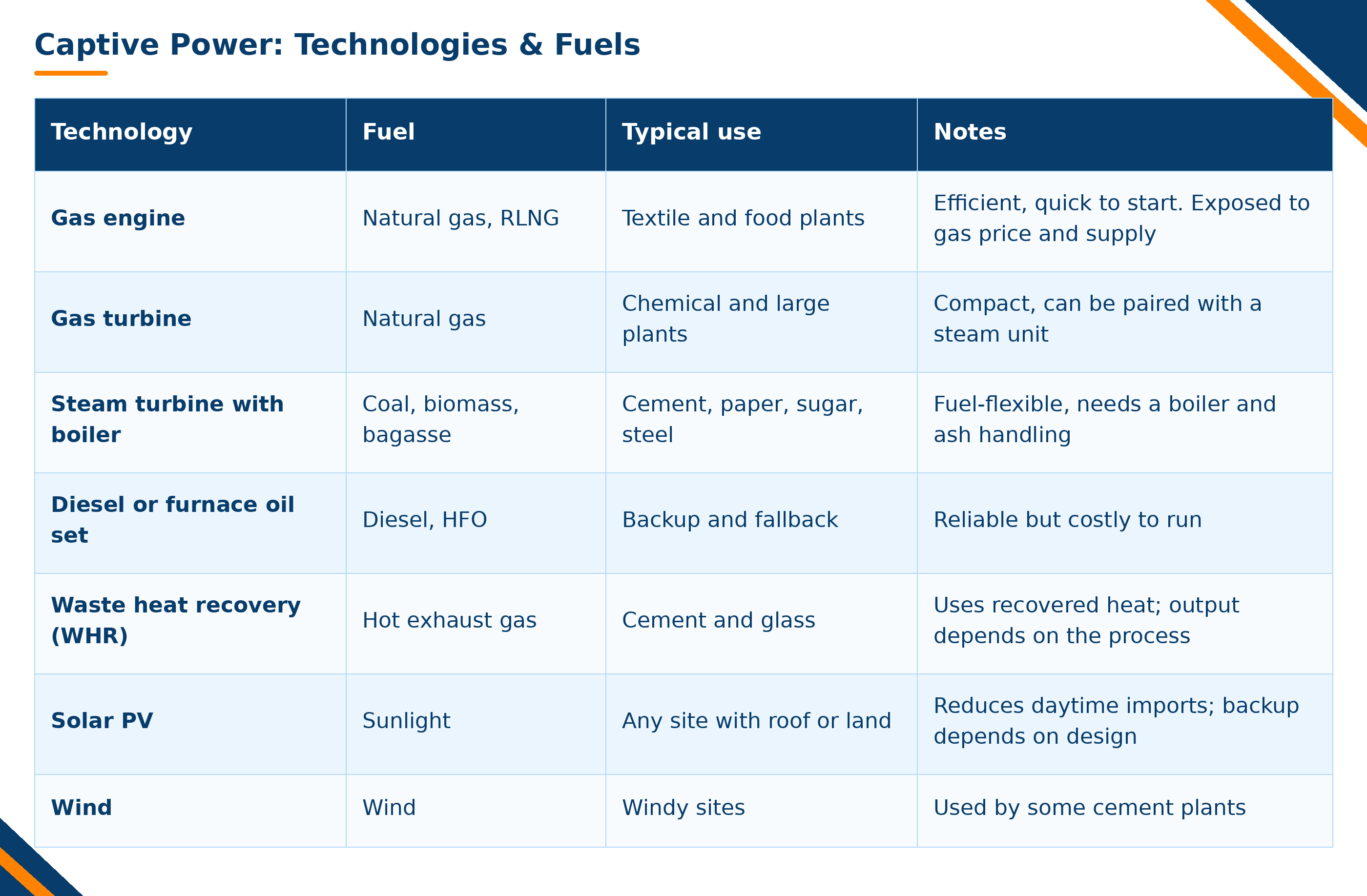
A factory with daytime demand may benefit from solar PV, while a site with continuous steam requirements may find a thermal or cogeneration system more suitable.
Hybrid designs can reduce dependence on a single fuel.
Coal-Based Captive Power Plant: Working and Fuel Cost
A coal-fired plant burns fuel in a boiler to produce steam. The steam drives a turbine connected to a generator.
Depending on the design, steam may also supply industrial heating before condensation.
When comparing Duki coal with Hyderabad coal, ask for a delivered price and a recent laboratory report covering calorific value, moisture, ash, and sulphur.
The examples below use assumed prices and heat values, not live quotations or guaranteed product specifications.
Fuel cost per kWh = (price in Rs/kg × 860) ÷ (calorific value in kcal/kg × net electrical efficiency).
Use the same calorific-value basis for both fuels. The table illustrates the calculation at three assumed efficiencies.
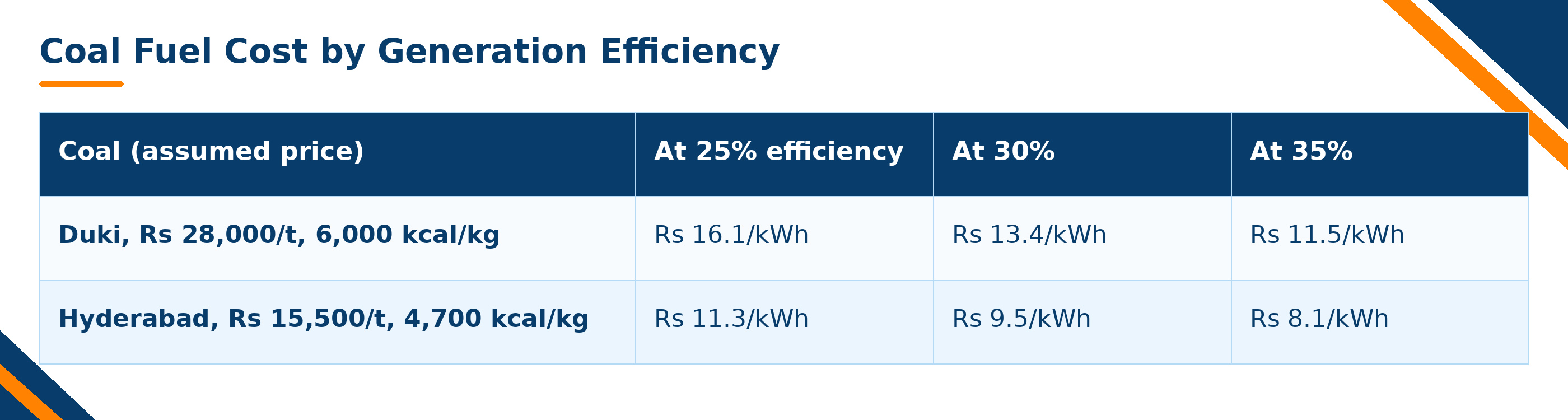
Illustrative fuel-only estimates. Delivery, auxiliary consumption (if not included in net efficiency), capital, maintenance, emissions control, ash disposal and financing must also be considered.
Do not compare these fuel-only figures directly with an all-inclusive grid tariff.
Compare the total annual cost of electricity supplied to the same industrial load, including backup and connection charges.
Lower-priced coal may produce more ash or require additional emissions controls.
Buyers can compare grades in the coal category, but fuel suitability must be confirmed against the boiler design and environmental requirements.
Agricultural residues and biomass briquettes may be an alternative in compatible boilers.
Co-firing requires an engineering assessment of fuel handling, combustion and ash behaviour.
Captive Power Plant Examples in Pakistan
NEPRA’s published captive generation licence register provides examples of industrial installations.
The capacities below are historical licensed gross capacities, not confirmation of current operating output.
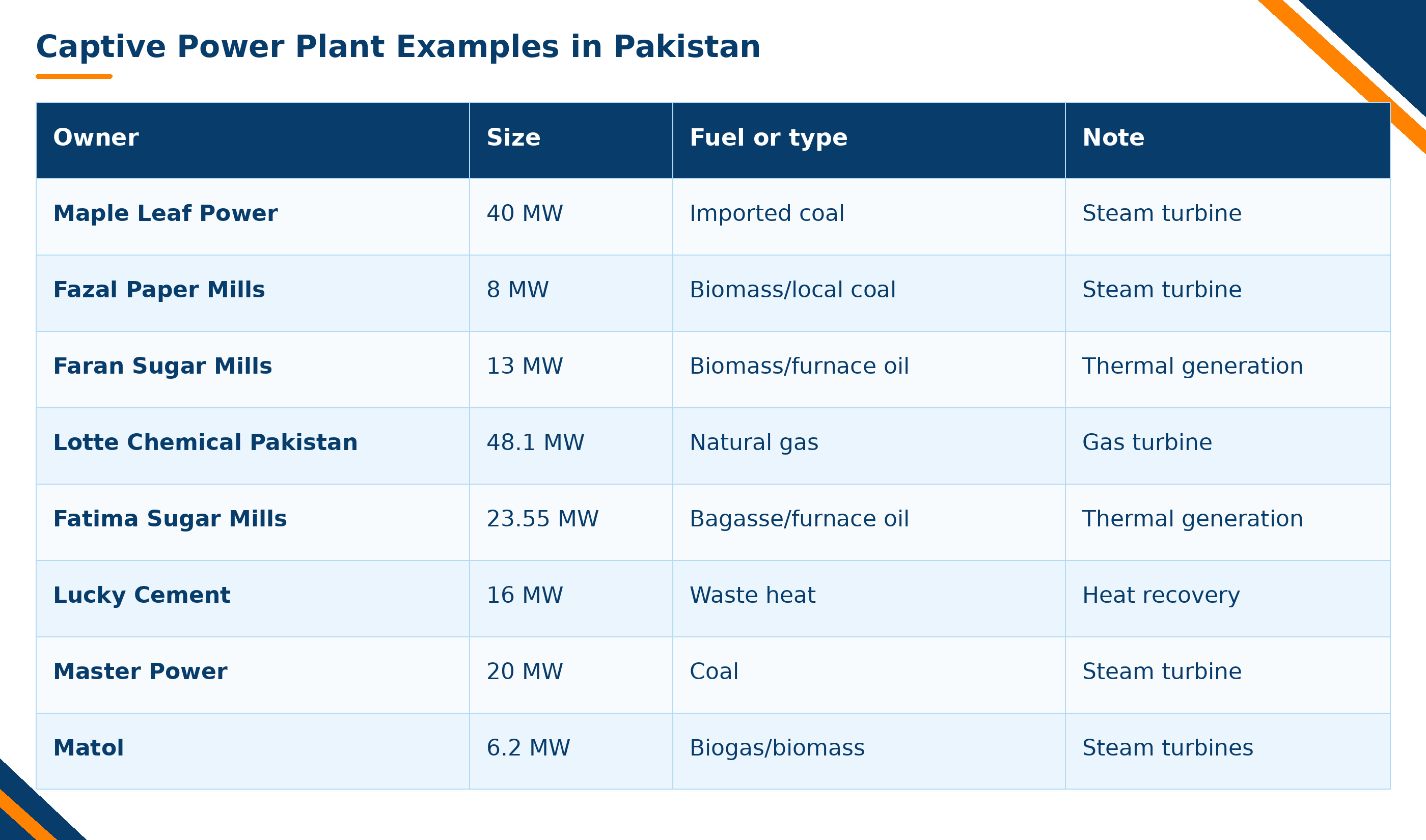
The examples illustrate why technology choices differ by industry.
Sugar mills have access to bagasse, paper facilities may use solid fuels, and cement plants can recover heat from industrial equipment.
Benefits and Disadvantages of Captive Power
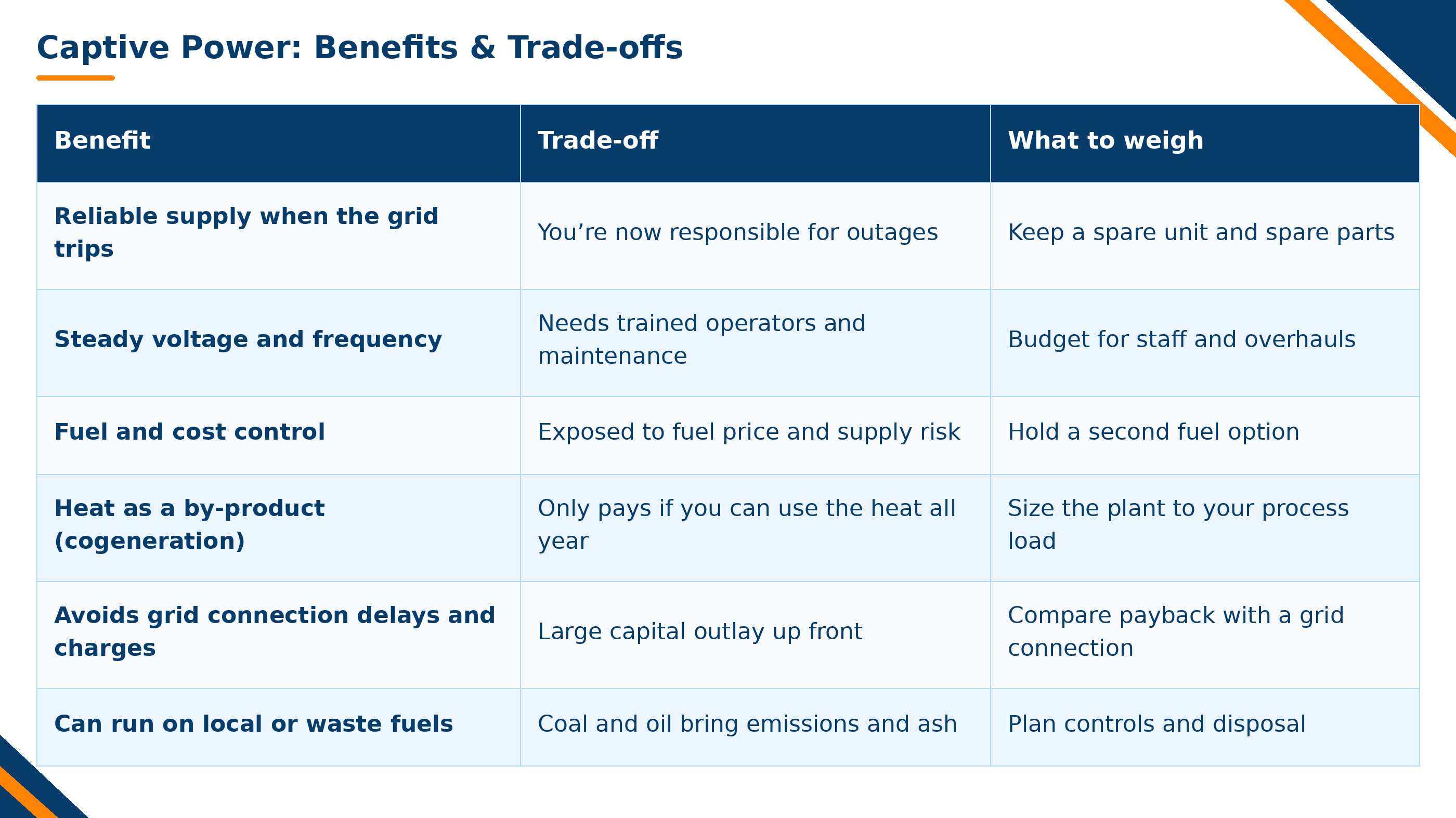
Reliability is valuable when an interruption would stop production or damage a batch. However, a captive plant can fail too.
The business needs a realistic backup plan and enough maintenance capacity to keep essential loads supplied.
Captive Power in Pakistan: Gas Levy and Industrial Costs
Pakistan introduced the Off the Grid (Captive Power Plants) Levy framework in 2025 to encourage gas and RLNG users to shift towards grid electricity.
The announced schedule increased the levy calculation in stages, reaching a scheduled 20% adjustment by August 2026.
The percentage schedule is not a flat 20% surcharge on every gas bill.
Actual amounts are notified in rupees per million British thermal units (MMBtu) for specified periods.
For example, the Petroleum Division’s January 2026 rate was reported in April 2026 as Rs 1,406/MMBtu.
Sources: Senate Standing Committee on Finance and Revenue briefing, 15 May 2025; Business Recorder, 8 April 2026.
Confirm the latest Gazette notification and applicable utility bill before budgeting.
Fuel prices and supply conditions can change quickly.
Compare gas, grid electricity and alternative fuels under several price and operating scenarios rather than relying on a single month’s figures.
Captive Power and the National Grid
Installed grid capacity is not the same as dependable capacity or electricity available at a particular factory.
Transmission limits, seasonal generation, outages, and local connection capacity affect what a business can actually receive.
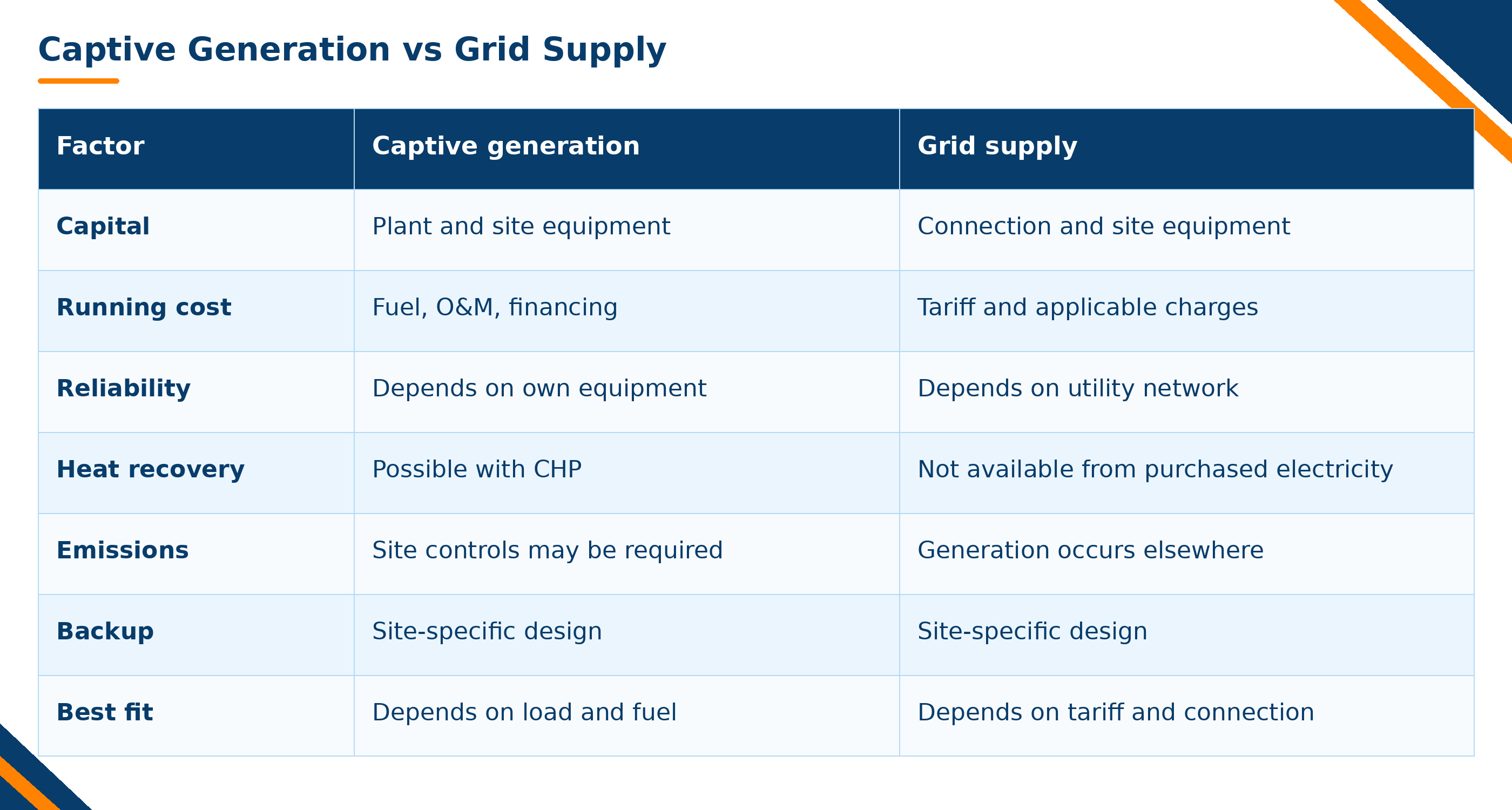
The comparison below highlights practical differences rather than mixing national generation statistics from different reporting dates.
On-site solar can reduce daytime grid imports.
Conventional grid-tied PV normally shuts down during an outage unless the installation includes suitable islanding and backup equipment.
How to Choose a Captive Power Plant: Practical Checklist
A) Measure Demand: Collect 12 months of load data, including peak demand, operating hours, and steam requirements.
B) Compare Energy Costs: Obtain delivered fuel prices, current gas levies, and electricity tariffs.
C) Assess Grid Supply: Include connection costs, demand charges, and interruption risks.
D) Select Technology: Match equipment to the load profile and plan redundancy.
E) Check Approvals: Confirm applicable NEPRA, utility, environmental, and provincial requirements.
F) Budget for Operations: Include staff, maintenance, storage, emissions control, and equipment replacement.
For industrial steam systems, learn how biomass boilers handle solid fuels before evaluating a conversion project.
Have a qualified power engineer assess the load, protection system, fuel requirements, and project economics before committing capital.
How to Source Fuel for Industrial Power Generation
For solid-fuel projects, compare available agricultural residues in the agriculture biomass category.
Request representative samples, moisture and ash test results, delivery schedules, and a written quotation before placing a bulk order.
A consistent fuel specification and reliable delivery schedule can matter more than the lowest quoted price per tonne.
Frequently Asked Questions
What are the Main Types of Captive Power Plants?
Common types include gas engines, gas turbines, coal or biomass steam plants, diesel generators, waste heat recovery systems, solar PV and wind.
The best option depends on site demand and available resources.
What is the Difference Between Captive Power and Grid Power?
Captive power is generated primarily for a business’s own use. Grid power is purchased from a utility.
A factory may use both if its connection and protection arrangements permit parallel operation.
Is Captive Power Cheaper Than Grid Electricity in Pakistan?
Not always. Compare total generation costs, including fuel, levies, maintenance, financing and backup, with the applicable grid tariff and reliability costs.
Can a captive power plant sell its extra electricity?
Export may be possible where the plant has the necessary approvals, interconnection arrangements, and commercial agreement.
A captive plant does not automatically have the right to sell surplus electricity.
Wrap Up
A captive power plant can help an industrial business manage electricity supply, but its value depends on the actual cost and reliability of the system.
Compare grid supply, fuel availability, operating hours, and process heat needs before choosing gas, coal, biomass, or solar.
A sound engineering and financial assessment is more useful than selecting a technology on fuel price alone.