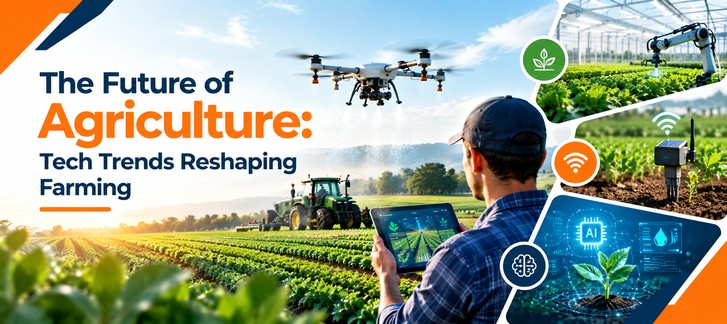
The Future of Agriculture: Tech Trends Reshaping Farming
Explore the future of agriculture. Discover how smart AI, field robotics, vertical farming, and precision technology are transforming global food production.
Introduction:
Agriculture has always evolved with human civilization. Whether you talk about the first farmers cultivating wild grass to today's GPS-guided tractors. Or you could talk about AI-powered crop monitoring. So every generation has found new ways to produce more food from limited resources.
But the next transformation could be the most significant yet.
The world's population is growing. Therefore farmer are dealing with increasingly unpredictable weather conditions. Moreover farmland and freshwater resources are all under pressure. That's why consumers expect food to be affordable and safe at the same time. While consumers also expect to be traceable and sustainably produced food.
So, what is agriculture's future?
It is likely to be a combination of technology and resource management. While it also depends on generative farming practices. Future farming will not simply mean using more machines. Because future farming will mean using information and innovation within its premises. These techniques make better decisions about every seed, drop of water and unit of fertilizer.
Meeting Demand in the Future of Agriculture:
The fundamental challenges that face agriculture today are straightforward. Because they produce enough food while using resources more efficiently.
Although global food demand is expected to continue increasing as populations grow. Yet farmers cannot simply keep expanding farmland. Or they are consuming more water and fertilizer indefinitely because world diets change.
These situations create a productivity challenge in the agricultural field.
Future agricultural systems will need to increase their output. At the same time they are reducing unnecessary resource use. Farmers may need to produce more yields from their existing land and protect their soil health. While minimizing post-harvest losses at the same time. So farms must become more resilient to droughts and changing pest pressures. As they are also resilient to floods and dangerous heat.
That's why technology has become valuable in this field.
Instead of asking only, "How much can we produce?". Modern agriculture increasingly asks: How can we produce more with fewer inputs and less waste?
That shift is at the heart of agriculture's future.
The Role of Technology in the Future of Agriculture:
Technology has become one of the most powerful tools to grow in agriculture. Also it is available to farmers.
Modern agricultural technology can collect information about soil and machinery. While it also recognises bad weather and crop diseases. Because it allows farmers to make decisions based on actual field conditions rather than assumptions.
Some of the most important developments include:
1) Precision agriculture
2) Artificial intelligence
3) Agricultural drones
4) Satellite imagery
5) IoT sensors
6) Automated machinery
7) Robotics
8) Smart irrigation
9) Controlled-environment agriculture
10) Digital farm-management platforms
The important point is that these technologies do not necessarily replace farmers.
Instead, technology can give farmers better information and greater control over agriculture.
A farmer still makes the final decision as to what they can do in the field. But technology can help determine where a crop is stressed. Because a huge part of a field needs water especially when machinery requires maintenance.
Precision Farming - Doing More With Less:
One of the biggest trends shaping the future of agriculture technology is precision farming.
Traditional agriculture often treats an entire field relatively and uniformly. Therefore precision agriculture recognizes how a single field can contain significant differences. Especially in many aspects like soil fertility and productivity. While it also recognizes the moisture and crop health.
GPS and farm-management software can help farmers identify these differences. Where satellite imagery and advanced sensors can also make a difference.
For example, a farmer may use field data to apply different rates according to crop and soil requirements. Instead of applying the same amount of fertilizer across an entire field which is a bad practice.
The same principle can be applied to the irrigation and seeding processes that improve crop protection.
Precision farming can therefore help farmers:
1) Reduce input waste
2) Improve fertilizer efficiency
3) Optimize irrigation
4) Identify crop stress earlier
5) Improve field monitoring
6) Increase operational efficiency
7) Make data-driven decisions
The future is increasingly moving from field-level management toward plant- and location-specific management.
Robotics and Automation:
Agriculture may involves many repetitive and physically demanding tasks these days.
Planting and spraying with crop monitoring require enormous amounts of labor. Same as harvesting and weeding crops requires labor. Therefore, robotics and automation are emerging in agriculture as potential solutions.
Autonomous tractors can perform certain field operations with limited human intervention. Robotic systems can assist with precision weeding and harvesting techniques. Same as crop monitoring assists.
For example, machine-vision systems can identify individual plants or weeds. Because it enables equipment to target specific areas instead of treating an entire field.
Automation could become especially important in agriculture. A space where agricultural labor is scarce or expensive to sustain.
However, future farming will not necessarily mean completely autonomous farms. So human expertise will remain essential for managing complex biological systems and interpreting data. Because it makes strategic decisions in the field.
The likely agriculture future will be farmers working place alongside intelligent machines.
Artificial Intelligence and Smart Decision-Making:
Artificial intelligence is another technology with enormous potential.
Agriculture generates huge quantities of data. Where it's weather forecasts or satellite images are added to soil measurements. Or you can talk about historical yields and market information about agriculture.
AI systems can analyze these datasets much faster than humans. While these systems also identify patterns that may otherwise be difficult to detect on your farm.
Potential applications include:
1) Crop disease detection
2) Yield forecasting
3) Weather-risk analysis
4) Pest identification
5) Irrigation recommendations
6) Soil analysis
7) Farm planning
8) Predictive equipment maintenance
Imagine a system that alerts a farmer to a particular section of an affected field. Thus the system shows you early signs of water stress in the field.
Therefore, farmers can investigate and respond earlier to the affected area of the field. Instead of discovering the problem after visible crop damage occurs.
That is the promise of agricultural AI: turning data into timely decisions.
Regenerative Practices:
Technology will be important for farmers. But the future of agriculture will not be entirely digital.
The health of soil remains fundamental.
Regenerative agriculture focuses on different kinds of agriculture practices. Because these practices can improve soil health and ecosystem resilience on farms. While they will also improve biodiversity and water management systems in your field.
Common regenerative approaches include:
1) Cover cropping
2) Crop rotation
3) Reduced tillage
4) Maintaining soil cover
5) Increasing crop diversity
6) Integrating livestock where appropriate
7) Improving soil organic matter
These practices are particularly relevant since farmers face the impact of climate variability. Because they face declining soil quality in some agricultural regions as well.
Technology and regenerative agriculture can also work together on different criteria.
For example, soil sensors can help monitor moisture levels present in the field. While satellite imagery techniques can track your crop's development. Farmers can then combine these insights with cover crops and crop rotation techniques. These practices reduce soil disturbances and build a more resilient production system in your field.
The future does not have to be high-tech versus traditional organic farming.
It can be more high-tech supporting better ecological farming.
Controlled Environments:
Another major development in future farming is the growth of controlled-environment agriculture.
This includes greenhouses and vertical farming systems. While other systems where the growing conditions can be carefully managed are also included in them.
Instead of relying entirely on outdoor weather, growers can control factors such as:
1) Temperature
2) Humidity
3) Light
4) Nutrient delivery
5) Irrigation
6) Carbon dioxide levels
Hydroponics and other soilless systems can grow crops efficient. Because these systems use carefully managed water and nutrient solutions for agriculture.
Controlled environments can be particularly useful for producing vegetables and herbs close to urban populations. These are places where land is limited and transportation distances can be reduced.
However, these systems can require significant capital and energy. While agriculture's economic development and environmental benefits therefore depend on crop choice, location, energy sources and system efficiency.
Drones and Satellite Monitoring:
Farmers increasingly have access to an aerial perspective.
Agricultural drones can capture high-resolution images of individual fields, while satellites can monitor agricultural areas across much larger regions.
These technologies can help identify:
Crop stress
Irrigation problems
Pest damage
Nutrient deficiencies
Uneven crop development
Changes in vegetation
Instead of physically inspecting every part of a large farm, farmers can use imagery to identify areas that deserve closer attention.
This can make field scouting faster and potentially improve the timing of interventions.
Smart Irrigation and Water Management:
Water is one of agriculture's most valuable resources.
Future farming will increasingly focus on delivering water according to actual crop needs rather than following rigid schedules.
Smart irrigation systems can combine soil-moisture sensors, weather data and automated controls to determine when irrigation is required.
Drip irrigation can deliver water closer to plant roots, while sensors can help prevent unnecessary irrigation.
The objective is simple:
Use less water without sacrificing crop productivity.
As water scarcity becomes a bigger concern in many agricultural regions, smart irrigation could become one of the most important components of sustainable agriculture farming.
Digital Agriculture and Connected Farms:
The future farm may also become increasingly connected.
Internet-connected sensors can continuously collect information from fields, machinery and storage facilities.
Farmers can potentially monitor equipment performance, weather conditions, soil moisture and crop development through centralized digital platforms.
This connectivity can improve decision-making and help farmers identify problems earlier.
Digital agriculture can also improve traceability. Businesses and consumers increasingly want to know where agricultural products came from and how they were produced.
Better digital records can make agricultural supply chains more transparent and efficient.
Challenges Facing Future Farming:
Despite its potential, agricultural technology has limitations.
Advanced machinery, sensors and software can be expensive. Smallholder farmers may struggle to afford or maintain sophisticated systems.
There can also be challenges involving:
1) Internet connectivity
2) Technical skills
3) Data ownership
4) Equipment maintenance
5) Cybersecurity
6) Access to financing
7) Compatibility between different technologies
Technology must therefore become not only more advanced but also more accessible.
The best agricultural innovation is not necessarily the most complicated one. It is the one that solves a real problem at a cost farmers can justify.
What Is the Future of Agriculture?
So, what is the future of agriculture likely to look like?
It will probably not be a single model.
Some farms will use autonomous machinery and advanced AI. Others will rely on relatively simple technologies such as improved irrigation systems and mobile agricultural applications.
Some crops will continue to be grown outdoors across enormous fields, while others may increasingly be produced in greenhouses and controlled environments.
The common thread will be efficiency, resilience and informed decision-making.
Farmers will increasingly combine biological knowledge with digital tools, using technology to understand their farms more precisely while adopting sustainable practices to protect their natural resources.
Wrap Up:
The future of agriculture is already beginning to take shape.
Precision farming is making field management more targeted. Robotics are reducing repetitive work. AI is turning agricultural data into actionable insights. Drones and satellites are providing new ways to monitor crops. Regenerative practices are putting soil health back at the center of farming. Controlled environments are changing where and how certain crops can be grown.
But technology should never become the goal itself.
The real goal of future farming is to produce reliable food while using land, water, energy and other resources responsibly.
The farms of tomorrow may look very different from those of today, but the farmer's fundamental mission will remain unchanged: grow healthy food, protect the land and make every resource count.
The biggest agricultural revolution may therefore not be about replacing farmers with machines. It may be about giving farmers the knowledge, technology and tools to make better decisions than ever before.
FAQ's:
What is the future of agriculture?
The future of agriculture will combine advanced technology with sustainable farming practices to produce more food using fewer resources. Precision farming, artificial intelligence, robotics, smart irrigation, drones, controlled environments and regenerative agriculture are expected to play increasingly important roles in future farming.
What are the biggest trends shaping future farming?
Major trends shaping future farming include precision agriculture, artificial intelligence, robotics and automation, smart irrigation, regenerative agriculture, controlled-environment farming, agricultural drones and digital farm-management systems. Together, these technologies can improve efficiency and make farms more resilient.
How will technology change agriculture in the future?
Technology will allow farmers to collect and analyze more information about crops, soil, weather and machinery. AI can help identify diseases and predict yields, sensors can monitor soil moisture, drones can inspect crops and autonomous machinery can automate certain field operations. This can help farmers make faster and more accurate decisions.
How will future agriculture save water?
Future agriculture can improve water efficiency through drip irrigation, soil-moisture sensors, weather-based irrigation systems, automated controls and precision farming. These technologies can help farmers determine when and where crops need water, reducing unnecessary irrigation and improving water-use efficiency.
Will future agriculture be more sustainable?
Future agriculture has the potential to become more sustainable by combining efficient technologies with practices that protect soil, water and biodiversity. Precision application of inputs, renewable energy, smart irrigation, regenerative practices and better resource management can all contribute to more sustainable farming systems.