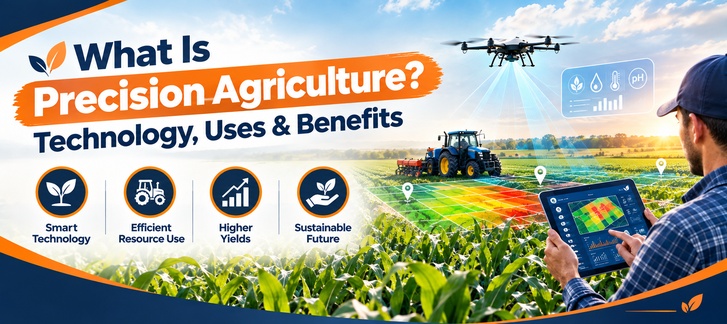
What Is Precision Agriculture? Technology, Uses & Benefits
What is precision agriculture? Explore the ultimate guide to smart farming technologies, from GPS auto-guidance to AI analytics, and how to scale your farm.
Introduction:
Agriculture has always been dependable on land understanding. Because farmers observe soil and adjust their practices based on their experience. They watch weather conditions and also monitor their crops. But modern farms have a new advantage. That is called 'data'.
Smart machinery and artificial intelligence can help farmers understand advanced farming techniques today. While farmers also rely on GPS, sensors, satellites and drone technology as well. What is happening in different parts of a field and responding accordingly? The answer is you know!
This approach is known as precision agriculture or precision farming.
But what is precision agriculture? How does it work? What role does technology play in modern farming?
Precision agriculture uses location-specific data and digital technologies to help farmers. Because farmers make more precise decisions about crops and other agricultural inputs. While they also make decisions about soil, water and fertilizer. Instead of treating an entire field as though every area had identical conditions as well. So farmers can identify the differences and manage them accordingly.
The basic idea is:
Collect data → Analyze conditions → Make decisions → Apply inputs precisely → Monitor results
Whether you are talking about GPS-guided tractors. Or whether you are talking about AI-powered crop monitoring systems. Because precision agriculture is changing how farmers approach productivity and farm decision-making. It's also changing farmers' approach to resource management as well.
What Is Precision Agriculture?
Precision agriculture is a data-driven farming approach. Because it uses technologies such as GPS/GNSS and variable-rate machinery to identify differences between agricultural fields. While it also uses modern sensors, satellite imagery, drones, digital mapping and yield monitors to adjust farming practices accordingly.
Although a field may look uniform from a distance. Yet, the field's conditions below and above the soil can vary considerably.
Another area may have completely different conditions.
Traditional farming practices may apply the same amounts of seed or water across a large area of your field. But precision agriculture attempts to identify these differences. Because this type of agriculture makes its management more site-specific according to fertilizer.
How Does Precision Agriculture Work?
Precision agriculture generally follows a continuous cycle:
1) Data collection: Some advanced sensors, GPS systems, satellites, drones and other machinery can collect your farm information.
2) Mapping: This technique is about data that is connected to specific locations within a field.
3. Analysis: Software identifies patterns, variations and potential problems.
4) Decision-making: Farmers can determine what action is required according to his field.
5) Variable-rate application: Latest equipment can adjust the amount of seed or other inputs according to field conditions for farmers. These equipments can also help farmers adjust their amount of water and fertilizer according to the field.
6) Monitoring: Monitoring results are measured and can be used to improve future decisions about fields.
This makes precision agriculture more than simply using a GPS device. It is an integrated approach to measuring, analyzing and managing agricultural variability.
Where Is Precision Agriculture Used?
Precision agriculture can be used across many types of farming and at different stages of crop production.
1) Precision Agriculture in Crop Production
Precision techniques can support the production of crops such as:
1) Wheat
2) Rice
3) Corn
4) Cotton
5) Soybeans
6) Sugarcane
7) Vegetables
8) Fruits
For example, a farmer growing wheat can use soil maps, satellite imagery and yield data to identify areas of a field with different productivity levels.
2) Precision Irrigation
Water is one of agriculture's most important resources.
Precision irrigation uses information such as soil moisture, weather conditions, crop requirements and field characteristics to help determine where and when irrigation is needed.
Instead of assuming that every part of a field requires exactly the same amount of water, farmers can use data to make more targeted decisions.
3) Precision Fertilization
Fertilizer is another major application.
Soil testing, yield maps and digital field information can help identify areas with different nutrient requirements. Variable-rate equipment can then adjust fertilizer application according to a digital prescription or sensor information.
This approach can potentially improve input efficiency while reducing unnecessary applications.
How Did Precision Agriculture Come About?
The concept of managing agricultural land according to location-specific conditions is not entirely new. Farmers have always noticed differences in soil and crop performance.
What changed was the ability to measure and map those differences digitally.
1) From Mechanization to Digital Farming
The development of tractors and mechanized equipment transformed agriculture by making large-scale cultivation possible.
Later, GPS technology made it possible for farm machinery to determine its location with increasing accuracy.
This opened the door to more sophisticated precision agriculture technologies.
2) GPS and Digital Mapping
GPS/GNSS technology allows machinery and farmers to associate information with specific field locations.
GIS and digital mapping can then help visualize this information.
3) Yield Monitoring
Modern harvesting equipment can collect information about crop yield and, in some systems, moisture and other characteristics.
The result can be a yield map showing how different areas of a field performed.
4) Variable-Rate Technology
The next step was using field information to change the rate at which inputs were applied.
Variable-rate technology allows equipment to apply different quantities of seed, fertilizer or other inputs according to field conditions.
Today, precision agriculture has expanded further through drones, satellite imagery, IoT sensors, cloud computing, artificial intelligence and robotics.
What Is the Difference Between Precision Agriculture and Conventional Agriculture?
The biggest difference is the level of site-specific management and data use.
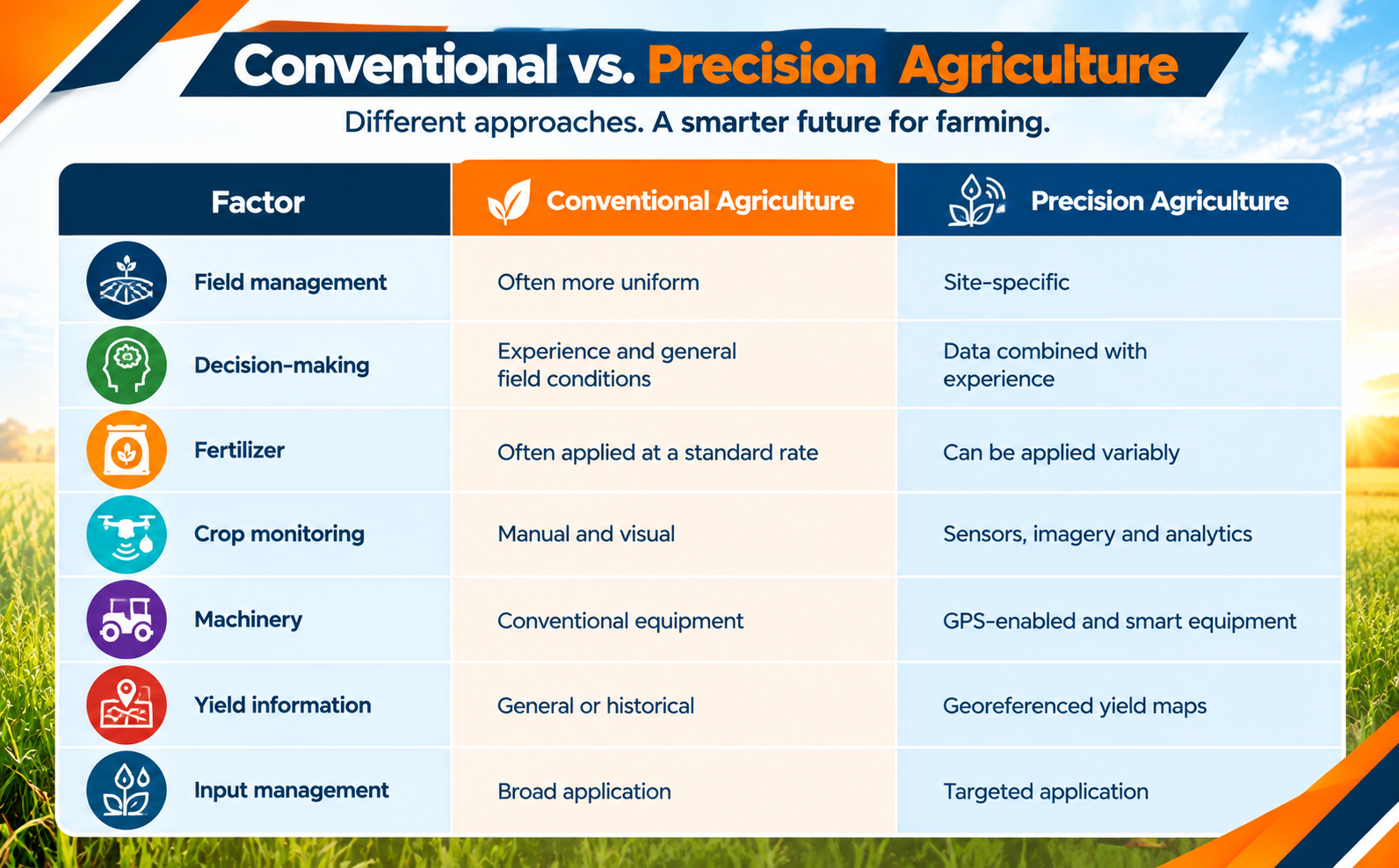
This does not mean conventional agriculture is simply "bad" or that precision agriculture is automatically better.
Precision technologies can require significant investment, technical knowledge, connectivity and reliable data. Their usefulness depends on the farm, crop, field variability and technology being adopted.
The important difference is the management approach: precision agriculture aims to make decisions according to specific conditions rather than assuming the entire field is identical.
What Machinery Does Precision Agriculture Use?
Modern precision agriculture technology involves a wide range of machinery and digital tools.
1) GPS-Guided Tractors
GPS/GNSS systems allow tractors and other machinery to determine their position in the field.
GPS guidance and autosteer can help operators maintain accurate passes during planting, spraying and other field operations.
This can reduce overlaps and missed areas during certain operations.
2) Variable-Rate Seeders and Fertilizer Applicators
Variable-rate equipment can change application rates as machinery moves across different management zones.
For example, an applicator may deliver different fertilizer rates in two areas based on a digital prescription map.
3) Yield Monitors
Yield monitors are commonly associated with harvesting equipment.
They can record information about crop output and connect measurements to geographic locations.
The resulting yield map can help farmers identify high- and low-performing areas.
4) Drones and UAVs
Agricultural drones can capture high-resolution imagery of fields.
Depending on the equipment and analysis system, imagery can help identify:
1) Crop stress
2) Weed growth
3) Pest problems
4) Uneven crop development
5) Irrigation issues
6) Areas requiring further inspection
Drones can therefore complement traditional field scouting.
5) Soil and Crop Sensors
Sensors can provide information about conditions such as:
1) Soil moisture
2) Temperature
3) Electrical conductivity
4) Nutrient conditions
5) Crop characteristics
This information can support more informed irrigation, fertilization and crop-management decisions.
6) Precision Sprayers
Modern precision sprayers can use cameras, sensors and software to identify specific targets.
For example, machine-vision systems can distinguish weeds from crops and potentially direct herbicide only where it is required.
AI and Precision Agriculture
Artificial intelligence is becoming one of the most important developments in modern precision farming.
AI can process large amounts of agricultural data much faster than traditional manual analysis.
How Is AI Used in Precision Agriculture?
AI and machine learning can support:
1) Crop disease detection
2) Weed identification
3) Yield prediction
4) Irrigation recommendations
5) Pest monitoring
6) Crop-stress detection
7) Targeted spraying
8) Weather analysis
9) Predictive maintenance
10) Autonomous machinery
1) AI-Powered Crop Monitoring
Cameras, drones and satellites can generate large amounts of agricultural imagery.
AI models can analyze this imagery and identify patterns that may indicate crop stress, disease or weed presence.
Instead of manually inspecting every part of a large field, farmers can use technology to identify areas that deserve closer attention.
2) AI for Precision Spraying
One promising application combines machine vision with agricultural machinery.
A camera can capture images of plants as equipment moves through a field. AI software can then classify plants and determine whether a target is a crop or weed.
The sprayer can respond accordingly.
This concept moves agriculture toward targeted application rather than blanket application.
3) Does AI Replace Farmers?
AI is better understood as a decision-support and automation technology.
Farmers still provide knowledge about local conditions, crop requirements, weather, markets and practical field management.
The future is therefore less about replacing agricultural expertise and more about combining human experience with increasingly sophisticated data.
What Are the Benefits of Precision Agriculture?
The benefits of precision agriculture depend on the technology, farm and management system being used.
1) More Targeted Input Use
Precision technologies can help farmers apply inputs according to specific field conditions.
This may include:
1) Seed
2) Fertilizer
3) Water
4) Crop-protection products
5) Better Field-Level Decisions
Instead of relying solely on whole-field averages, farmers can analyze smaller management zones.
This can reveal problems and opportunities that may otherwise remain hidden.
2) Reduced Overlap
GPS guidance can help machinery follow more accurate paths, potentially reducing unnecessary overlap during field operations.
3) Improved Monitoring
Satellite imagery, drones and sensors can provide more frequent information about crop and soil conditions.
4) Potential Environmental Benefits
More targeted use of agricultural inputs can potentially reduce unnecessary applications and improve resource efficiency.
However, outcomes vary. Precision agriculture is a management system, not a guarantee of higher yields or lower costs.
What Are the Challenges of Precision Agriculture?
Precision agriculture also comes with practical challenges.
1) Initial Investment
GPS equipment, sensors, drones, software and specialized machinery can require substantial investment.
2) Technical Skills
Farmers and farm workers may need training to operate equipment and interpret digital information.
3) Data Management
Collecting data is only useful if the data is accurate, accessible and properly interpreted.
4) Connectivity
Some digital agricultural technologies depend on reliable internet or mobile connectivity, which can be challenging in rural areas.
5) Equipment Compatibility
Different manufacturers and systems do not always integrate seamlessly.
6) Return on Investment
The economic value of a technology depends on factors such as farm size, crop type, field variability, input costs and how effectively the technology is used.
For smaller farms in particular, lower-cost technologies and shared services may provide more practical entry points than purchasing an entire suite of advanced machinery.
The Future of Precision Agriculture:
The future of precision agriculture is moving toward increasingly connected and automated farming.
Several trends are likely to shape the next generation of smart agriculture.
1) Autonomous Machinery
Self-driving and semi-autonomous tractors could increasingly perform field operations with limited operator intervention.
2) AI-Powered Decision Making
AI systems will increasingly combine information from sensors, weather data, imagery, historical records and machinery.
3) Agricultural Robotics
Robots may perform tasks such as crop monitoring, mechanical weed removal, harvesting and targeted spraying.
4) Real-Time Sensors
Instead of relying only on periodic measurements, connected sensors can provide continuous information about field conditions.
5) Smart Irrigation
Future irrigation systems can increasingly combine soil moisture, weather forecasts, crop requirements and field maps to improve water-management decisions.
6) Connected Farm Platforms
The long-term direction is toward integrated systems where machinery, sensors, imagery and farm-management software communicate with one another.
The farm may increasingly operate as a connected information system rather than a collection of independent machines.
Wrap Up:
Precision agriculture represents a major shift in how farmers understand and manage agricultural land.
Instead of asking only, "How much fertilizer does this field need?" precision farming encourages a more detailed question:
"How much fertilizer does each part of this field need?"
That difference is at the heart of the technology.
GPS can locate machinery. Sensors can measure conditions. Satellites and drones can observe crops. Yield monitors can reveal field performance. Variable-rate equipment can respond to differences. AI can bring these data streams together and help turn them into actionable decisions.
The future of farming will not depend on technology alone. Successful agriculture will continue to require farmer knowledge, agronomic expertise and practical understanding of local conditions.
But when human experience is combined with accurate data and intelligent machinery, agriculture can become increasingly measurable, responsive and precise.
That is ultimately what precision agriculture is about: putting the right information in the right hands so that the right agricultural decision can be made at the right place and time.
FAQ's:
What is precision agriculture in simple terms?
Precision agriculture is a farming approach that uses data and technology to manage different areas of a field according to their specific conditions. GPS, sensors, satellite imagery, drones, AI and smart machinery can help farmers apply inputs more precisely.
What are examples of precision agriculture?
Examples include GPS-guided tractors, variable-rate fertilizer application, precision irrigation, yield mapping, soil sensors, agricultural drones, satellite crop monitoring, precision spraying and AI-powered crop analysis.
What technology is used in precision agriculture?
Major precision agriculture technologies include GPS/GNSS, GIS, remote sensing, drones, IoT sensors, yield monitors, variable-rate equipment, robotics, artificial intelligence and machine learning.
What is the difference between precision agriculture and traditional farming?
Precision agriculture uses location-specific data and technology to adjust farm management within a field. Traditional farming approaches may rely more heavily on uniform field-level practices, farmer experience and general recommendations.
How does AI help precision agriculture?
AI can analyze agricultural data and imagery to support crop monitoring, weed and disease detection, yield prediction, irrigation decisions, targeted spraying and automated farming operations.